
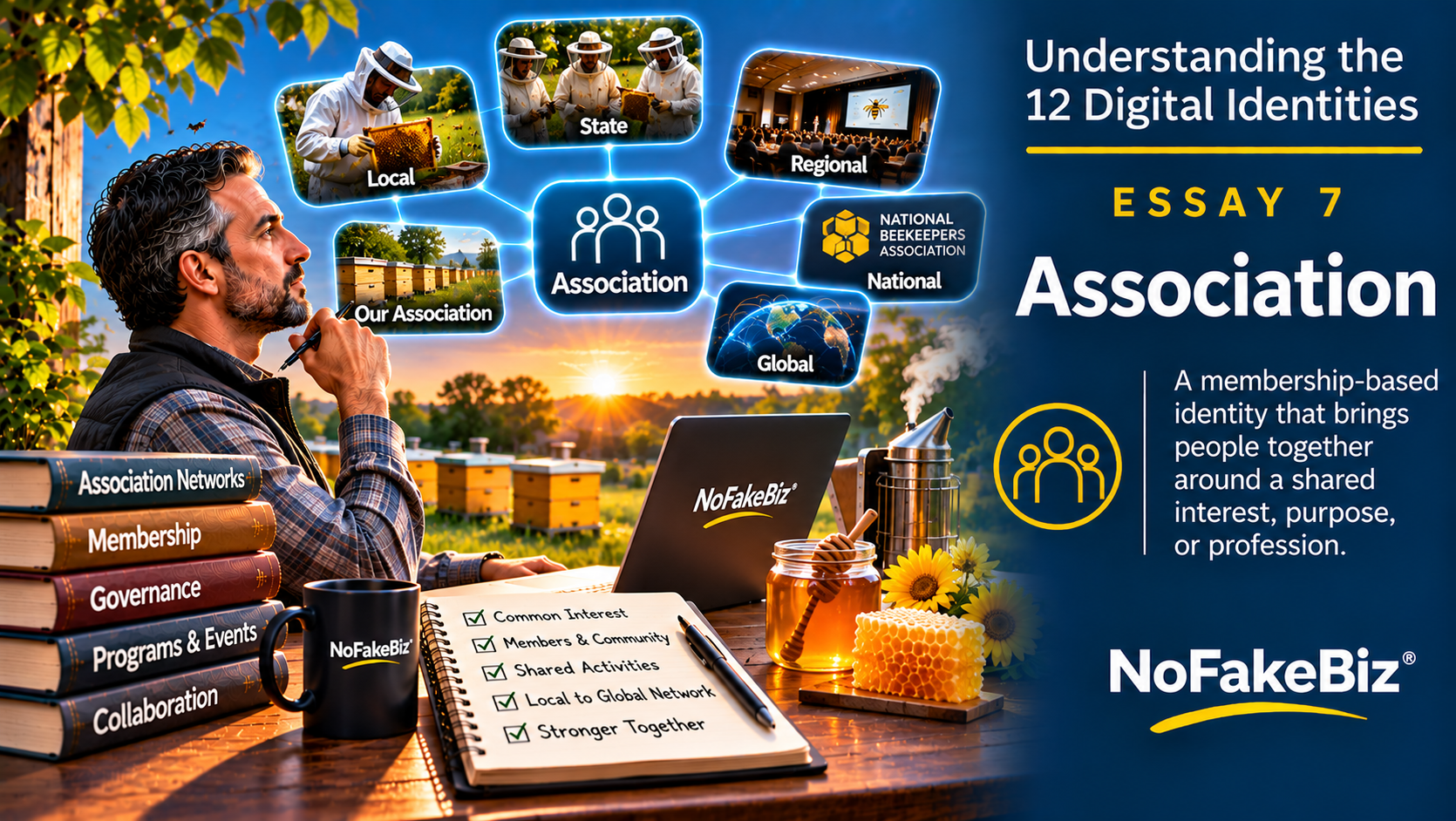
Around 2020, I became interested in beekeeping and started keeping bees. Like many people beginning something new, I quickly discovered that being interested in an activity and knowing how to do it are two very different things. I had questions, made mistakes, and needed advice from people who had already spent years doing what I was just learning. I could read about beekeeping online, watch videos, and find equipment to buy, but there were situations where what I really needed was another beekeeper, preferably someone nearby who understood the conditions in our area. That search led me to a local beekeeping association, and I decided to join.
What I discovered there was something different from a business or an organization built primarily around providing services to the public. I found a group of people brought together by a common interest. Some had been keeping bees for many years, while others were beginners like me. They came together to exchange knowledge, discuss problems, share experiences, and learn from one another. A person who had already dealt with a problem in a hive could explain what happened and what they had learned. Someone new could ask questions without having to pretend they knew everything. The value of the association came from the people themselves and their willingness to share what they knew.
That experience helped me recognize why associations deserve their own Digital Identity on NoFakeBiz. An association is not simply a collection of individual profiles, and it is not necessarily a business selling something to customers. It is a group of people who have chosen to come together around a shared interest, profession, trade, activity, or cause. The association may organize meetings, share information, represent common interests, or support its members in different ways. Its public identity should help people understand who those members are as a community, what brings them together, and how someone else can become involved.
I also began to see something beyond the local group I had joined. Beekeeping associations exist at different geographic levels. There may be a group serving one county or community, other groups elsewhere in the state, statewide associations, national associations, and even international networks connecting people who share the same interest. Some of these associations have formal relationships, while others are completely independent but work on similar problems or exchange information. They do not all belong to one organization, and they do not necessarily report to one another. Yet they are connected by the same activity and by the knowledge their members develop.
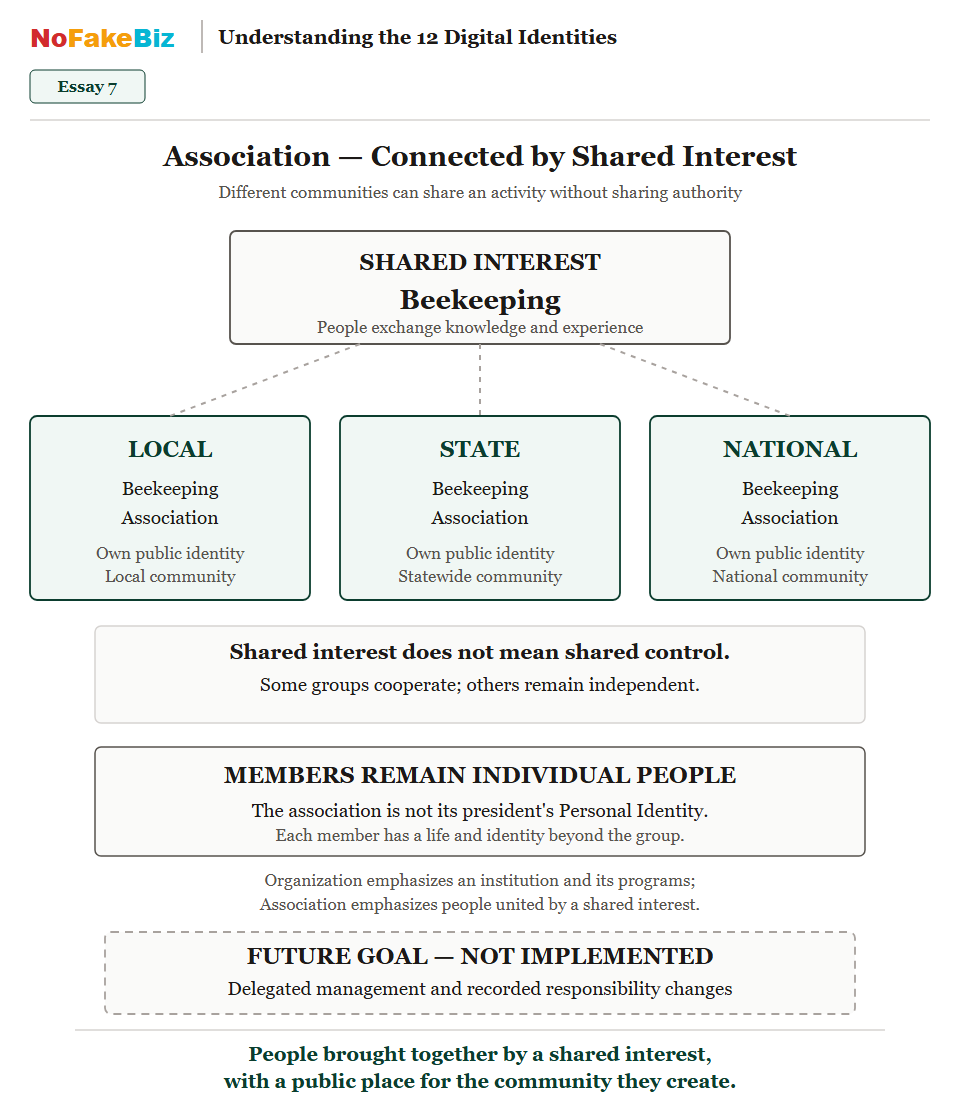
That made me think about how difficult it can be for an ordinary person to discover these relationships online. Imagine someone who has just moved to a new county and wants to begin keeping bees. Where should that person look? Is there a local association? When does it meet? Can beginners attend? Is there someone nearby who can answer a question? And if the local group cannot help, is there a statewide or national association that provides additional resources? Today, people often have to search through separate websites, old directories, social media pages, and information that may no longer be current. I wanted NoFakeBiz to provide a clearer way for associations to present themselves and, where those connections exist, make the wider network easier to discover.
An Association Identity should give a group a public place to explain its purpose, describe its activities, share meeting information, and tell interested people how they can participate. A local beekeeping association might publish information about its meetings, educational activities, or opportunities for beginners to learn from experienced members. Another association might announce a gathering, share news relevant to its members, or explain how to join. The association decides what it wants to make public, but the information belongs under the association's own identity rather than being scattered across the personal pages of whichever members happen to be most active online.
This also helps explain the difference between Association and Organization, which we discussed in the previous essay. Both can have members, leaders, budgets, meetings, employees, and organized activities. Both may educate people, support communities, or work toward important goals. The difference is often found in what brings people together and what the public identity is primarily meant to represent. An Organization Identity emphasizes an institution and the mission or programs it carries out. An Association Identity emphasizes people who come together because they share an interest, activity, profession, or common purpose.
Consider a learning center and a beekeeping association. A learning center may exist primarily to provide educational programs to students. A beekeeping association exists because people interested in beekeeping want to meet, exchange knowledge, and support one another. The association may also organize classes and educational programs, just as the learning center may have members or volunteers. Those activities can overlap without making the two institutions identical. The categories are intended to help represent their primary purpose, not to impose a rigid legal definition on every group in the world.
And beekeepers are only one example. People form associations around professions, trades, sports, arts, culture, history, hobbies, and countless other interests. Mechanics may come together to exchange technical knowledge. Writers may organize an association to support one another's work. People interested in local history may meet to preserve stories and information about their communities. Sports enthusiasts may organize clubs, while professionals in a particular field may establish associations to share knowledge and represent common interests. Some groups are small and informal, while others have thousands of members and operate nationally or internationally.
What matters is that people have something they want to pursue together. They may not be customers of one another, and they may not be employees working under one director. They are participants in a shared activity or purpose. Their association develops relationships, experiences, and a history that belongs to the group itself. Individual members may join or leave, leadership may change, and the activities may develop over time, but the association can continue as the same community.
I also believe these groups are an important part of local life. When we think about a town or county, we often think first about businesses, schools, government offices, and public services. But communities are also shaped by the people who organize around shared interests. A local association may preserve a craft, teach practical skills, introduce newcomers to experienced members, or simply bring together people who otherwise might never meet. These connections can be especially valuable when someone is learning something new and needs help from people who understand the local circumstances.
That is exactly what happened to me with beekeeping. I did not begin by looking for a company to represent me or an institution to provide a public service. I needed to meet people who shared an interest and knew more about it than I did. The association gave me access to that community. Later, as I thought about how NoFakeBiz should represent the different activities of human life, I realized that associations could not simply be treated as businesses or placed under the Personal Identity of whoever happened to organize their meetings.
There is also a practical question of continuity. An association may have a founder, a president, a secretary, or other people responsible for its activities, but those roles can change. Members come and go, and new people take responsibility for the work. The association's public history should not disappear whenever its leadership changes. Its identity should remain connected to the association itself, while the people involved retain their own Personal and Professional Identities. As with other institutional identities on NoFakeBiz, the full system for delegating management and recording changes in responsibility is part of the longer-term vision rather than a feature I am claiming is already complete.
An association does not need to be large, famous, or formally connected to a national institution to deserve its own public presence. A small group meeting once a month in one county may be just as meaningful to its members as a national association with offices and paid staff. The size is different, but the reason people come together is often the same: they share something that matters to them, and they believe they can learn, accomplish, or preserve more by working together than by remaining alone.
Looking back, my experience with the beekeeping association helped me understand something that applies far beyond bees. People do not always need another company, another product, or another service. Sometimes they need to find one another. They need a place where a beginner can meet someone experienced, where knowledge can be passed along, and where people who share an interest can build a community.
That is what Association Identity is meant to represent on NoFakeBiz: people brought together by a shared interest or purpose, with a public place for the community they create.
---
AMIR BASIC
Founder & CEO, NoFakeBiz
ABOUT THIS SERIES
Understanding the 12 Digital Identities is a connected series about the ideas behind NoFakeBiz. Each essay explores one part of the larger picture. For a complete understanding, we recommend reading the entire series, beginning with the Introduction.
PREVIOUS ESSAY
Organization — A Public Identity for a Shared Mission
NEXT ESSAY
Government — Connecting Public Institutions with the People They Serve
READ THE COMPLETE SERIES