
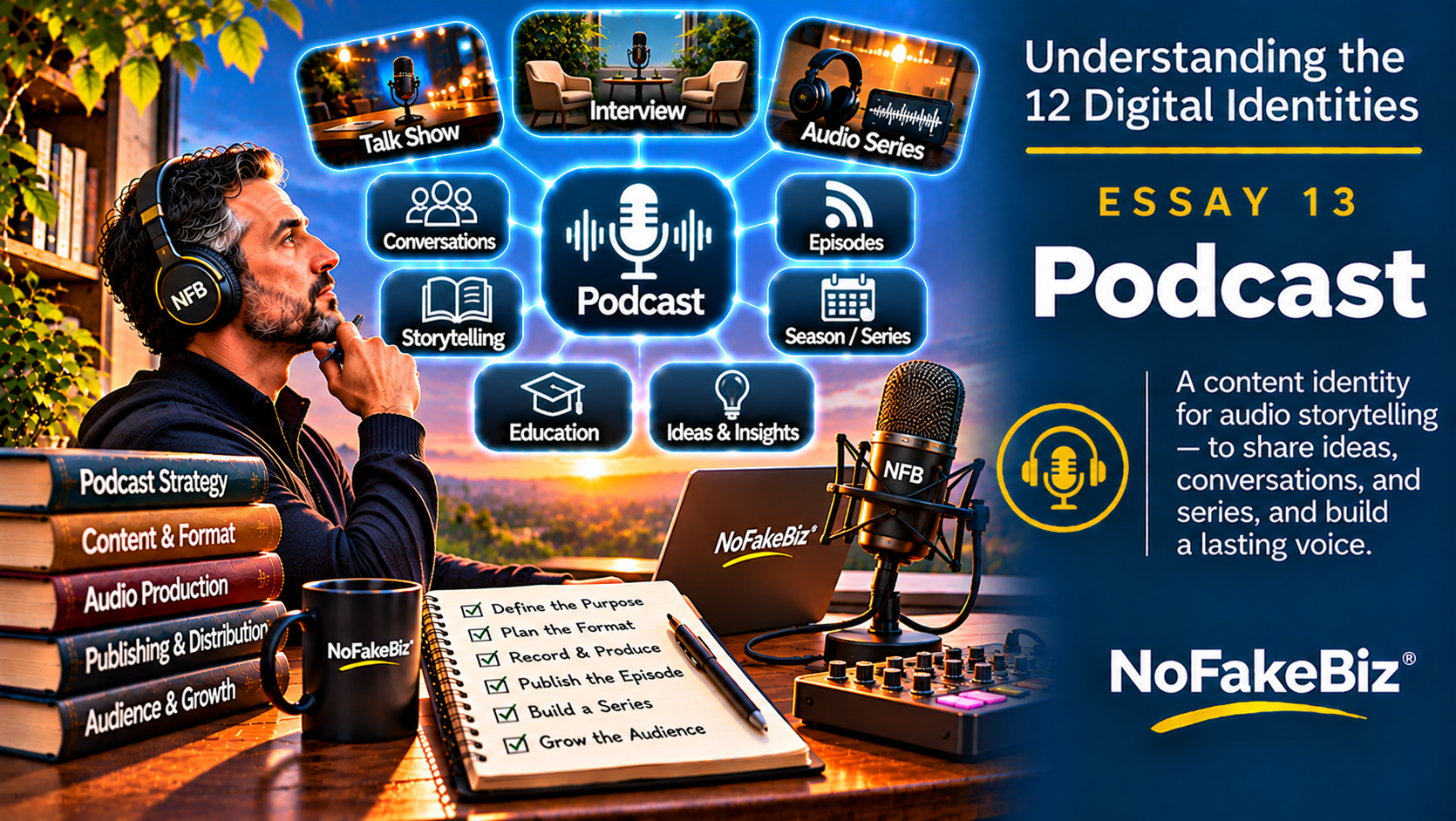
Podcasts have become a familiar part of everyday life. People listen while driving, working, walking, exercising, or spending time at home. Some follow conversations about politics and current events, while others prefer history, technology, education, business, religion, sports, or entertainment. There are podcasts devoted to almost every subject imaginable, created by people with different backgrounds and reasons for wanting to speak to an audience.
Some podcasts have become major commercial productions with large audiences and substantial revenue. Others are created by one person sitting in a room with a microphone, sharing knowledge or discussing something they care about. Between those extremes are countless independent shows produced by small teams, local communities, professionals, and people who simply enjoy having conversations.
When I was developing the idea for NoFakeBiz, I wanted these creators to have the option of giving their shows a public identity of their own. Alongside Blog and Video, I believed Podcast deserved to be one of the twelve Digital Identity categories. The reason was not simply that podcasts were becoming popular. It was that a podcast represents something distinct from the person who hosts it, the company that may produce it, and the individual recordings that make up the show.
Think about a podcast that has been running for several years. It may have a recognizable title, hundreds of episodes, recurring guests, a particular subject, and listeners who return whenever a new episode appears. The host may be the reason some people first discovered it, but the podcast has developed a history and an identity that people recognize separately from the host's other activities.
One episode is a particular piece of content. The podcast is the continuing show to which those episodes belong.
The listener should not have to search through the host's personal life, professional activities, business information, and unrelated publications just to find the show.
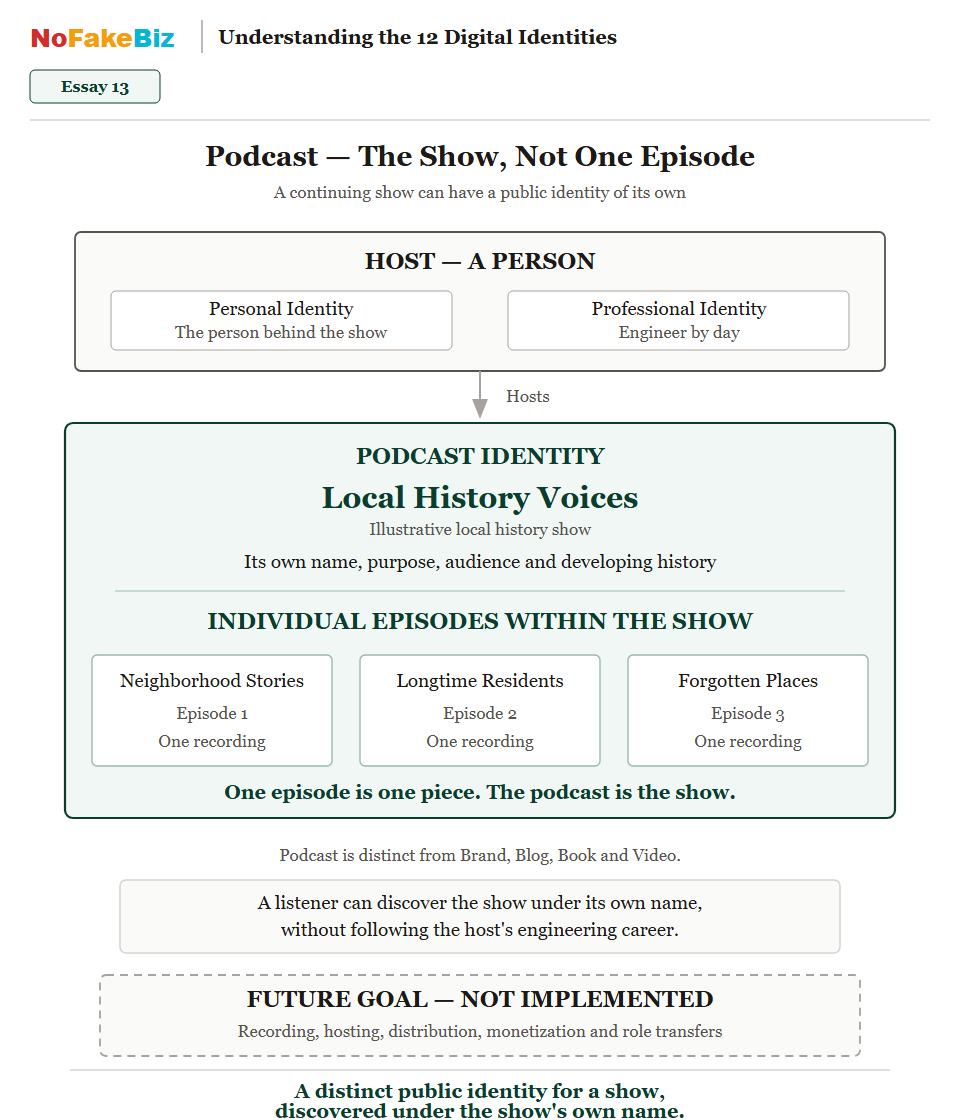
Consider a person who works as an engineer during the day but hosts a weekly podcast about local history. The engineering profession is one part of that person's life. The podcast is another. Its episodes may explore the history of neighborhoods, interview longtime residents, or preserve stories that are rarely discussed elsewhere. People interested in those stories may know the podcast's name without knowing anything about the host's professional career.
The podcast should not have to become part of the engineer's Professional Identity simply because the same person is responsible for both activities. It can have its own name, subject, audience, and history while remaining connected to the person who created it.
Now imagine a local business owner who starts a podcast about entrepreneurship. The business may help pay for equipment or provide a place to record, but the podcast does not automatically become the business itself. It may eventually feature guests from many different companies, discuss subjects unrelated to the owner's particular business, or develop an audience interested in the conversations rather than the products the business sells.
A Podcast Identity helps preserve those distinctions. The business remains a business, the host remains a person, and the podcast remains a show.
The same principle applies when several people work together. A podcast may have two regular hosts, a producer, an editor, and different guests from episode to episode. Those people may have their own Personal and Professional Identities, and some may participate in several different shows. Their involvement connects them to the podcast, but it does not make their individual identities interchangeable with the identity of the show.
A person can leave a podcast while the program continues. A new host may join, the format may change, or the subject may develop in a different direction. The podcast can remain recognizable under the same name, with a history that includes the people who contributed to it over time. The details of managing those relationships, permissions, and changes in responsibility would require additional tools and rules as NoFakeBiz develops, but the underlying distinction matters from the beginning.
There is also a relationship between Podcast Identity and Brand Identity, which we discussed earlier in this series. A successful podcast may develop a recognizable brand. People may know its name, artwork, style, or reputation even before listening to an episode. But the brand and the podcast are not exactly the same thing.
The podcast is the show: its episodes, conversations, participants, and continuing publication. The brand is the recognizable name and meaning people associate with it. They may be closely connected, and in everyday conversation people may use the same name for both, but they represent different aspects of the same activity.
Consider The Joe Rogan Experience, which we mentioned in the Brand essay. It is a recognizable media name, but it is also a continuing podcast with episodes, guests, and a history of conversations. Joe Rogan remains a person with other professional activities. The show's identity does not have to absorb every part of his life, and his Personal Identity does not have to serve as the only public place where the podcast can be discovered.
This is one reason I wanted the twelve Digital Identities to be separate but connected. We should not have to pretend that a person, a business, a brand, and a podcast are the same thing merely because they are closely associated with one another.
I also want Podcast Identity to serve people whose shows may never become commercially successful. A local podcast with fifty regular listeners may be extremely valuable to those listeners. Imagine a group of people recording conversations about the history of their county. They might interview older residents, discuss changes in their community, or preserve memories that younger generations have never heard.
That podcast may not attract national attention or generate substantial income. But it could still become an important record of local experiences and knowledge. Its value should not be measured only by audience size or advertising revenue.
Another podcast might help people learn a particular skill. A mechanic could discuss common maintenance problems. A teacher could explain educational subjects. A group of beekeepers could record conversations about seasonal challenges, equipment, and lessons learned through experience. These shows could reach people across the world, but they might also be especially meaningful to people in the same county or region.
This connects Podcast Identity to the geographic structure of NoFakeBiz. Not every podcast belongs to a particular location, and many are intended for international audiences. But some shows are deeply connected to the communities where they are created. A resident looking for local voices should have a way to discover relevant shows, just as someone searching for a particular subject should be able to find podcasts regardless of where they are recorded.
The public identity of a podcast should help answer the questions listeners naturally have. What is the show called? What subjects does it cover? Who hosts it? How often does it publish? What episodes are available, and where can people listen? If the creators want to provide additional information, introduce guests, or explain the purpose of the show, the podcast's public page should provide a recognizable place for that material.
I do not think every podcast needs the same format or publishing schedule. Some are weekly programs with regular hosts. Others are limited series devoted to a particular subject. A podcast may consist of interviews, storytelling, educational discussions, or conversations among friends. Some shows publish audio only, while others also record video versions of their episodes.
That last example raises another distinction. A podcast may be distributed in both audio and video formats, but that does not mean Podcast Identity and Video Identity must be treated as identical. Podcast Identity represents the continuing show and its episodes. Video Identity, which we will discuss in the next essay, addresses video-centered publishing and creative work. The two may overlap, but they serve different purposes within the larger system.
A podcast also differs from a blog or a book. A blog is primarily a continuing written publication. A book is a particular work with its own structure, even when it is still being written. A podcast is a continuing or limited audio-centered program that people follow through episodes. All three may explore the same subject, and a creator may use them together, but each deserves to be understood according to its own form.
For example, someone researching local history might write a book, maintain a blog with shorter articles, and host a podcast featuring interviews with residents. The subjects may be related, and the same person may be responsible for all three. But a reader looking for the book, a visitor looking for an article, and a listener looking for an interview are not necessarily looking for the same thing.
NoFakeBiz should allow those different works to remain connected without forcing them into one public page.
There is also an economic side to podcasting that deserves recognition. For some creators, a podcast begins as a hobby and eventually becomes a source of income. A show may attract sponsors, receive support from listeners, sell related products, or become part of a larger media business. Other creators may have no interest in commercializing their work. Podcast Identity should not depend on whether the show generates revenue. Its purpose is to represent the podcast itself, while any commercial relationships can be connected where appropriate.
The same care is necessary when discussing what NoFakeBiz can actually provide. A Podcast Identity is not automatically a complete audio-hosting service, recording studio, distribution network, or monetization system. Those are separate capabilities that require infrastructure, agreements, and ongoing development. My vision is for a podcast to have a recognizable public identity on the platform, with connections to its creators, episodes, audience, and related activities as the necessary tools are developed.
Ultimately, what interests me most is the relationship between a show and the people who choose to listen to it. A podcast may begin with one person wanting to share an idea, but over time it can become a familiar voice in the lives of its listeners. People return because they value the conversations, information, perspectives, or experiences the show provides.
That relationship should not have to disappear into the host's personal profile or become indistinguishable from a company that happens to produce the episodes. The show has a name people recognize, a body of work they can follow, and a history that develops over time.
That is what Podcast Identity is meant to represent on NoFakeBiz: a distinct public identity for a show, connected to its creators and listeners, where its episodes, purpose, and history can be discovered under the show's own name.
---
AMIR BASIC
Founder & CEO, NoFakeBiz
ABOUT THIS SERIES
Understanding the 12 Digital Identities is a connected series about the ideas behind NoFakeBiz. Each essay explores one part of the larger picture. For a complete understanding, we recommend reading the entire series, beginning with the Introduction.
PREVIOUS ESSAY
Book — A Public Identity for a Work of Its Own
NEXT ESSAY
Video — A Public Identity for the Channel People Follow
READ THE COMPLETE SERIES