
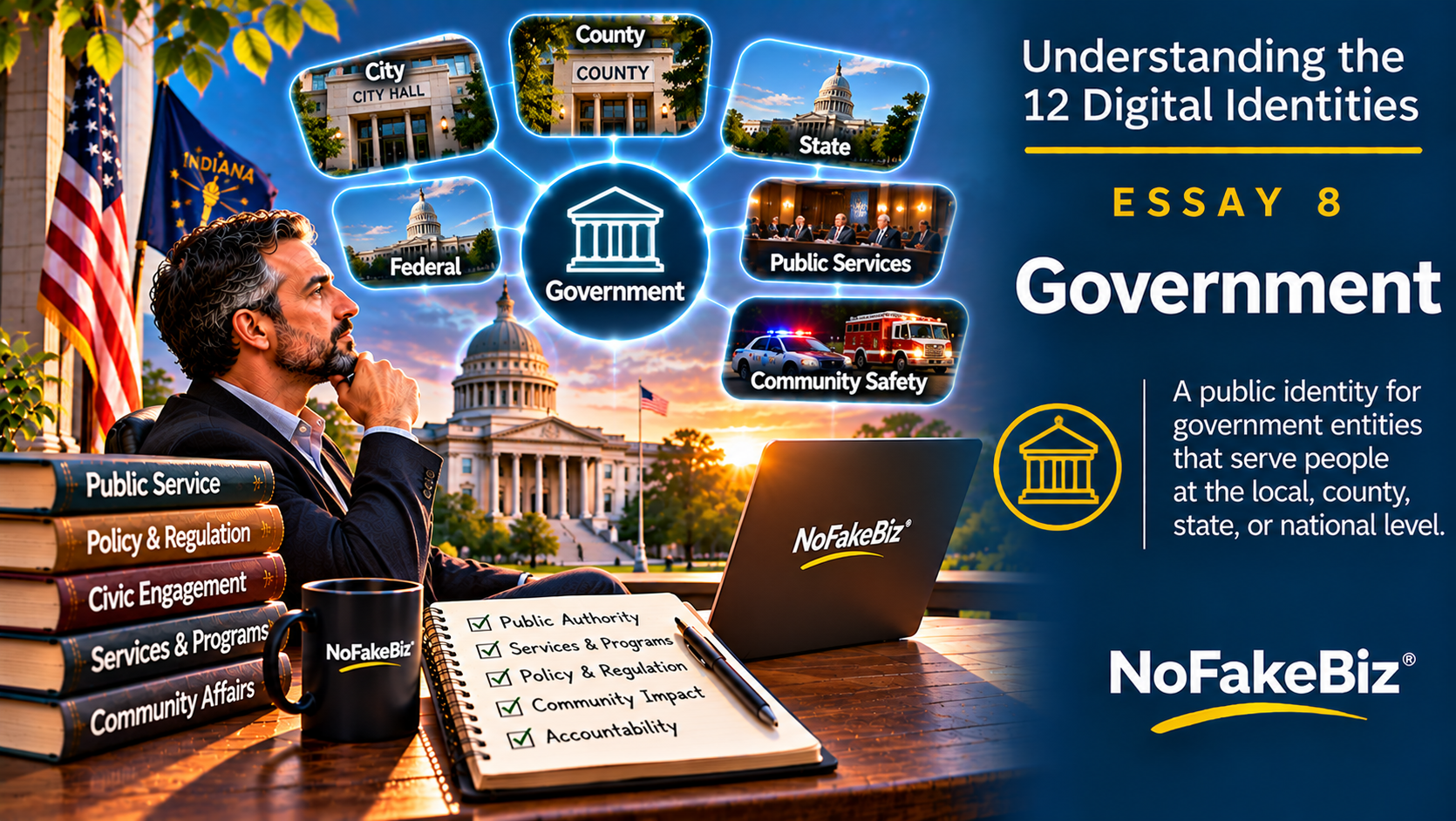
Government is part of our everyday lives, whether we pay much attention to it or not. We drive on public roads, pay property taxes, use public services, send children to schools, and live in communities where decisions made by public officials can affect us for years. Yet many people know surprisingly little about the offices responsible for those decisions, the people who make them, or where to go when something needs attention. This is one of the reasons I believe Government deserves its own Digital Identity on NoFakeBiz: to create a clearer public connection between government institutions and the people who live in the communities they serve.
Imagine someone who has lived in the same county for twenty years. He knows the roads he drives, the stores where he shops, the people he works with, and many of his neighbors. Then one day he receives a property tax bill that does not seem right. He wants to understand why the amount has changed, how the property was assessed, and whom he should contact. He may know that the county government has something to do with it, but that does not mean he knows which office is responsible, what information he needs, or how the process works. Finding the right office can become a problem of its own, even before he has had a chance to explain the original problem.
Note. While I was writing this essay, I had just come from the local government office myself. I had gone there to resolve a property tax problem of my own.
I think this example reveals something important about the relationship between government and ordinary people. Public institutions may have websites, telephone numbers, offices, and published procedures, but that does not automatically mean residents understand how to reach the right person or follow what is happening. Government should not be something people encounter only when they receive a bill, need a permit, or have a problem. People should also have opportunities to understand what their local government is doing, what decisions are being considered, and how those decisions may affect the place where they live.
NoFakeBiz is being built around real people and real geographic communities. People live in neighborhoods, towns, cities, counties, and states. Businesses operate there, organizations provide services, associations bring people together, and public institutions make decisions affecting those same communities. I want people to be able to discover these different parts of local life within one connected system, without pretending they all serve the same purpose. A business has customers, an association has members, and a government institution has public responsibilities that come from its legal authority.
County government is a natural starting point for this idea, particularly in the United States. Counties are familiar geographic areas where many people already deal with public offices, records, property matters, and local services. But a county does not control everything that happens within its borders. Cities and towns have their own responsibilities, states have theirs, and federal agencies operate under different authority. School districts and other public bodies may also have separate responsibilities. A Government Identity should help people understand these distinctions rather than suggesting that one county office is responsible for every public service in the area.
Consider what a resident should be able to learn when looking at a government office's public identity. What is this office responsible for? What services does it provide? Who currently holds the relevant public positions? Where is the office located, and how can someone contact it? When are public meetings held, and how can residents attend or participate? If the office publishes notices, reports, decisions, or information about ongoing projects, people should have a clear way to find that material. These are ordinary questions, but answering them in a consistent and understandable way can make a meaningful difference in how people interact with their government.
I also believe that communication should work in both directions. Government offices have information about the work they plan to carry out, the resources they manage, and the decisions they are responsible for making. Residents have another kind of knowledge: they live with the results. They know which roads have problems, where public services are difficult to access, what their neighborhoods need, and how decisions affect their daily lives. Both perspectives matter, and a useful public connection should make room for both.
Imagine that a county announces a road improvement project. Residents may want to know what work is planned, when it is expected to begin, which roads will be affected, and how long the disruption may last. As the project continues, they may want to know whether it has started, whether there are delays, and whether the work has been completed. Someone who lives along that road may also have a concern that was not obvious when the project was first planned. Government Identity could eventually help bring official project information and community observations into a clearer public relationship, while keeping the source of each statement identifiable.
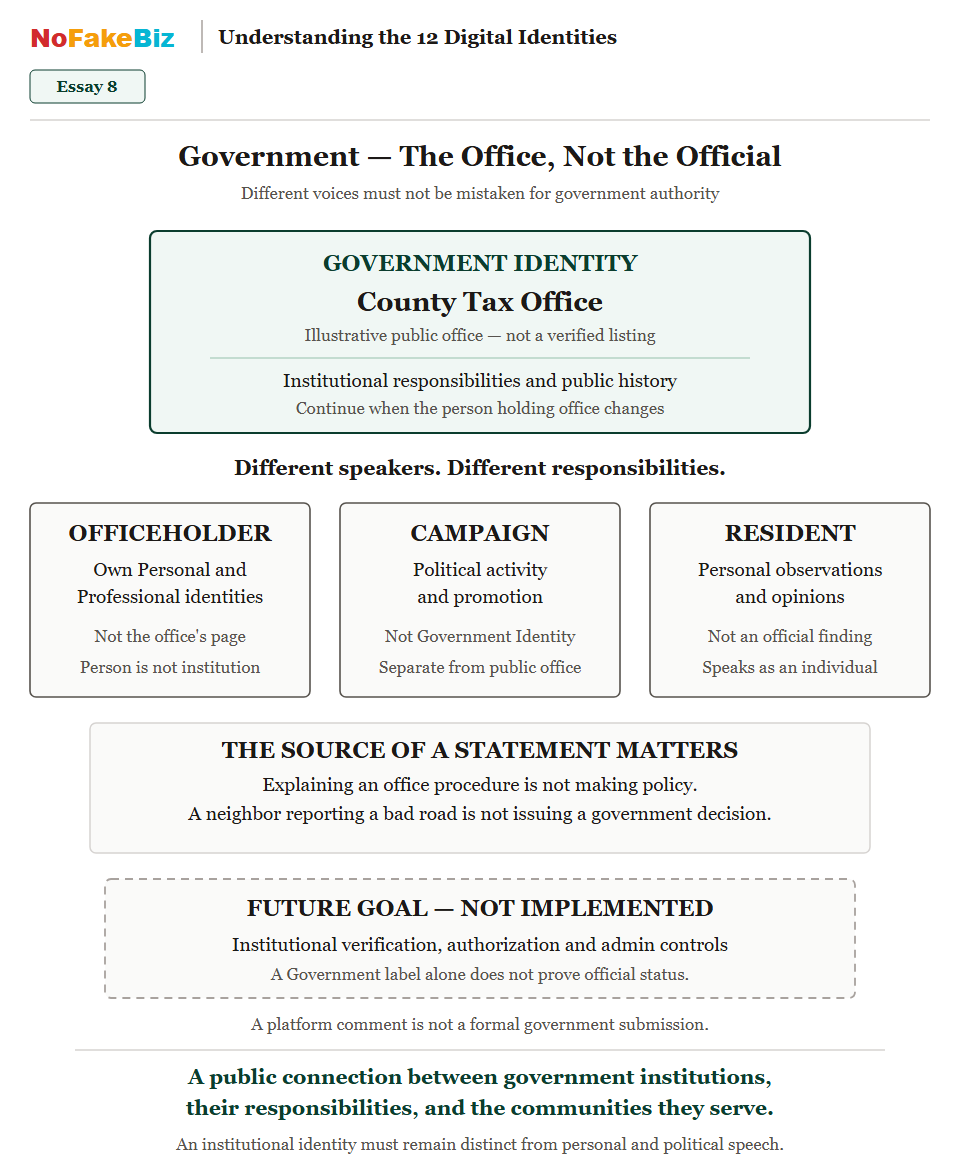
That last distinction is essential. An official announcement from a government office is not the same as a comment from a resident. A public employee explaining an office procedure is not necessarily making an official policy decision. And a neighbor who believes a road has been neglected is expressing an observation or opinion, not issuing a government finding. These different voices should be able to exist near one another without being confused. NoFakeBiz should make it clear who is speaking, in what capacity, and whether the information comes from an official institution or from an individual member of the community.
I would also like people to have a better way to follow public work over time. When a project is announced, what happens next? Was it approved? Did construction begin? Was the work completed, postponed, or changed? If residents report a recurring problem, can they find out which office is responsible and whether any action has been taken? These questions are not limited to elections or political disagreements. They are part of everyday public accountability. People should not have to wait for an election campaign to begin paying attention to the work being done in their community.
Of course, Government Identity must respect the difference between public discussion and official government procedures. A comment posted on NoFakeBiz would not automatically become a legally valid appeal, public-records request, permit application, or formal notice to an agency. Government offices have laws, deadlines, recordkeeping requirements, and established channels that cannot simply be replaced by a social platform. Any future communication tools would need to make those boundaries clear so residents do not mistakenly believe that posting a message has completed an official process.
There is also an important question of who has the authority to speak for a government institution. A Government Identity should belong to the public office or institution it represents, not to the personal profile of the official temporarily holding that position. An elected official may leave office, a department director may retire, or an employee may move to another agency. The institution's responsibilities and public history do not disappear because those people change. The person holding the office may have a Personal Identity and a Professional Identity, but neither should be confused with the official public identity of the institution.
For the same reason, political campaigns and personal promotion should remain distinct from official government communication. A public office exists to carry out responsibilities under the law, not to serve as the personal page of an elected official or a campaign organization. If people are going to rely on Government Identities for public information, they need to know that the institution being represented is genuine and that the people publishing on its behalf are authorized to do so.
This is an area where I want to be especially careful about what NoFakeBiz can currently do. Government is one of the twelve Digital Identity categories, but the platform has not yet completed the verification, authorization, administrative controls, and public communication tools that would be necessary for a fully developed government participation system. Creating a page labeled Government must not, by itself, be treated as proof that the page is officially operated or endorsed by a public agency. That distinction needs to remain clear as the platform develops.
The longer-term vision is to give public institutions a recognizable place within the same geographic network as the people and communities they serve. A resident looking at their county should eventually be able to discover local businesses, organizations, associations, and the relevant public institutions without having to search through a collection of disconnected websites. Government offices should have a way to explain their work, while residents should have appropriate ways to learn, participate, ask questions, and express concerns. The goal is not to replace government websites or legal procedures, but to make public information and community connections easier to discover and understand.
I do not believe that technology alone can make a government responsible, transparent, or responsive. Those qualities depend on laws, institutions, public officials, and the people who hold them accountable. But technology can make information easier to find, help people understand who is responsible for what, and create opportunities for communication that might otherwise be missed.
A government institution is not a business selling products, an association serving its members, or a personal profile belonging to an elected official. It has public authority and responsibilities toward the people within its jurisdiction. Those people should have a clearer way to understand its work, follow its decisions, and know where their own voices belong.
That is what Government Identity is meant to represent on NoFakeBiz: a public connection between government institutions, their responsibilities, and the communities they serve.
---
AMIR BASIC
Founder & CEO, NoFakeBiz
ABOUT THIS SERIES
Understanding the 12 Digital Identities is a connected series about the ideas behind NoFakeBiz. Each essay explores one part of the larger picture. For a complete understanding, we recommend reading the entire series, beginning with the Introduction.
PREVIOUS ESSAY
Association — People Connected by a Shared Interest
NEXT ESSAY
Project — Giving Every Idea and Effort Its Own Place
READ THE COMPLETE SERIES