
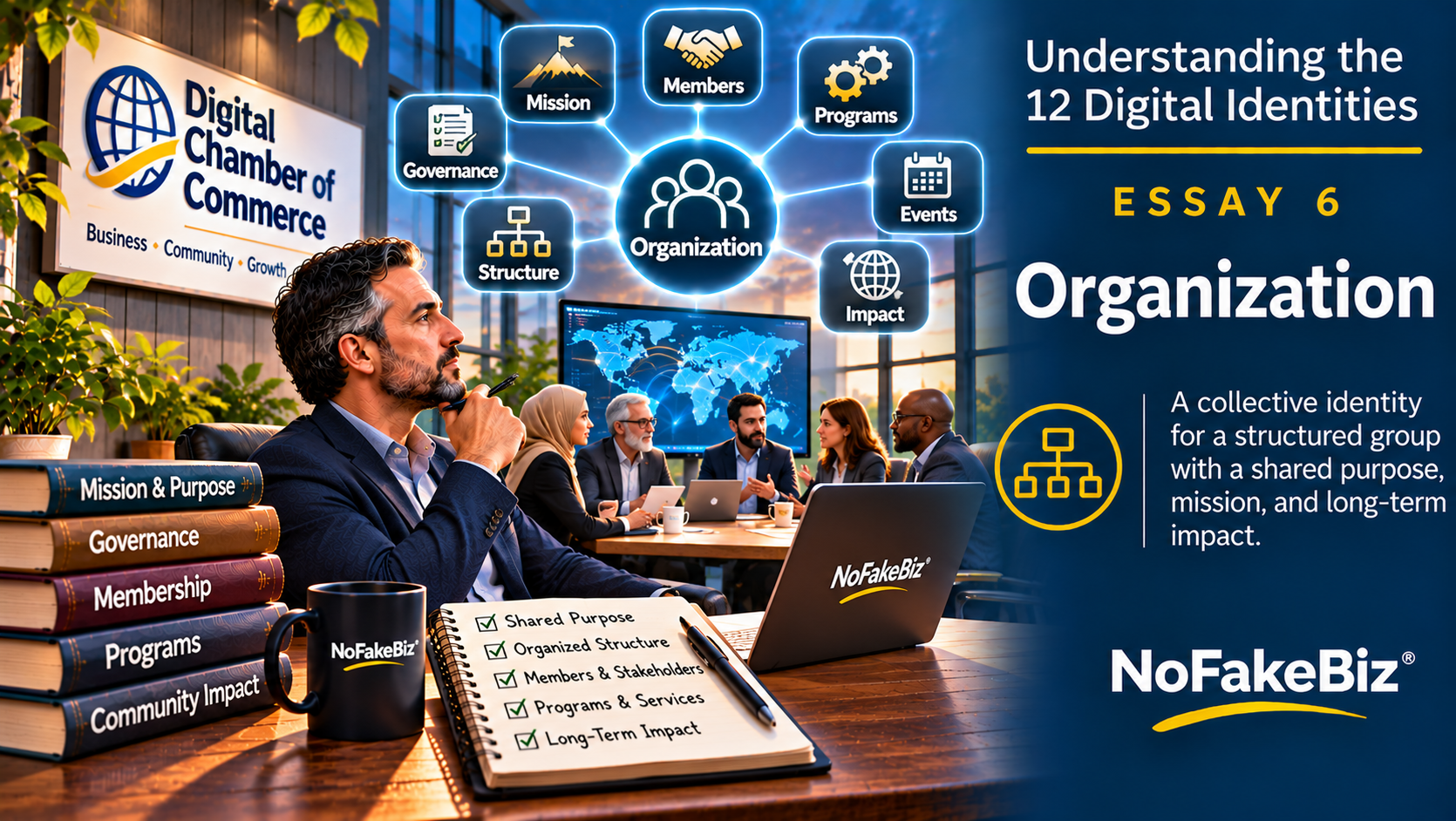
Not everything people build together is a business, and not every organized activity belongs to one person's profession. Some people come together to educate, help, support, research, create, or serve a community. They establish programs, bring people together, develop responsibilities, and work toward something that goes beyond the personal interests of the people involved. That work may continue for years, sometimes long after the people who started it have moved on. This is why NoFakeBiz has a separate Organization Identity: to give an organization its own public place, where people can understand its purpose, activities, and the communities or causes it serves.
Think about a learning center that offers classes to children and adults. It may have a director, several teachers, volunteers, classrooms, and a regular schedule. Parents want to know what programs are available, where the classes take place, and how their children can participate. Or imagine a food pantry that provides assistance to families. People need to know where it is located, when it operates, what assistance is available, and how they can receive help or contribute. A neighborhood organization may run a youth program, while another group may provide educational resources, cultural activities, or humanitarian assistance. These organizations do different kinds of work, but they share something important: people recognize them by the work they do together, not simply by the name of the person currently managing them.
An Organization Identity gives that work a public home. It should help answer the questions that people naturally ask: What is this organization? Why does it exist? What does it actually do? Who can participate or receive its services? Where does it operate, and how can someone contact it? An organization may want to publish information about its programs, announce an upcoming activity, explain a new initiative, or share something it has accomplished. Those communications belong to the organization itself. They should not have to appear on the director's Personal Identity or be mixed into the Professional Identity of a teacher, researcher, or staff member.
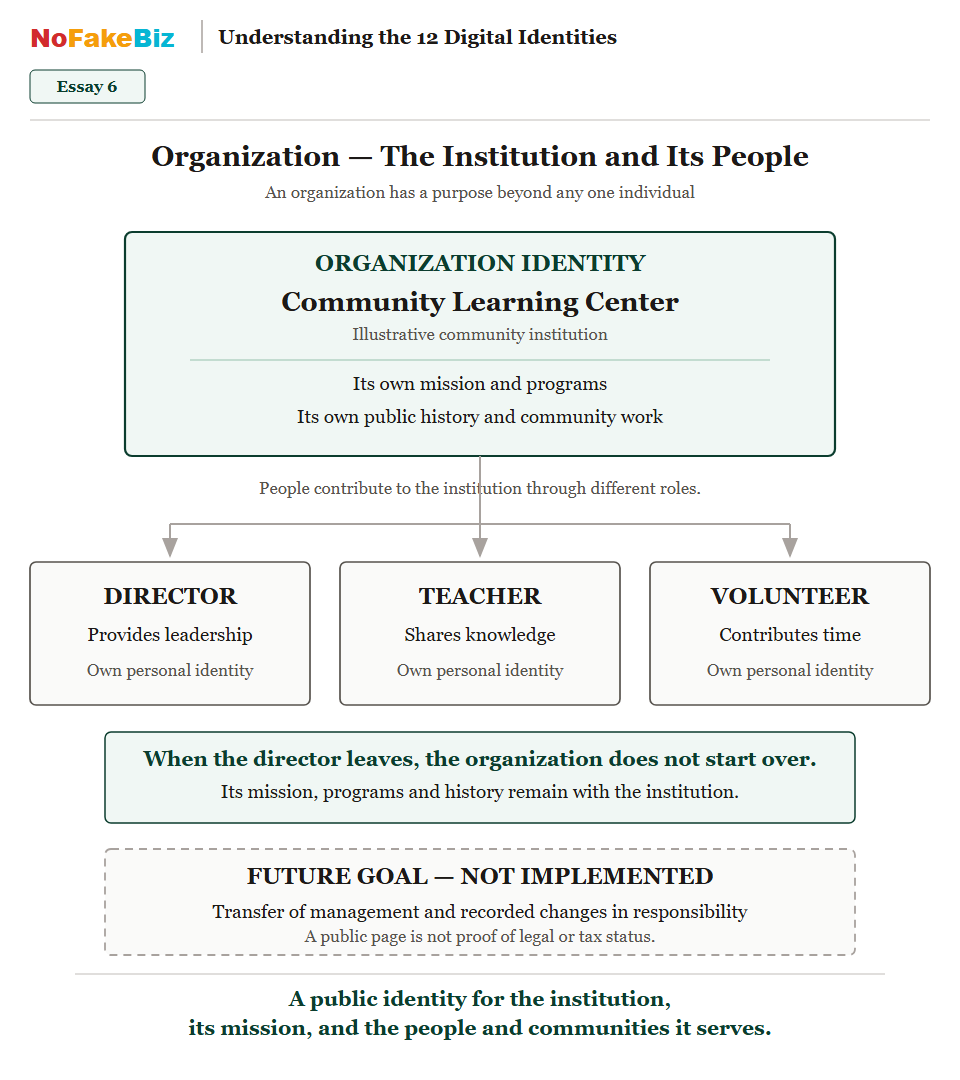
This distinction becomes especially important when we consider the people who make an organization function. A director may provide leadership, a teacher may contribute professional knowledge, and a volunteer may give time without receiving payment. Each person has a life and identity beyond the organization. At the same time, the organization has a purpose that cannot be reduced to any one of them. When a teacher leaves a learning center, the center does not become that teacher's personal project. When a new director takes responsibility, the organization's public history should not have to begin again. Its programs, relationships, and work belong to the institution that carries them out.
Organizations can take many forms. Some are involved in education, research, culture, humanitarian assistance, community development, or religious and charitable activities. Others support public health, provide social services, or work on problems affecting particular communities. Some operate in a single neighborhood with only a few volunteers, while others have employees, offices, and programs across several countries. They may receive donations, charge fees, employ people, purchase equipment, and manage substantial budgets. None of those activities automatically turns an organization into a Business Identity. What matters for this distinction is the nature of the institution being represented and the purpose for which its public identity exists.
This is also where we need to distinguish Organization from Association. Both may bring people together, have leaders, collect membership fees, organize activities, and serve their communities. But an association is generally formed around its members and their shared interests, profession, activity, or common cause. An organization, as we are using the category here, is more directly presented as an institution carrying out a mission, operating programs, or providing services. The boundaries are not always perfect, and some real institutions may fit more than one description. The purpose of separating these categories is not to force every institution into an artificial definition, but to represent the different ways people organize their work and relationships.
There is another side of organizations that I consider especially important. People do not always approach an organization because they need assistance or a service. Sometimes they approach it because they want to contribute. A person may want to volunteer at a food pantry, help teach a class, support a youth program, donate equipment, or share knowledge with people who could benefit from it. Someone may have lived in a community for years without knowing that a local organization was doing exactly the kind of work they would like to support. A clear public identity can help people discover not only what an organization offers, but also how they might become involved.
I think this matters particularly at the local level. When someone moves to a new city or county, they need more than restaurants, stores, and businesses. They may want to find a learning center for their children, a community organization that provides assistance, a cultural institution, or a place where they can volunteer. These are part of the life of a community, even when they do not operate like commercial businesses. One of the goals of NoFakeBiz is to make such organizations easier to discover and connect with, beginning with the places where people live and extending to wider regional, national, and international networks.
A small organization should not have to be famous or employ a large staff to deserve a public presence. Imagine a group of neighbors who organize a regular program for local children. They may have no large office, no marketing department, and very little money. Yet the work they do may be valuable to dozens of families. Another organization may operate internationally, coordinating people and resources across many locations. Their scale is very different, but both need a way to explain their purpose, present their activities, and maintain relationships with the people they serve.
Over time, an organization develops its own history. It may begin with a few people, introduce new programs, move to another building, reach new communities, or change its leadership. Some initiatives succeed, others end, and new ones take their place. Those developments become part of the organization's story. The public identity should be able to reflect that history without treating every change in leadership as the creation of a completely new organization.
Of course, having an Organization Identity does not automatically establish that an institution is legally registered, tax-exempt, charitable, or officially recognized by a government authority. Those are separate questions that may require documentation or independent verification. The purpose of the identity is to provide a place where the organization can present itself and its work, not to turn every public statement into a verified fact.
And just as we discussed with Business Identity, the longer-term vision includes clearer ways to represent who founded an organization, who is responsible for it, and who is authorized to manage its public presence. NoFakeBiz already distinguishes Organization as a public identity type, but the complete system for delegating management and recording changes in responsibility is still work to be developed. The principle is that an organization's identity should remain connected to the institution itself rather than becoming the personal property of whoever happens to operate its page.
Ultimately, organizations exist because people recognize a purpose worth pursuing together. Some teach, some provide assistance, some conduct research, some preserve culture, and others support communities in ways that are difficult to measure only in money. Their directors, employees, and volunteers each have their own lives and identities, but the work they carry out together also deserves to be represented.
That is what Organization Identity is meant to provide on NoFakeBiz: a public identity for the institution, its mission, its activities, and the people and communities it serves.
---
AMIR BASIC
Founder & CEO, NoFakeBiz
ABOUT THIS SERIES
Understanding the 12 Digital Identities is a connected series about the ideas behind NoFakeBiz. Each essay explores one part of the larger picture. For a complete understanding, we recommend reading the entire series, beginning with the Introduction.
PREVIOUS ESSAY
Business — A Public Identity for the Business Itself
NEXT ESSAY
Association — People Connected by a Shared Interest
READ THE COMPLETE SERIES