
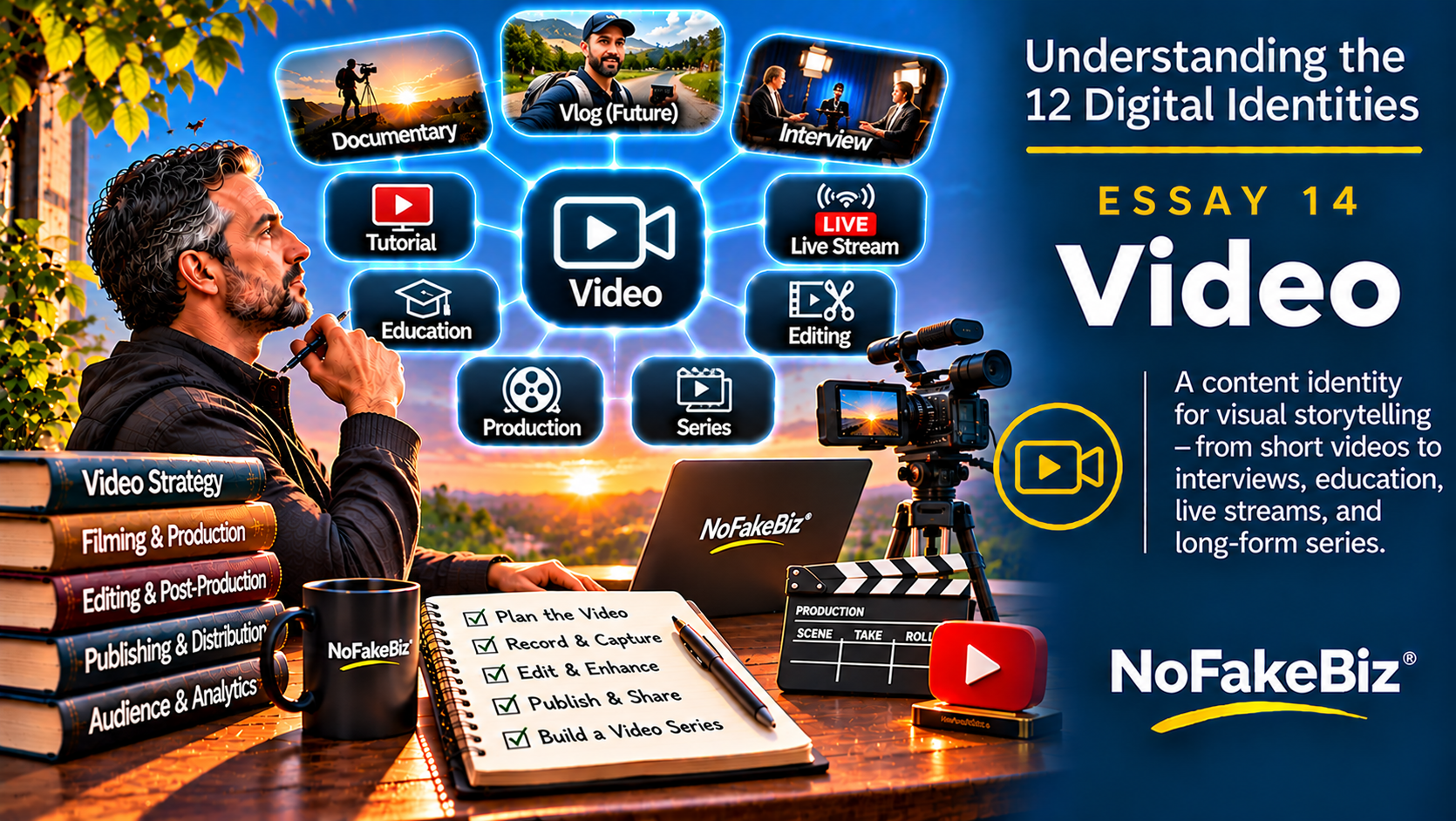
When I began thinking about Video Identity, I did not expect it to be particularly difficult to explain. After all, almost everyone knows YouTube. We watch videos every day, sometimes several times a day. We watch them to learn something, understand a problem, follow a story, see how something works, or simply enjoy what another person has created. Video has become such a familiar part of everyday life that explaining what a video is seems almost unnecessary.
But explaining why video deserves its own Digital Identity is a different question.
When I was developing the twelve Digital Identity categories for NoFakeBiz, I was not trying to create a separate category for every kind of content people might publish. I was thinking about the different public identities people build around their work, their activities, and the things they create. Video stood out because it had become much more than a convenient way to share recordings. For many people, it had become a profession, a business, and a continuing form of publication with its own audience.
Consider how much the role of video has changed. Years ago, recording and sharing videos often required equipment, technical knowledge, and distribution opportunities that were not available to everyone. Today, a person can begin creating videos with a phone and gradually develop a channel that people recognize and follow. Some creators remain small, producing videos for friends, neighbors, or people interested in a particular subject. Others build audiences that reach across countries and languages.
For some, video creation becomes a primary source of income. A channel may generate revenue through advertising, sponsorships, subscriptions, related products, or other commercial activities. Successful creators may eventually employ editors, camera operators, producers, and other professionals. What began as one person's activity can develop into a substantial media operation.
Looking at this from a business perspective, I believed people who build their work around video should have the opportunity to establish a Video Identity on NoFakeBiz, alongside their other identities.
But the importance of video is not limited to commercial success. A person who publishes educational videos for a few hundred viewers may be providing something valuable. A local historian may record places and stories that would otherwise be forgotten. A mechanic may demonstrate repairs that help people understand their vehicles. A teacher may explain difficult subjects in a way that students find easier to follow. A beekeeper may show what is happening inside a hive rather than trying to describe everything through words alone.
These creators may have very different goals, audiences, and resources, but they share something important: they use video as a continuing way to communicate their work to others.
Another reason I included Video Identity was the way video had spread across the internet. YouTube is probably the first platform many people think of when they hear the word video, but it is no longer the only place where people regularly watch or publish it. Social networks, professional platforms, news websites, educational services, and publishing platforms have all made room for video in different ways.
Even platforms that became known primarily for other forms of communication have increasingly incorporated video. LinkedIn, traditionally associated with professional networking, supports video content. Substack, widely associated with newsletters and writing, has also expanded into video. This reflects a broader change in how people communicate: written words, audio, and video increasingly exist alongside one another.
When I was deciding which identities belonged on NoFakeBiz, I wanted Blog, Podcast, and Video to have distinct places within the same larger system. They can be connected to the same creator, but they are not interchangeable.
A blog is a continuing written publication. A podcast is a show people primarily follow through audio, although it may also have a video version. A Video Identity represents a channel or continuing body of video-centered work that viewers recognize and follow under its own name.
That distinction becomes clearer when we separate an individual video from the channel to which it belongs.
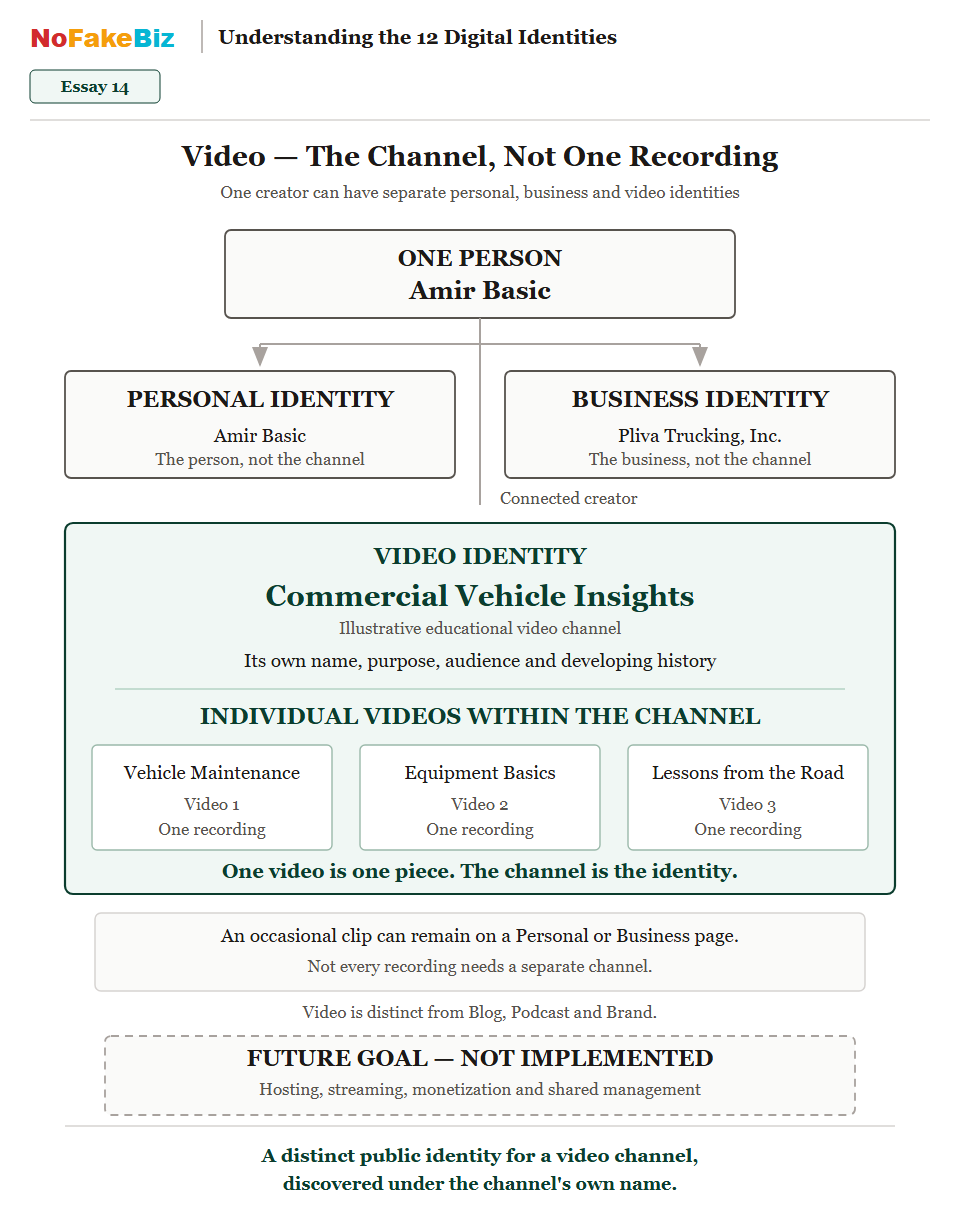
One video may explain how to repair a machine. Another may document a trip. A third may contain an interview, a lecture, or a short film. Each is a particular piece of content. But when a creator regularly publishes videos under a recognizable channel name, the channel becomes something larger than any individual recording.
It develops a subject or range of subjects, a style, a history of published work, and an audience that may return for future videos. A viewer who hears about that channel should be able to find it under its own name, understand what it is about, and discover the videos associated with it.
That is what Video Identity is meant to represent on NoFakeBiz.
Imagine a person who operates a trucking business and also produces educational videos about commercial vehicles. The videos might explain maintenance, demonstrate equipment, or discuss practical lessons learned on the road. Some viewers may know the channel without knowing the name of the trucking company. Others may be interested in the company without wanting to watch the videos.
The Business Identity represents the trucking business. The Personal Identity represents the person. A Professional Identity may represent the person's knowledge and experience. The Video Identity represents the channel and its continuing video work.
They can be connected without being treated as one identity.
The same principle applies to someone who creates videos about cooking, history, technology, travel, education, or community life. The creator may have other professions and responsibilities, but the channel can remain recognizable under its own name. Viewers interested in the videos should not have to search through unrelated articles, books, projects, or business information to find the content they want.
I also think it is important to distinguish between publishing an occasional video and maintaining a Video Identity. A person may record a family event and share it through a Personal Identity. A business may publish a short demonstration of a product on its Business Identity. An organization may post a recording of a meeting or public event. Those videos can belong naturally to the identities that published them.
There is no reason every video must become part of a separate channel.
Video Identity is intended for situations where the video publication itself has a recognizable purpose and public presence. A creator may establish a channel devoted to a particular subject, or a company may operate a channel that viewers follow independently of its other business activities. The channel has its own name, its own body of work, and its own relationship with viewers.
A person may also operate more than one video channel. Someone might create educational videos about technology under one name and travel documentaries under another. The audiences may overlap, but the channels have different purposes. Each can maintain its own identity while remaining connected to the same creator.
This reflects one of the principles we have returned to throughout the series: one person can be involved in many activities without requiring all of those activities to share a single public identity.
There is another form of video publishing worth mentioning: the vlog.
A vlog often follows a person's daily experiences, travel, activities, or ongoing personal stories through video. Some vlogs are informal recordings shared occasionally, while others develop into recognizable channels with regular audiences. A vlog may resemble a personal diary in video form, but it can also become a continuing publication with its own name and purpose.
When I was considering the twelve categories, I did not create a separate Vlog Identity. In this system, a vlog can be represented through Video Identity when it functions as a video channel. A person may also write about the same experiences through a Blog Identity. The distinction is not that one subject belongs exclusively to one format, but that each identity represents a different kind of publication.
A creator might write about a journey in a blog, discuss it in a podcast, and show the experience through video. Those publications may complement one another, but they do not have to become the same identity simply because they cover the same events.
This is also where the relationship between Video and Brand becomes important. A successful video channel may develop a recognizable brand. People may recognize its name, logo, visual style, or the way its videos are presented. But the brand and the channel are not exactly the same thing.
The Video Identity represents the channel and its published video work. Brand Identity represents the recognizable name and meaning associated with it. A channel may have a strong brand, but it remains a video publication with its own content, participants, and history.
A company may also own or support a video channel, and several people may contribute to producing it. One person might appear on camera, another might handle editing, and someone else might manage production. The channel's identity should not automatically become the personal identity of whichever participant is most visible.
Over time, the people involved may change. A host may leave, new contributors may join, or the channel may develop a different format. The history of the channel can remain connected to its original work and the people who contributed to it. Establishing the necessary controls for shared management, permissions, and changes in responsibility is part of the longer-term development of NoFakeBiz, rather than something I want to claim is already complete.
There is also the question of how viewers discover video channels. Some channels serve audiences around the world, while others are strongly connected to particular places. A person may want to find videos about local history, community events, or businesses in their county. Someone else may be looking for a channel about a specialized technical subject, regardless of where the creator lives.
My idea was to make different kinds of work easier to find by giving them recognizable identities. A person looking for a video channel should be able to search for that channel as itself, rather than having to reconstruct its existence from unrelated content scattered across different pages.
At the same time, a Video Identity is not automatically a complete video-hosting or streaming service. Uploading, storing, processing, delivering, and monetizing video at scale require substantial technical infrastructure. Rights management, moderation, accessibility, and other responsibilities also have to be considered. The purpose of including Video among the twelve identities is to establish a public place for video-centered work, with additional capabilities developed according to what the platform can reliably support.
I did not include Video Identity because I believed NoFakeBiz needed to become another YouTube. I included it because video creators, like writers and podcasters, can build recognizable bodies of work and lasting relationships with their audiences. Those relationships deserve to be represented clearly, even when the creator also has a personal life, a profession, a business, or other publications.
When I look at the twelve Digital Identity categories together, this is the larger idea I see. A person may write articles, develop a book, host a podcast, produce videos, operate a business, and participate in projects or organizations. These activities may all belong to the same life, but they do not all represent the same thing.
The purpose of NoFakeBiz is not to separate them so completely that their connections disappear. It is to allow each to have an identity appropriate to what it represents, while preserving the relationships between them.
Video is the final category in this series, but it is not the end of that larger idea. It brings us back to the question that started everything: how can one human being have many different public roles, activities, and creations without having to present all of them as one undifferentiated digital profile?
That is what Video Identity is meant to represent on NoFakeBiz: a distinct public identity for a video channel, connected to its creators and viewers, where its work, purpose, and history can be discovered under the channel's own name.
---
AMIR BASIC
Founder & CEO, NoFakeBiz
ABOUT THIS SERIES
Understanding the 12 Digital Identities is a connected series about the ideas behind NoFakeBiz. Each essay explores one part of the larger picture. For a complete understanding, we recommend reading the entire series, beginning with the Introduction.
PREVIOUS ESSAY
Podcast — A Public Identity for a Show and Its Voice
NEXT ESSAY
One Digital You, Twelve Identity Types — Separate, but Still Connected
READ THE COMPLETE SERIES