
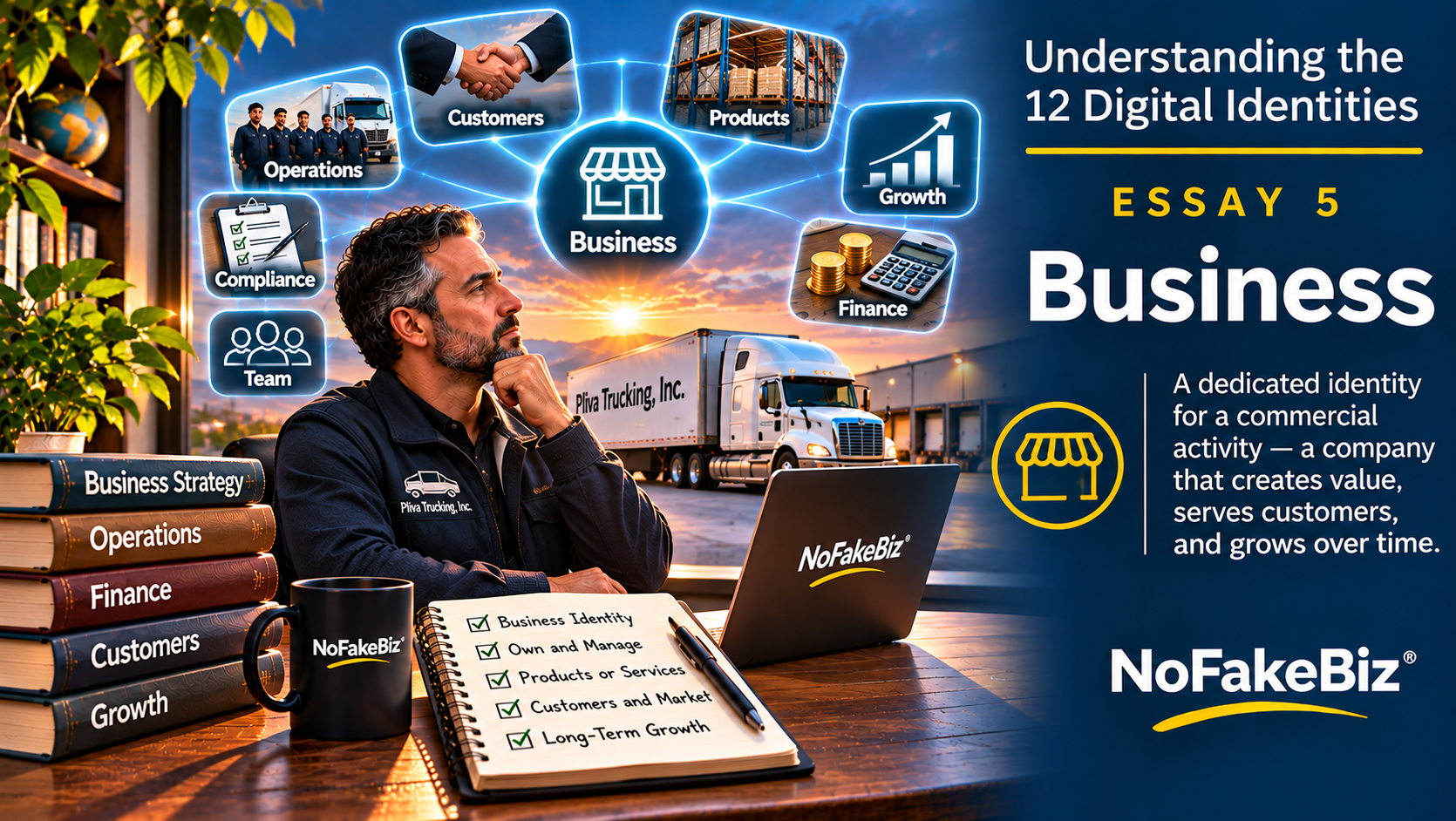
A business is not the same thing as the person who owns it. It may begin with one person's idea, money, and hard work, but once that person starts offering products or services to others, the business develops a purpose of its own. It has customers to serve, work to perform, commitments to fulfill, and a name by which people recognize it. Whether it is a small family operation or a company employing hundreds of people, it needs a public place where people can understand what it does and how to reach it. That is what Business Identity is meant to provide on NoFakeBiz.
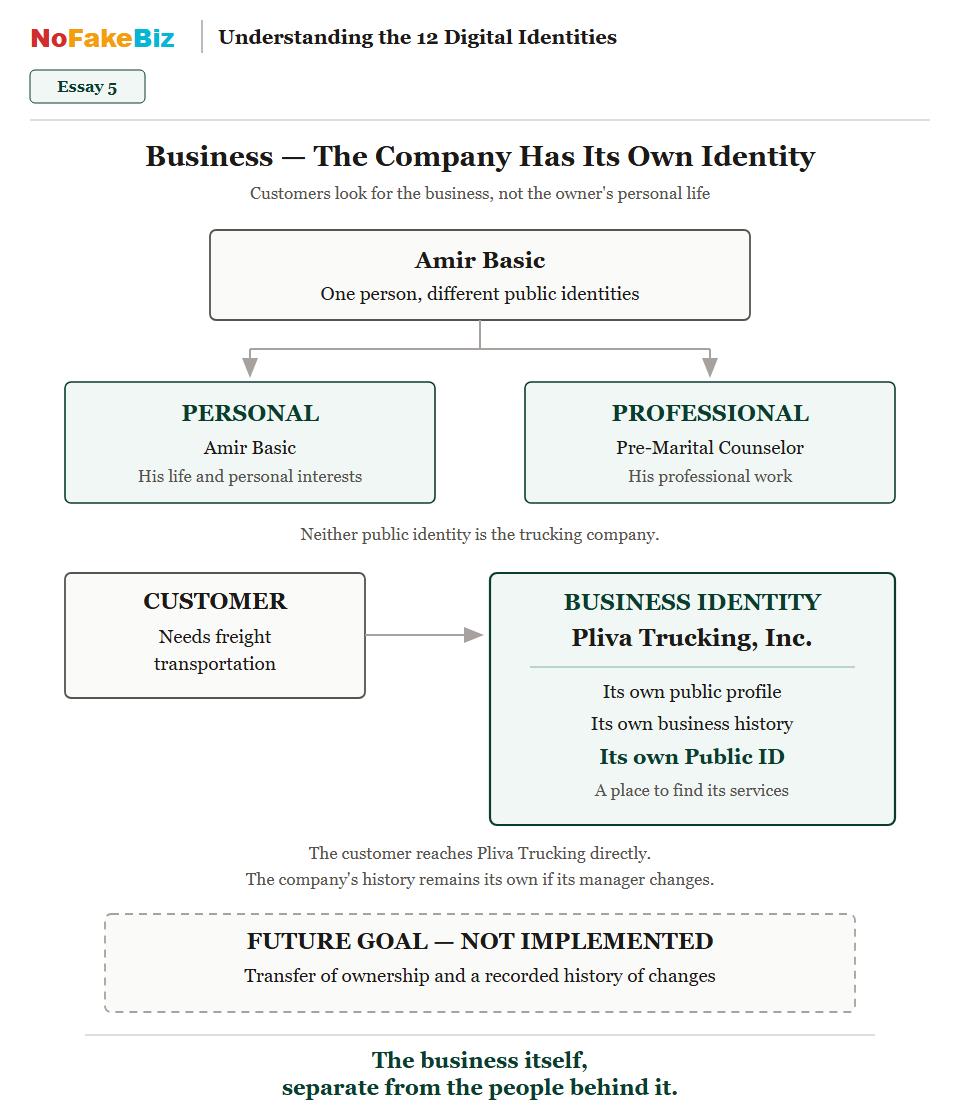
Let me use my own company, Pliva Trucking, as an example. When someone contacts Pliva Trucking about transporting a load, they are not calling me to discuss my personal life or ask for premarital counseling. They need transportation services. They want to know whether the company can handle the shipment, where it operates, how to contact it, and what services it provides. Those questions belong to the business, not to my Personal or Professional Identity. I may be the person answering the phone, but the customer is dealing with Pliva Trucking. That distinction should be just as clear online as it is in everyday business.
A Business Identity gives a company a place to introduce itself, describe its products and services, publish information related to its activities, and present offers to the people it wants to reach. A trucking company may want to explain the kinds of freight it transports and the areas it serves. A restaurant may want customers to find its location, learn what food it offers, and discover something new on the menu. A repair shop may want people to understand the services it performs, while a small manufacturer may want to show the products it makes. These are different businesses with different needs, but each deserves a public identity that represents the business itself rather than requiring customers to search through the owner's personal profile.
And a business does not have to be large or famous to deserve that place. Think about a family restaurant that has served the same neighborhood for thirty years. The people who started it may have spent much of their lives building relationships with customers who return week after week. Or imagine a woman who makes products at home and sells them locally, a mechanic who opens a small repair shop, or a contractor who works with a few employees. Their businesses may be small, but the work they do is real. They have customers, responsibilities, and something to offer. A public business identity should not be a privilege reserved for large companies with marketing departments.
I also think about the people on the other side of those businesses: the customers trying to find them. Imagine moving to a new town where you do not know anyone. You need someone to repair your car, fix a leaking pipe, prepare your taxes, or help with a home renovation. You may not know the names of the local businesses, and you may not know which ones serve your neighborhood. At the same time, a small business may have opened nearby and be struggling to let people know it exists. One of the goals of NoFakeBiz is to make those connections easier, beginning with the communities where people actually live and extending outward to larger markets.
That local connection matters to me because businesses are not just names in a directory. They are part of the economic and social life of a community. A neighborhood restaurant may become a place where people know one another. A repair shop may serve the same families for generations. A local trucking company may connect manufacturers, warehouses, and customers across several states. Each business participates in a network of people, places, and relationships. I want Business Identity to help make those connections visible without requiring every business to build its own complicated online system just to be found.
If you have ever searched for a company through Google Maps, visited a Facebook business page, or looked through an online business directory, you already understand the basic need. People search because they want to find a particular business or discover one that provides something they need. NoFakeBiz is not trying to pretend that those services do not exist or that they provide no value. The difference I want to build is a system where a business is not merely an isolated listing. It has its own public identity, connected where appropriate to the people, professions, organizations, and communities around it.
Consider Pliva Trucking again. The company has its own Business Identity, while I have my Personal Identity and my Professional Identity. Someone looking for transportation services should be able to find Pliva Trucking directly. Someone interested in my professional writing about marriage and relationships should be able to find that work separately. And someone who wants to learn more about the person behind these activities may discover the connection between them. The relationship is real, but the purposes are different. One identity should not have to carry the responsibilities or public communication of another.
Over time, a business also builds something that cannot be reduced to its current owner or manager: its own history. It may develop long-standing customer relationships, introduce new services, move to another location, expand into new markets, or change the way it operates. Those developments belong to the business's story. If a manager leaves, that story should not disappear. If ownership changes, the public identity should be able to continue representing the same business, with its history preserved and its current responsibilities made clear.
We discussed the distinction between founders, owners, and managers earlier in this series, so I will not repeat the entire explanation here. The important point for Business Identity is that a company should not have to begin its public life again every time someone new takes responsibility for it. The long-term goal is to preserve the continuity of the business's public identity while clearly representing changes in ownership or management. The complete system for transferring control and recording those changes is still part of the work ahead for NoFakeBiz.
A Business Identity also has to represent the business accurately. Having a public page does not automatically mean that a company is licensed, insured, financially sound, or approved by NoFakeBiz. A business may publish information about its services and qualifications, but customers should not confuse those statements with independent verification. The identity provides a place to present information and establish a public presence. Trust must still be supported by real conduct, reliable information, and evidence where appropriate.
The same principle applies whether the business is operated by one person or employs hundreds. A small local shop may need only a simple public introduction and a way for customers to contact it. A larger company may have many services, locations, and people involved in its work. Both should be able to represent themselves without confusing the business with the personal identity of whoever happens to manage its page. The scale may be different, but the underlying need is the same.
Ultimately, a business deserves to be recognized for the work it does, the products or services it provides, and the relationships it builds with customers and communities. The founder has a personal history. The employees have their own professional lives. The owners and managers may change over time. But the business itself has a purpose and a public history that should remain identifiable.
That is what Business Identity is meant to represent on NoFakeBiz: the business itself, separate from the people behind it, but connected to them where those relationships matter.
---
AMIR BASIC
Founder & CEO, NoFakeBiz
ABOUT THIS SERIES
Understanding the 12 Digital Identities is a connected series about the ideas behind NoFakeBiz. Each essay explores one part of the larger picture. For a complete understanding, we recommend reading the entire series, beginning with the Introduction.
PREVIOUS ESSAY
Professional — Your Knowledge, Skills, and Experience
NEXT ESSAY
Organization — A Public Identity for a Shared Mission
READ THE COMPLETE SERIES