
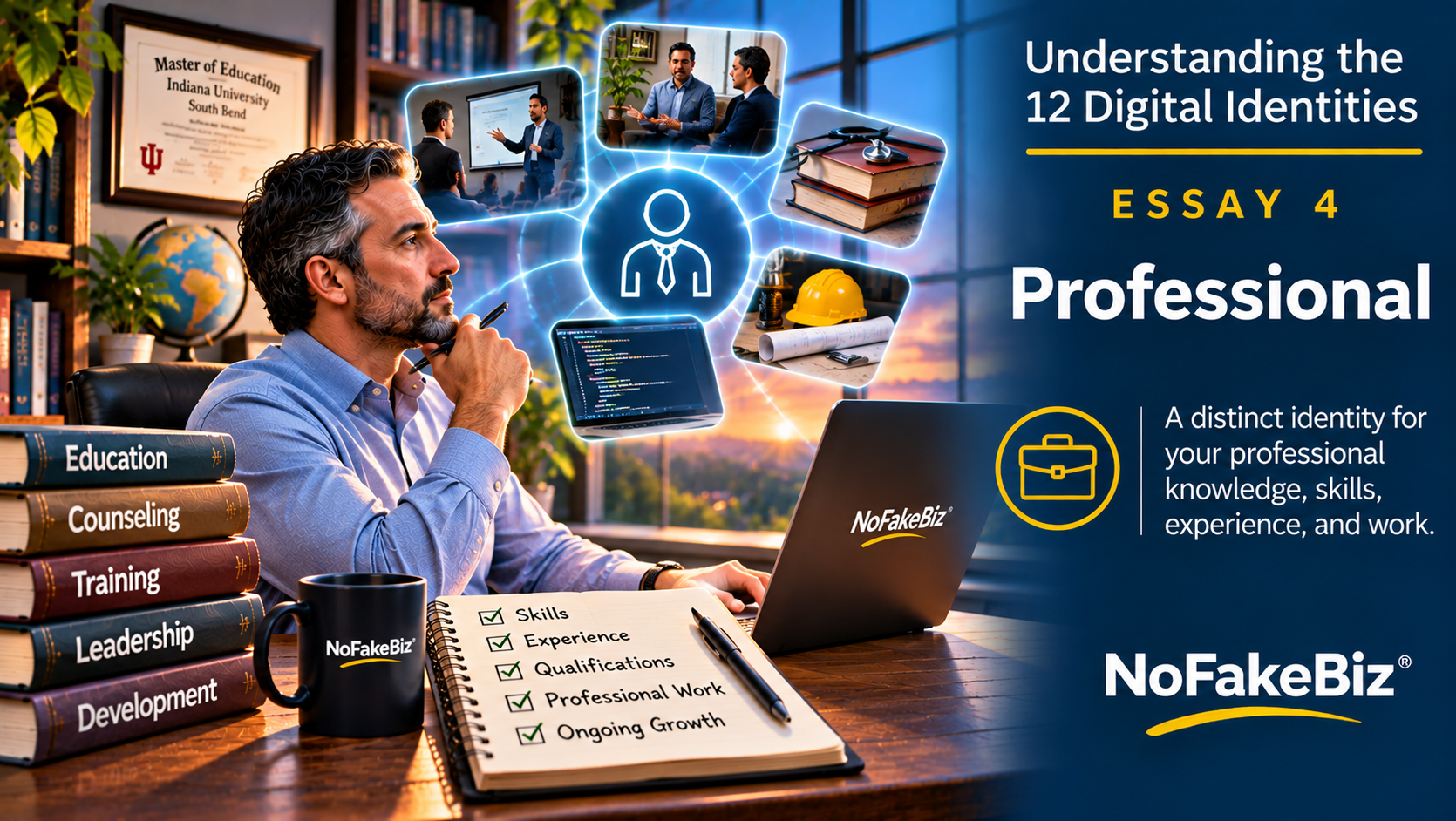
Who are you when someone needs your knowledge, your skills, your experience, or the professional services you can provide? You are still the same human being, but now people are approaching you for something specific that you know how to do. They may need your advice, your expertise, your work, or simply want to understand your professional background. That part of your life deserves a place where it can be presented clearly, without being mixed with your personal stories or the activities of a company. This is what Professional Identity is meant to represent on NoFakeBiz.
A profession is not necessarily a business, and having professional knowledge does not mean you must own a company. A counselor may work directly with individuals or families. A mechanic may spend twenty years repairing vehicles for someone else's business. A teacher may work in a school, an engineer in a manufacturing company, or a doctor in a hospital. Each of these people has knowledge, skills, and experience that belong to them as individuals, even when their work takes place within a larger organization. Their employer may change, but the experience they have gained does not disappear when they leave the building.
Consider an engineer working for Boeing. That engineer may have spent years studying, solving technical problems, developing specialized skills, and contributing to important projects. Boeing has its own business identity, its own products, and its own public responsibilities. But the engineer also has a professional life that cannot be reduced to the company's name. The engineer may not be looking for private clients or offering independent services at all. That does not make their professional identity any less meaningful. Their education, experience, and professional achievements are still part of who they are.
I can explain the same distinction through my own work. I have professional knowledge and experience related to premarital counseling, marriage, and relationships. When I write about those subjects, I want people to understand that I am speaking from my professional perspective. I am not speaking on behalf of Pliva Trucking, and I am not simply sharing an unrelated personal story. A couple looking for guidance about marriage has a very different reason for contacting me than a customer looking for transportation services. Both may eventually discover that the same person is connected to these activities, but they should not have to search through trucking advertisements to find my counseling work, or through counseling articles to find a trucking company.
That separation matters because professional communication carries its own responsibilities. When I discuss marriage, relationships, or the difficulties that young couples may face, I want readers to know the background from which I am speaking. They should be able to see my professional interests, relevant education, experience, and the work I have chosen to make public. At the same time, presenting myself professionally does not mean that everything I say is automatically correct or that readers must accept my opinions. Professional Identity gives people a clearer way to understand the person behind the work and decide for themselves whether that person's knowledge or services are relevant to their needs.
This is also why I have always felt that professional life needs its own public place. When I am at home with family or friends, I am simply Amir. I may cook Bosnian grah, discuss something happening in the community, or talk about a subject that has nothing to do with my profession. But when I write about premarital counseling, I want to speak as the person who has studied and worked with those questions. Both voices belong to me, but they serve different purposes. My Personal Identity does not need to become a professional résumé, and my Professional Identity does not need to carry every personal experience I choose to share.
LinkedIn helps illustrate why people need a professional presence online. It was built around professional relationships, employment, experience, education, and career opportunities. In that respect, I understand its purpose. Someone looking for a colleague, an employee, a professional connection, or a particular skill has good reasons to use a network organized around work. But a professional network is not the same thing as a complete representation of a human being, and a single professional profile is not always the clearest way to represent every professional role that person may have.
What happens when one person has two or three professions? Imagine someone who is both an engineer and a counselor, or a teacher who also works professionally as a designer. LinkedIn allows people to list multiple positions, qualifications, and experiences, but those activities still appear within one professional profile. On NoFakeBiz, the idea is different. Each professional role can have its own Professional Identity, with its own public presentation and relevant work, while remaining connected to the same member. A person does not have to decide that one profession is the only one worth representing publicly.
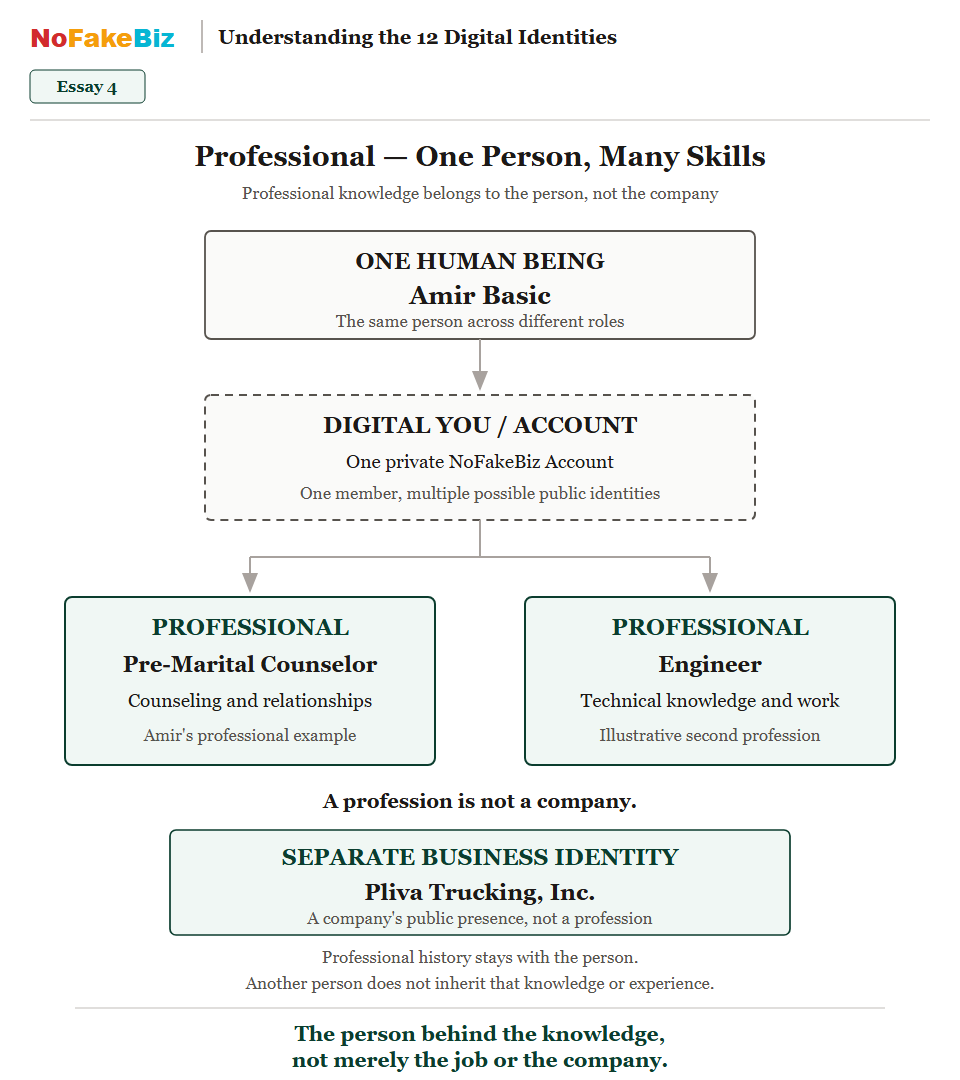
This distinction is particularly important for people whose careers change over time. An engineer may work for one company today, move to another company five years later, and eventually start a business. A teacher may become a counselor. A mechanic may become an instructor. People learn new skills, gain experience, change directions, and sometimes practice more than one profession at the same time. Their professional identities should be able to reflect those changes without being confused with the companies that employ them. The employer has its own history, but the person's professional experience continues with the person.
I also do not want Professional Identity to become a place reserved only for people with university degrees or impressive titles. Some of the most knowledgeable people I have met learned their skills through years of practical work. Think about a mechanic who has spent twenty or thirty years repairing engines. That person may understand certain problems better than someone who has only studied them in a classroom. Or consider a carpenter, electrician, farmer, technician, or skilled tradesperson whose knowledge comes from daily experience. They should have a place to present their work and experience without pretending to hold qualifications they do not have.
The same applies to someone who is just beginning. A young graduate may have education but little professional experience. An apprentice may be developing a trade. Someone returning to work after years away may want to present the skills they already have and the direction they hope to pursue. A retired professional may no longer have an employer or actively seek work, but still possess decades of knowledge that could be valuable to others. Professional Identity should make sense for all of them. It is not a reward for already being successful, and it is not limited to people who are selling services.
Of course, there is an important difference between presenting a professional qualification and having that qualification independently verified. A person may describe their education, experience, skills, or professional services, but NoFakeBiz should not automatically treat every statement as proven simply because it appears on a Professional Identity. Some professions require licenses, certifications, or other legal qualifications, and those requirements continue to apply. The purpose of Professional Identity is to provide a clear public place for professional information, not to replace professional licensing authorities or guarantee the truth of every claim.
Professional Identity is also separate from the private member Account. The Account is where a person manages their presence on NoFakeBiz, while the Professional Identity is the public place where they choose to present their professional work. If the same person has several professional identities, they remain connected through that person's membership without requiring separate private accounts. And unlike a Business Identity, which may continue under a new owner, a Professional Identity remains connected to the human being whose knowledge and experience it represents. Someone else cannot simply take over my professional history and become the person who earned it.
Ultimately, a profession is more than the position written on a business card or the company name printed on a paycheck. It is the knowledge we develop, the skills we practice, the experience we gain, and the responsibilities we accept through our work. Companies may change, jobs may end, and new opportunities may appear, but that professional history remains part of the person who lived it.
That is what Professional Identity is meant to represent on NoFakeBiz: the person behind the knowledge, not merely the job or the company.
---
AMIR BASIC
Founder & CEO, NoFakeBiz
ABOUT THIS SERIES
Understanding the 12 Digital Identities is a connected series about the ideas behind NoFakeBiz. Each essay explores one part of the larger picture. For a complete understanding, we recommend reading the entire series, beginning with the Introduction.
PREVIOUS ESSAY
Personal — Your Identity as a Person
NEXT ESSAY
Business — A Public Identity for the Business Itself
READ THE COMPLETE SERIES