

For most of human history, life happened in one obvious place: the physical world. You were born there, went to school there, found work there, met people there, and built a reputation there. If someone wanted to know who you were, they asked around — or they met you.
That world still exists. We still live in homes, go to work, shake hands, sign papers, and talk to neighbors.
But something else became part of everyday life: a second place.
The internet used to feel like a tool you visited. You sat down, found what you needed, and left. That is not really how most of us live with it now.
Think about an ordinary day. You check email. You search for a business before you visit it. You read about someone you have never met. You may pay a bill, apply for a job, talk to a customer, or work for hours with people who are not in the same room.
Now flip it. Before someone calls your business, they may search for it. Before they hire you, they may search your name. Before they reply to your email, they may want to know who you are. Before they trust what you wrote, they may look for other things you have written.
In many cases, people meet your digital presence before they meet you. That is a big change in how human beings interact. We rarely talk about it that way. We talk about apps, profiles, accounts, followers, and search results — the tools. We never really developed a clear way to talk about what happened to us.
You are still here in the physical world. Part of your life is also happening online.
It is not another you
When I say we live in two places, I do not mean there are two versions of you. There should not be a “real you” and an “internet you.”
If you send a business email, it is still you. If you write something, it is still your work. If you make an agreement online, you are still responsible. If you build a good reputation over years, that reputation came from things you actually did.
Technology changed the place where the interaction happened. It did not create another human being.
That sounds obvious. But much of the internet is built as if the opposite were true. We keep making new profiles, new accounts, new usernames, and new pages. Professional life goes here. Personal life goes there. The business has another page. Writing lives somewhere else. Reviews sit on another platform. Conversations are split again.
After years of this, pieces of one person's life can be scattered across many companies and databases. We got very good at creating profiles. We have not been nearly as good at thinking about the person behind them.
What happens online can change real life
There is another reason not to treat digital life as less real. What happens there often affects what happens here.
A review can decide whether someone walks into a physical store. An email can start a business relationship. A search result can shape whether someone trusts you. A post can help a reputation or hurt it. A conversation between people who never met in person can lead to a job, a contract, a friendship, or a dispute.
I have seen this in my own business life, not only as a theory.
I work in transportation. In that industry, brokers and shippers often check carriers through online tools before they give someone a load. One of those platforms is Carrier411. I am not saying they set out to damage companies on purpose. The problem I ran into was more structural than that — and more personal.
Our company was reported for something. When we tried to respond, we could not really tell the full story. The system limited how much we could write. We needed several times more space to explain what actually happened, but that was not how the process worked. So a short version of their side could travel farther than our full explanation.
The record stayed. Years later, it can still affect whether we get work. Sometimes a business built over years can lose a load, or a chance, because of a digital mark that other people see before they ever speak with you. What hurt the most was not only the accusation. It was the feeling that we could not properly defend ourselves or put our side of the problem next to theirs in a fair way.
That is what I mean when I say digital life has real consequences. The interaction happens on a screen. The damage can show up in real income, real relationships, and a reputation you spent years building.
So the internet is not only a tool we use sometimes. It has become a place where part of human life — and part of business life — happens.
One person, two places
Forget the gadgets for a moment and the picture gets clearer.
There is one real person. That person has relationships, work, history, and a reputation in the physical world. That same person also has a presence in the digital world — even if that presence is currently scattered across search results, social networks, business listings, email, websites, articles, reviews, and things other people have published.
All of those pieces still point back to the same person: you.
That is the idea I want to keep coming back to in this series.
One person. Two places.
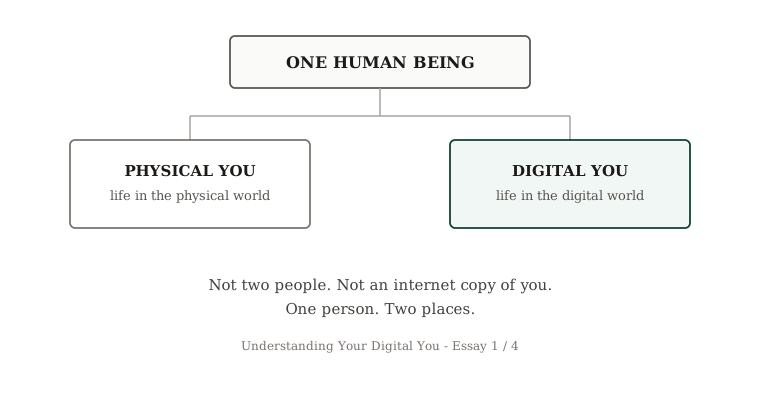
The first is the physical world, where human life has always existed. The second is the digital world, which became part of human life much more recently. We have had thousands of years to learn how identity, reputation, responsibility, and trust work in the physical world. Online, we have had only a few decades. I do not think we have finished that job. Maybe we have not even asked the right questions yet.
That is where the idea of Digital You begins to matter — not as another profile, not as an AI copy, and not as a personal brand, but as a way to think about what happens when the same real person now exists and acts in two places.
In the next essay, we will look at what people already mean when they say Digital You. There are more meanings than you might expect. Almost all of them describe something real. The question is whether any one of them describes the whole person.