
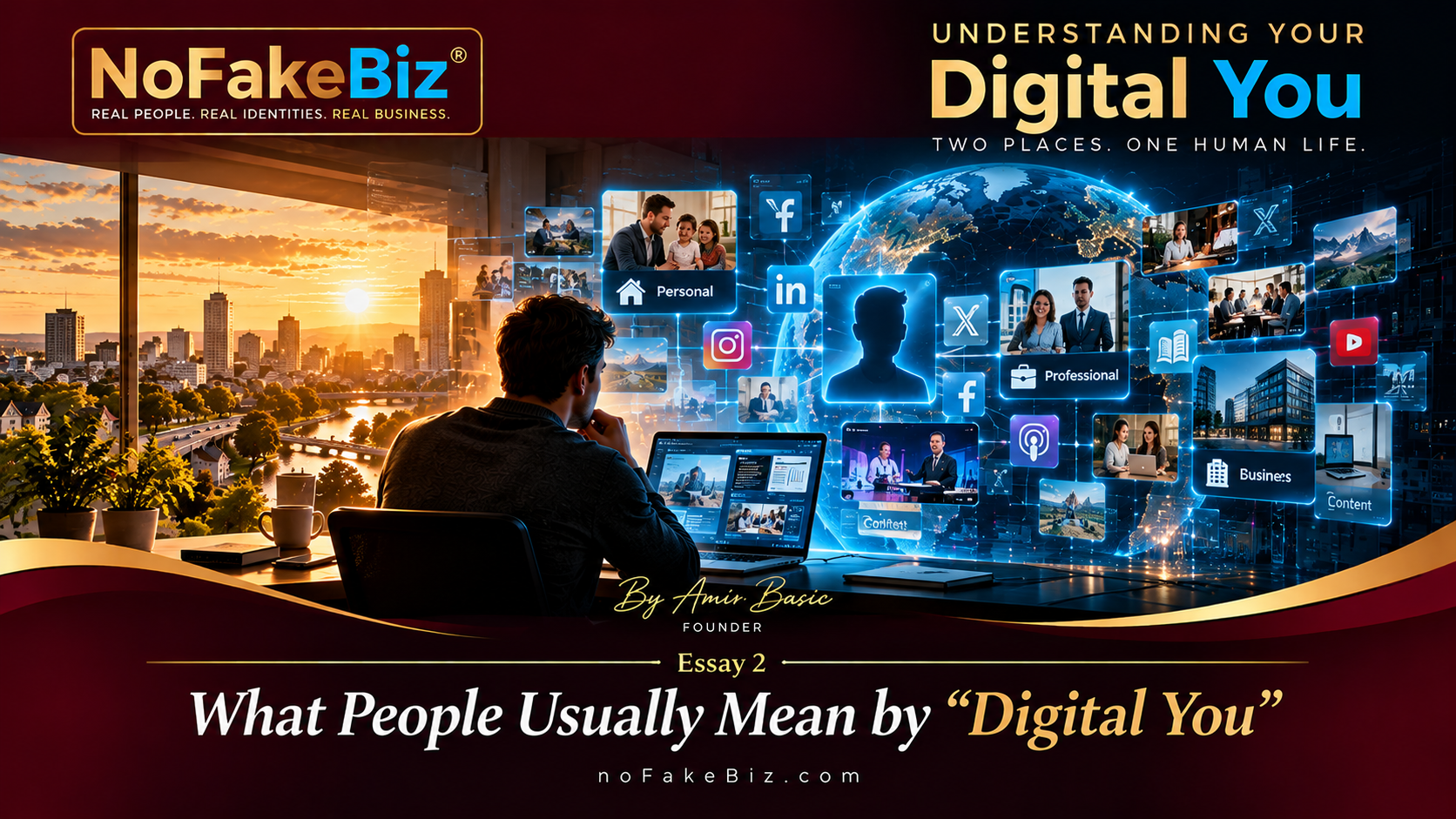
In the first essay, we started with a simple idea: the same human being now lives and acts in two places — one physical, one digital.
But if you search for the words Digital You, you quickly discover that people do not always mean the same thing. That surprised me when I first looked into it. The words sound simple. You might expect them to mean you in the digital world.
Instead, depending on who is speaking, Digital You might mean your LinkedIn profile, your personal brand, the data companies collect about you, a computer model of your body, or an AI system trained to act like you. Those ideas are very different. What they share is that each one tries to describe part of what happens when a human being enters the digital world.
So before we decide what Digital You should mean, it is worth looking at what people already mean by it.
Your online profile
This is the easiest meaning to understand. For many people, their digital identity is basically the profiles they have online. LinkedIn for work. Facebook or Instagram for personal life. A business page for a company. An author page for a writer. When someone searches your name, these are often the first things they find.
So it makes sense that we began to treat those profiles as digital versions of ourselves. There is some truth in that. A profile can hold your name, photo, bio, work history, posts, and years of activity. It can tell another person a lot about you.
But there is an obvious question. If your LinkedIn profile is your Digital You, what is your Facebook profile? What about your business page, your website, your email, your articles, your reviews, or your search results? They cannot all be the whole Digital You at the same time. Maybe each one is only showing part of something larger.
Your personal brand
Another common meaning comes from business and marketing: Digital You as your personal brand. The basic idea is reasonable. People form opinions from what they see online, so it matters how you present yourself — your photo, your bio, the work you share, what appears when someone searches your name.
For anyone whose reputation affects their work, those questions matter. A person can spend years building a professional reputation online. Still, I have always felt a little uncomfortable reducing a person to a brand. A company can have a brand. A product can have a brand. A person can build one too. But a human being is more than the image they carefully show an audience. You have work and public roles, and you also have relationships, responsibilities, history, and parts of life that are not a marketing message.
Your personal brand may be something your Digital You creates. That does not necessarily mean it is your Digital You.
Your digital footprint
Then there is a meaning that is almost the opposite of branding. A digital footprint is not mainly what you choose to present. It is what you leave behind: searches, purchases, website visits, old accounts, posts, photos, things other people posted about you, and information companies collect while you use their services. Some of it is public. Much of it is not. A surprising amount can exist without you thinking about it at all.
This creates a strange kind of Digital You — not necessarily the person you chose to show, but a picture of you assembled from data. Companies may know what you search, buy, watch, click, and care about. Algorithms can use those pieces to predict things about you. In that sense, a digital version of you really does exist in many databases.
But is data about you the same thing as you? That distinction matters.
Your digital twin
In science, medicine, and engineering, people talk about a digital twin — a digital model of something that exists in the physical world. For a machine, that might help engineers understand how the real machine is performing. Applied to people, the idea gets much bigger. Imagine a detailed digital model of your body that doctors could use to study your health or test how a treatment might affect you. That could be enormously useful.
But again, the same question appears. Is a model of you actually you? If a computer can simulate your heart, it knows something valuable about your body. It still is not the person whose heart it is simulating.
AI versions of us
Artificial intelligence has added another meaning. We can already build systems that write in someone's style, copy a voice, generate an image, remember information, and answer questions using a person's material. It is not hard to imagine an AI assistant that knows your work, preferences, schedule, and way of speaking. Someone might reasonably call that their Digital You. I understand why. It may sound like you, know a lot about you, and even do tasks for you.
Still, the same distinction matters. Something that represents you, knows about you, or acts for you is not automatically the same thing as you. An AI assistant may become a very useful part of digital life. There is still a human being on whose behalf that assistant is supposed to act.
They are all describing something real
I do not think any of these ideas are useless or wrong. That is what makes the conversation interesting. Profiles matter. Personal brands matter. Digital footprints matter. Digital twins may matter more and more in medicine and science. AI may become an important extension of how we work and communicate. They all describe real parts of modern digital life.
Put them next to each other, though, and something becomes clear. A profile shows how you appear on one platform. A personal brand shows how you intentionally present yourself. A digital footprint is data around your activity. A digital twin models something about you. An AI may represent you or act for you. Those are five different things — and we sometimes use the same two words for all of them: Digital You.
Maybe that is why the term still feels unclear. We have been trying to name the whole person by pointing at pieces around the person.
In the next essay, I want to look more closely at that problem — not because these meanings are wrong, but because each one may be answering a different question. And if Digital You is supposed to describe what happens to you when human life extends into the digital world, we still have to ask:
Where is the person in all of these definitions?