
Essay 2 showed that a number can stand in front of a tool. A company page waited on more than one connection. A newsletter waited on 150 before LinkedIn would even consider the Page. This essay does not go back through those doors.
It asks the question Essay 2 left on the table:
What do those numbers actually tell us about the person behind them?
A number is easy to count. What it means is much harder.
The working title says popularity is not reputation. That may be too blunt, and this essay will test it instead of assuming it. A large audience can itself become something people know about you. “Widely followed” is a fact of a kind. The title is useful only if we first say what a count honestly records, and only then notice the moment someone asks it to prove a different thing.
What the counters record
None of these is a moral failure. Each is a record of an event the platform could store.
Imagine a page about a plumber in South Bend, Indiana. Five different numbers can sit under that page. They do not all mean the same thing.
A view records that something was requested or displayed. Someone opened the page, or the platform showed it. It does not record that the person finished it, believed it, or would hire the plumber. A view is the thinnest attention: contact happened.
A like records a reaction the interface offered. It can mean agreement, habit, courtesy, or a mistake. It is evidence that a reaction was cheap enough to make. It is not evidence of what the reaction weighed.
A share records that someone passed the item on. The reason can be usefulness, loyalty, or anger. The counter stores the pass, not the reason. A neighbor can share the plumber’s page because the work was good, or because the price was a shock. The number looks the same.
A connection, on a network built for people who know each other, records that two accounts accepted a tie, or that one invited and the other confirmed. It is closer to a mutual acknowledgment than a follower is. It still does not record why the tie exists, how deep it is, or whether either person would rely on the other for anything that matters.
A follower or a subscriber records that an account asked to receive more. That is a continuing connection of a weak kind: not a contract, not a character reference, but not nothing. Someone, or something operating an account, chose this stream over silence. A paid subscription adds a harder signal: access carried a price, and the subscription was recorded as paid. Even then, that record proves interest in access strong enough to be priced. It does not, by itself, prove that the work is true, that the author is competent outside that circle, or that the author is the person the byline names.
Engagement, as platforms use the word, is usually a bundle of the above. It answers a question the platform can compute: did this item cause activity here? It does not answer whether another person should rely on the author. It also does not answer why the activity was wanted.
The founder and CEO of NoFakeBiz has watched these counters fill for reasons the counters cannot see. A like on a person’s own comment. A like given because the writer is a spouse, a child, or a relative, whether or not the comment deserved it. A share made so the likes and the views would rise, not because of what the post, the comment, the article, or the note said. Connection requests from people who did not know him, did not know the work, and did not know why he was on the platform. What was visible was a larger number under the name. The request did not require contact. The same shape appears in the sentence itself: please share this, please subscribe, please visit the site. The sentence asks the counter to move. It does not say the work is important, special, or new.
He has also seen people ask for attention before they have a clear thing to offer, or a clear thing to say. Sometimes they do not seem sure why they want it. Sometimes it looks less like a public claim and more like a wish to be noticed, when that notice is hard to get from the people closest to them. That can be human. It is still not a measurement of the work. A platform can count the attention. It cannot tell you whether the work earned it, or whether attention itself was the point.
So the legitimate reading is modest. These numbers measure attention, and some of them measure an audience. A follower count measures an audience. A connection count measures a network of accepted ties. A subscriber count measures people who asked to continue. Taken together, and when they are large, people call that popularity. Popularity here means size of notice. It is a description of the audience, not a description of the person.
Where the number is asked to change jobs
The trouble starts when a number that records an audience is treated as if it recorded something else.
The plumber can have two followers and a street full of finished jobs. A name on another platform can have a million followers and never have fixed a pipe. Two followers can be an accurate fact about an audience. A street of finished jobs can be evidence of experience. One is not a substitute for the other.
The problem is not that the number lies. The problem starts when we ask the number to prove something it never measured.
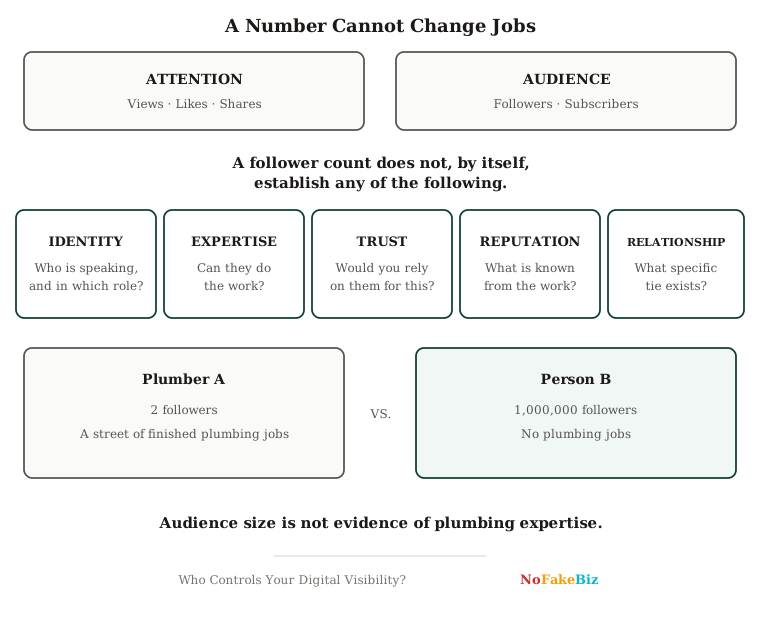
Identity is who is speaking, and in which role. A person. A business. A book. An organization. A follower count is attached to an account. An account is not yet an identity. Two roles can share a login. A name on a profile can be borrowed. The count cannot tell you which of those is true. It only tells you how many accounts pointed at this one.
Expertise is competence at a kind of work. It can be visible in the work, in a record of jobs done, in the judgment of people who needed the work and could tell. An audience can gather around expertise. An audience can also gather around confidence, novelty, outrage, or fame borrowed from somewhere else. The count does not separate those causes. It arrives after the gathering, and it looks the same either way.
Trust is a willingness to rely on someone for a stated purpose, for reasons that can be examined. “I follow this writer” can mean “I want to keep reading.” That is a thin trust, limited to attention. It is not yet “I would hire this person,” “I believe this claim,” or “I would send a customer here.” Those are different purposes. A single number cannot be all of them.
Reputation is what becomes known or believed about someone in relation to a particular thing. It can be accurate or inaccurate, deserved or undeserved, grounded in work or passed along as hearsay. A stronger reputation has stronger grounds: work observed, transactions completed, relationships experienced, or judgments made by people with a reason to know. A large audience can be part of what is known. “This writer is widely followed” is a reputational sentence, and it can be true. It does not say what the following is for. It does not say the person is competent. It does not say the information is true. It does not even say the audience is made of people. A reputation that consists only of size is a reputation for size.
Relationship is a specific tie between specific parties. A follower is the sketch of one: an account opted in. A finished job, a correction accepted in public, a customer who returned, a reader who argued with the work for years — those are relationships with content. The sketch is real. It is not the relationship.
These are not rungs on one ladder. Attention does not ripen into trust if you wait. Audience does not become expertise by addition. Popularity does not sit underneath reputation as the immature form of the same thing. They answer different questions. A platform that stores only the easy answers will keep offering the easy answers when someone asks a harder question.
What a follower actually proves
A follower count records that an account took a continuing-interest action toward another account, inside one platform’s rules, at a moment the platform recorded.
That can be attention. It can be interest. It can be the start of an audience. It can be a weak, ongoing connection. If many such actions accumulate, they can indicate popularity. They can also increase reach. Those are related facts, not the same fact. Reach, here, means how far the notice travels. Popularity, here, means how large the notice already is. If people outside the platform know about that notice, the notice can become part of a reputation: the reputation of being widely followed.
It does not, by itself, prove who the human is. It does not prove the role they are speaking in. It does not prove they can do the work. It does not prove a stranger should rely on them. It does not prove the audience would say the same thing if asked what the following is for.
Fake accounts, bought followers, and automated engagement matter here only because they attack the modest claim, not because this essay is about machines. If the event being counted can be performed by a script, then even “an audience exists” is less certain than the number looks. Generated text matters for a similar reason. Fluency is no longer evidence that a particular person stood behind the sentences. The counter still increments. The counter was never built to notice the difference. That is as far as this essay needs to take it. The measurement problem is older than the newest tools. The tools make the gap harder to ignore.
The title, after the test
Popularity is not reputation, if reputation means a judgment about competence, truth, or trustworthiness. Popularity can be part of reputation, if reputation includes the public fact that many accounts chose to keep watching. Both sentences can stand. The mistake is using the second as if it were the first.
A widely followed writer is widely followed. That is allowed to be true. It does not establish what the following is deserved for.
The internet became very good at measuring attention without necessarily becoming good at establishing identity, trust, or reputation.
That sentence is available now because the counters were described first. It is still a hypothesis about a pattern, not a finding that every platform fails in the same way, and not a law. Some numbers are better than others. A paid subscriber is more than a view. A mutual connection is more than an anonymous like. None of them crosses, by arithmetic, into identity or expertise.
What this asks of a record
If a follower count cannot do that work, a serious record has to store different facts, and it has to store them against the right thing.
Picture Amir Basic, founder and CEO of NoFakeBiz. One man. More than one real part of a life.
He has a family, relatives, friends, and acquaintances. He completed a master’s degree and specialized in counseling. He owns a transport business. He builds this platform and works as a web developer. He is writing a book for newlyweds, and he wants to write about the purpose of life, religion, leadership, and business ethics.
Put all of that on one public profile and a stranger meets one pile. A reputation for the book is not a reputation for the transport business, or for the counseling, or for the platform. A follower count hanging on that profile cannot tell those apart.
In the architecture we are building, an account is the private registration. A person creates it so the platform knows who the human is, and so the platform can reach that person. Other users do not see the account. They do not follow it. It has nothing to do with the outside world, and it is not meant to.
An identity is the public way that person steps forward in a particular role.
He does not want one audience for all of that. Some days he wants to talk only with other authors, and to work on the book or the blog. That conversation has nothing to do with the transport company, and nothing to do with the web development. On a holiday he may want to speak as an equal member of his family, with relatives, friends, and acquaintances. In that room he is not the founder and CEO of NoFakeBiz. He is not the business. He is not a president, a counselor, or a professional. Nothing beside his name has to say how many people follow him, or how many likes he has.
A platform built as one public profile makes him carry the whole pile into every room. That is the problem Amir keeps running into on X, Substack, LinkedIn, and Medium. Which Amir is supposed to enter the room?
The author? The business owner? The counselor? The founder? The family member? A single public profile asks him to bring all of them at once.
Separate identities let the same human enter different rooms without carrying every other role with him.
Even if the follower count were perfectly accurate, one question would remain. Follower count of whom — Amir in which role, doing what, for which audience?
That is why a single number on a single public profile is not a sufficient record of one real human being. The distinction we have been building toward is this: the account is not the identity, and the identity is not a follower count. This essay does not show the system. It shows why a count cannot be asked to serve as both. The next essay can ask what a platform would have to keep instead. Not this one.