
Essay 1 asked a question about search. You can already be online, and a stranger may still have to pass through Google before they can find you, understand you, or see you described correctly.
This essay asks a different question. Suppose you are already inside the platform. You have an account. The business is real. You still may not be allowed to use the tool you came for.
The rule looks like this:
You need this, or this many, before you may do that.
That is the problem in this essay. The platform is not only a place to publish. It also decides which tools you may use, and what you must already be — or already have paid, or already have accumulated — before you may use them.
What happened to us, and what LinkedIn wrote down
Some of what follows happened to us. Some of it is written on LinkedIn’s own help pages. Those are not the same kind of statement. This essay will not pretend they are.
Here is the ordinary case.
We wanted a company page for NoFakeBiz, so the business could have its own place, not only a personal profile. Creating that page is free. You need a LinkedIn account, and you confirm that you have the right to act for the organization. When we tried, LinkedIn would not let us continue. The message we saw said the account did not have enough connections. At the time, the account had almost none.
The main help page for creating a Page does not mention a number. A different page does. The troubleshooting page says that, to create a Page, the account must have more than one connection with another member. The best-practices page tells you to build your network until you have enough connections to create a Page.
So the message was not a mystery we invented. It was also not the later rule about newsletters. We had not reached “more than one.” The tool for introducing the business waited on that number. The business itself did not change.
Hold the size of this gate honestly. More than one connection is a small threshold. It can be read as an abuse control: a brand-new, empty account should not open organization pages in bulk. We are not describing it as a wall of followers. We are describing the shape. A number came before the tool. The number was not a fact about the business.
That company page is the case this essay is built on. The business was already real. A counted number stood in front of the tool. The next three notes are shorter on purpose. They show the same shape at other doors. They are not three new stories.
The same shape, in front of a newsletter
A newsletter lets a Page speak on a schedule to people who choose to subscribe. Every individual member may create one. A Page may not, until LinkedIn is willing to look at it.
The help center says a Page with more than 150 followers or connections is eligible to be evaluated for newsletter access. LinkedIn also looks for recent original posts, and for a record of following its professional community rules. Passing 150 does not give you the newsletter. It puts you in the group LinkedIn is willing to consider. The organization can be real on day one. The tool still waits on an audience the platform counts, and then on a review the platform conducts.
The same shape, in front of a badge
Verification is the badge a Page can request so LinkedIn may treat that Page as the official organization. The question here is not whether the badge looks good. It is who is allowed to ask for it.
LinkedIn says a Page may become eligible to request verification through meaningful engagement — posting, and responding to members — or through an established commercial relationship with LinkedIn. The examples include Ads, Jobs, or a Premium Company Page subscription. Buying that subscription makes the Page eligible for verification. Eligibility is not verification. The Page still has to pass a review, including proof that it controls the organization’s website. Only then is verification possible.
commercial relationship → eligibility to request verification → review → possible verification
Engagement can also open the request. The commercial path is not the only path. It is a path.
We will not write “LinkedIn sells verification.” We will not write “pay and get verified.” Both are stronger than the pages, and the second is false. LinkedIn says eligibility does not guarantee the badge.
If verification is meant to help establish authenticity or trust, why should a commercial relationship with the platform affect who becomes eligible to request it?
We are not adding a motive we cannot prove. We are asking why a request that has to do with authenticity is allowed to start, in part, because of a commercial relationship with the company that also runs the gate.
The same shape, on another platform
Medium does not use our connection count. It uses shelves. A shelf is where Medium introduces a story to people who did not already have the link.
Network reaches people who already follow the writer or the publication. It is the baseline for a story that does not break the rules. General also reaches readers who do not follow you, matched by interests and by related writers. Boost is a smaller shelf. Those stories get higher priority, and they still receive the wider distribution. Medium says these categories govern its own app, site, and digest. A reader can still open a story from a link someone sent them. Inside Medium, the shelf decides the introduction.
Spam is real, and a library needs some selection. The question is not whether Medium may refuse abuse. The question is who decides the shelf, and what they are treating as proof.
Safety is not the same job as status
Platforms have work that is legitimate. They have to refuse spam, fraud, impersonation, and abuse. A new account and a long-standing one are not the same risk. Good standing belongs in a safety decision. We will do that work too. An empty door is not the standard.
The gates above do not all do that job. A safety gate asks whether you are real, safe, and following the rules. A status gate asks whether you have already accumulated enough of what the platform values before you may use the next tool. Those are not the same door.
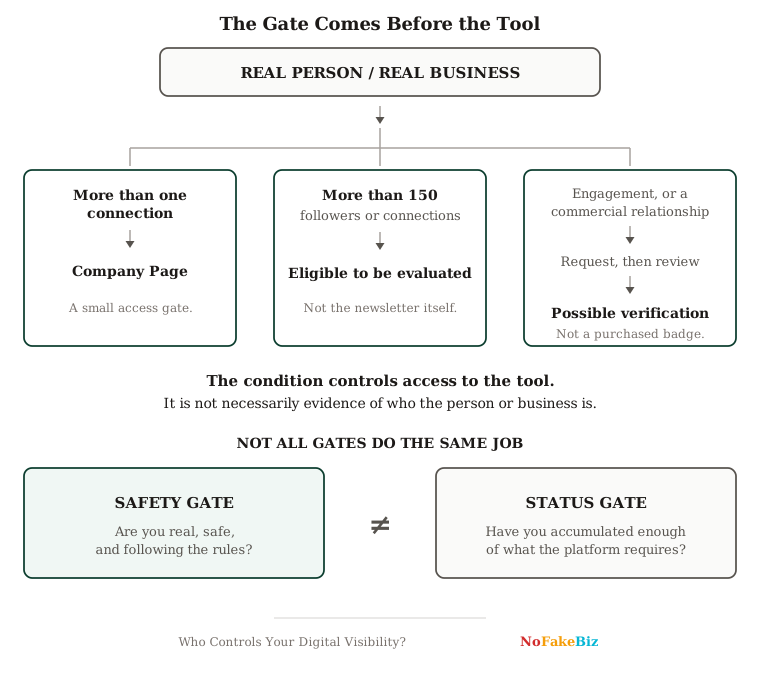
More than one connection can reasonably be read as a small abuse control.
The newsletter rule goes further. A review that looks at community rules can still be read as safety. The number 150 is a different question. Before a Page can even be considered, it must already have an audience on LinkedIn.
Verification raises a different question. A commercial relationship can help make a Page eligible to request the badge. But proof that the organization is authentic comes later, during review. That review asks whether the website belongs to the organization. The commercial product asks, first, whether the organization already has a certain kind of relationship with LinkedIn.
A follower count measures an audience. It does not, by itself, measure skill or trust. A subscription is a relationship with the platform’s business. It is not, by itself, proof of authenticity. LinkedIn’s own review admits that, by still requiring proof. The subscription has already been used to decide who even reaches that proof.
When a platform controls both the gate and the conditions for passing through it, who is the gate really designed to serve?
That question is the one this essay is willing to leave standing. The company page is the case we lived. The newsletter rule, the verification chain, and Medium’s shelves are the same shape, written down in more than one place. Essay 1 did not claim we had replaced Google. This essay does not claim we have abolished every gate, and it does not claim NoFakeBiz has finished a different one. It claims that a gate can be real without being a measure of who the person or the organization is.
What do those numbers actually tell us about the person behind them?
That is the next essay. Not this one.