
Why does your digital visibility still depend on someone else?
You can write the piece. You can open the business. You can put it on a platform that already has a huge audience. And a stranger who was never in that audience may still have to pass through another company before they can find you.
The picture is simple:
Person → platform → Google → reader.
This essay is about one difference. Having a public page online is not the same as being found, understood, and described correctly. Google is the example of a system that stands between those two things.
Imagine you open a real business and create a page for it online. The page exists. The business is real. Someone who searches for that business may still not find it. And even if they do, the search engine may not understand it, or may not describe it correctly.
That is the problem in this essay. Being online is not the same as being found, understood, or represented correctly.
You already did the human part. You published on a platform that already has a huge audience. Substack can email the people who subscribed. LinkedIn can show a post to people who already opened the app. For a huge share of people who are not in that circle, and who go looking through search, another company still sits in the middle.
This essay stays on that middle. Not to attack Google. To ask why your public life has to pass through it at all.
The platform is not the street
A large platform and the open web are not the same room.
Inside the platform, the company that hosts you can reach people who already chose you. That path does not need Google. Outside, there is no public phone book where you sign your name and write the sentence you want the world to use. Google’s own pages describe what happens instead. Its systems visit pages they can find, often because another page linked to them, or because a list of addresses — a sitemap — named them. Indexing means Google tries to understand what the page is about. Only then can the page be shown when someone searches.
Substack says, on its own help pages, that it does work behind the scenes so publications can be indexed and ranked in search engines, while ranking is determined by Google’s concept of creator credibility and the number of links that direct to the site. A writer can set a search title and a short description. Those fields speak to the search engine. They do not command it.
So the strange fact is not that Google exists. People already search there. We want our public pages to be readable by it. The strange fact is the dependence. Platforms like Substack or LinkedIn already have huge audiences, their own apps, their own email, and their own recommendations. A new writer or a new business on them can still be hard to find on the wider web. A second company has to visit the page, try to understand it, rank it, and decide what appears when someone searches.
No platform can order Google to rank a person. That limit is real. It does not answer the question this series is asking. Why should a person’s ability to be seen in public, as themselves, depend on pleasing every system that stands between them and another person?
Three problems hiding in one word
People call the whole chain SEO, and then they stop. The word hides three problems that are not the same.
Discovery. Can the machine find the page?
By machine, we do not mean a chatbot. We mean the search system a person uses when they type a query. In this essay, that system is Google. The same three questions can apply to other search systems. They are not a separate essay about AI.
Understanding. Once it has the page, does it know who you are and what the work is?
Representation. When it describes you to someone else, is the description true?
Suppose you are a plumber in South Bend, Indiana.
Discovery: Can someone find your business?
Understanding: Does the system understand that you are a plumber in South Bend, Indiana?
Representation: Does it describe your business correctly when someone finds it?
Those are three different problems. A sitemap can help the first. It does not guarantee the other two.
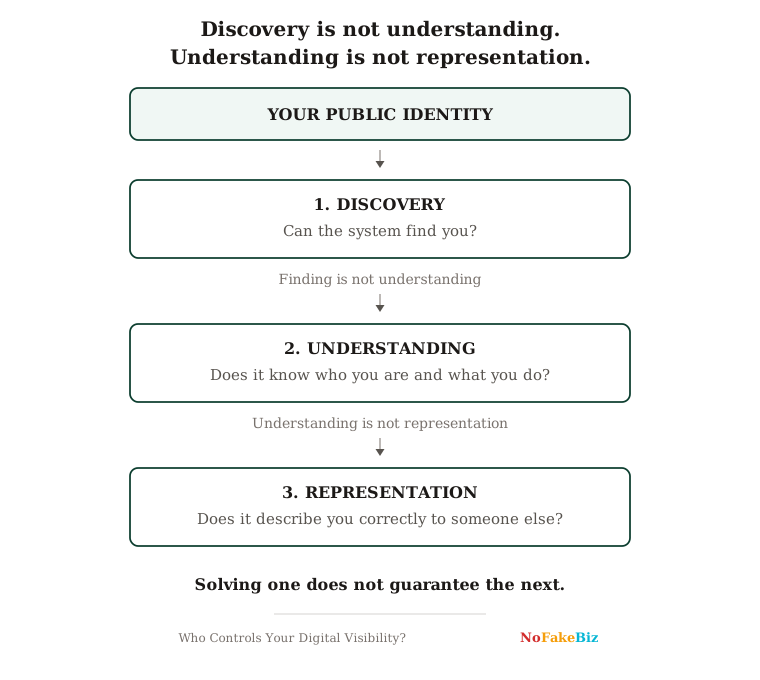
Most practical advice is about the first problem only. Connect a free Google tool called Search Console, so you can see whether Google knows your pages. Send Google a sitemap, which is simply a list of your page addresses. Then ask Google to look at an important address. That advice is fair. If Google never visits the page, it cannot understand the page. A writer can publish on Substack and still have to turn to those Google tools to help Google find the work and keep it. Finding the page is only the first step. The chain continues after that.
We learned the next two steps by living them.
While we were testing NoFakeBiz with Google, “Can Google find us?” was only the beginning.
Google does not ask you who you are. It visits the pages it can reach, reads what is written there, and then writes its own short description for a person who searches. That description is the sentence under the blue link. For nearly three weeks, and through more than six rounds, we would change our own words and the way the pages were organized, then look again. Google could find the site. Being found did not mean the sentence was right. It could not say what NoFakeBiz is. It could not say what we mean by a Digital You, or how that relates to the Digital Chamber of Commerce.
Those wrong sentences were useful, because they showed us mistakes on our own pages that we had not seen. We thought we had said who we were. Google’s description showed that we had not said it clearly enough, or not in a form a search system could keep. Only after those rounds did the description start to match the thing we are actually building.
That is our observation. It is not a case study Google published. A blue link is the clickable result Google shows, with a short sentence under it. We refused to treat that result as proof that Google understood us.
The most important lesson was this. If you do not show the world, clearly, who you are, what you are, and how you want to be presented, someone else will do it for you. That picture can come out in your favor, or against you. You do not get to choose, because you already handed the description away.
That is another reason NoFakeBiz is built so that users take their Digital You into their own hands. They decide how they present themselves, how other people see them, and how a system such as Google is given a chance to understand and describe them. Each time we put our own future, or the future of a business or a brand, in someone else’s hands, it rarely turns out well for us. It is rare that someone else knows you better than you know yourself.
A title and a sitemap can help a machine find you. They do not, by themselves, make the machine tell the truth about you.
Here, the machine is Google. A title helps it notice the page. A sitemap is a list of addresses you hand it. Neither one makes Google describe you correctly. The same risk shows up when an AI answer describes you from pages it can find. The title and the list do not make that description true either.
Search systems assemble a picture from the information they can discover and interpret. If we do not say clearly who we are, the picture is still assembled. It is assembled by someone else, from scraps.
In plain words: if we do not say who we are, the machine still builds a picture of us. It builds that picture from whatever pieces it can find.
What this essay will not settle
Google should remain a road. A useful one. The introduction already said the sentence we will keep: Google can index the public part. That is another door in. It is not the floor.
Google can help people find what you have made public. That door is welcome. It should not be the ground you stand on.
NoFakeBiz cannot control Google either. We are not trying to replace search. The difference we are trying to build is simpler. Your public identity should already have a place where it can be found and understood for what it is.
Take Amir as the example. Amir has an account. That account holds his public identities. Each identity says who that part of Amir is. One may be the person. Another may be a business, a book, a podcast, a video channel, a project, an organization, or a brand. When Google comes to NoFakeBiz, the aim is that it can see which of those belong to Amir, and how they are tied to him, instead of guessing from scattered pages.
NoFakeBiz starts from a different map. Substack begins with publishing. LinkedIn begins mainly with a professional presence. Facebook is closer to a personal and social presence. NoFakeBiz begins with the human being, and lets different identities grow from one private account.
That is why NoFakeBiz does not easily fit inside any one of those models. But those kinds of activity can fit inside NoFakeBiz. Publishing can belong to a content identity. Professional activity can belong to a professional identity. Personal activity can belong to a personal identity. A business, a brand, an organization, a project, a book, a podcast, or a video channel can have an identity of its own.
NoFakeBiz is the platform. Digital You represents the human being and the identities connected to that person. The Digital Chamber of Commerce is the larger environment where those identities can find one another, build relationships, and do business. The three are designed to work together.
The difference is not that NoFakeBiz has more profile types. The difference is where the architecture begins: with the human being, not with one particular kind of platform.
The wider web can still use Google to reach what is public. On NoFakeBiz, Google does not have to be the system that first decides what those identities are, or how they belong to the person. Google can be another way in. It does not have to be the system that gives them meaning.
We are not trying to remove Google from the internet. We are asking why Google should have to figure out who you are in the first place.
This essay does not claim we have built that floor. It claims the dependence is real, and that discovery, understanding, and representation are three separate problems, and solving one does not guarantee the next.
Finding you, understanding you, and describing you correctly are three different problems. Solving the first does not solve the next.
A platform can be excellent at the first door — the people who already follow you — and still leave the second door rented.
The next essay stays on a different gate. Not Google’s rank. The platform’s own rule: you need this, or this many, before you may do that.