
Almost everyone who publishes, sells, or simply tries to be found online runs into the same wall.
You do the human part. You write the piece, open the business, or put your name on something you are willing to stand behind. You place it on a platform that already has a huge audience. And then you discover that the platform is not enough.
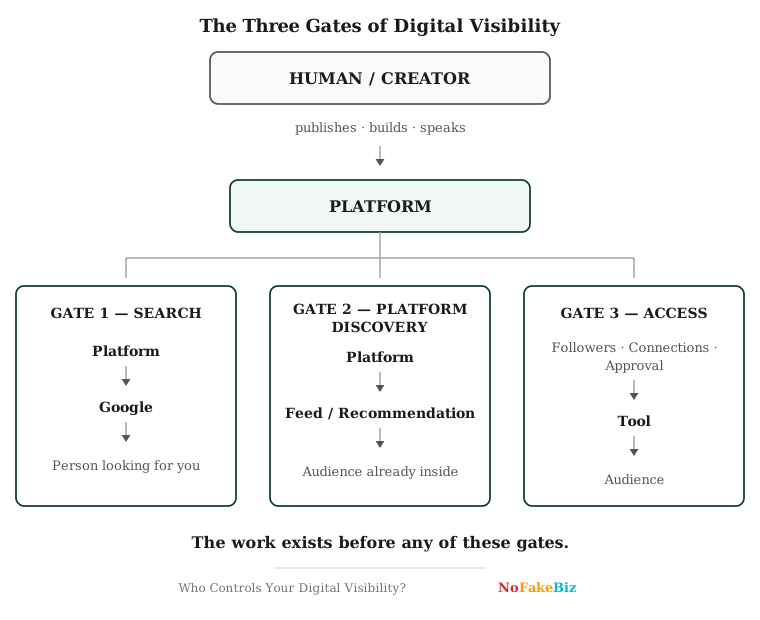
To be found by people who do not already follow you, you still need Google. Or you need the platform’s own feed to decide you are worth showing. Or you need a number — followers, subscribers, a review — before the platform will even let you use the tool that might help.
That third door was one of the main reasons we started building NoFakeBiz.
We kept asking a simple question. Why should followers, subscribers, reviews, impressions, likes, shares, and the rest of those counts be the main test of whether someone can hear about you, see you, or read what you wrote? A person can have millions of followers and say something that has nothing to do with the subject. People still stop and listen, because of the number, not because of the sentence. Another person can write one post, one article, or one short note on Substack or LinkedIn, and have almost no followers — maybe not even two. Almost no one turns to look. The post may be far more worth reading. The number decided first.
This happened often to the founder and CEO of NoFakeBiz. That is why he decided to build a platform where people who do not yet have a loud voice can still be seen and found.
We decided to build a platform that does not work that way. Identity is who you are. Reputation is what people come to know about you from what you have actually done. Those should not have to wait for a crowd.
We ran into that third door ourselves, on LinkedIn.
We had a LinkedIn account for years. We never got from it what we actually wanted. When we started building our own platform, we decided to rebuild that profile on purpose. We wanted to be known for three things: Digital You, the Digital Chamber of Commerce, and NoFakeBiz — the platform, which is also the business and the brand.
Then we tried to promote it. Within a few days the limit was obvious. Without connections, a profile cannot really do the job. People do not see you. You cannot reach them. The page sits there. The work does not travel.
So we tried the next reasonable step. NoFakeBiz is a business. It should have a company page, not only a personal profile. But when we tried to create one, LinkedIn would not let us proceed. The message we saw said the account did not have enough connections. At the time, the account had almost no connections.
Read that as a sequence, not as a complaint. We already had an account. We already had a real business. We already knew what we wanted to be known for. The missing number came before the tool. The tool was how a business introduces itself. Years on the platform had not removed that block. Starting a real company made the block show up faster.
The pattern is so common that we treat it as normal. It is not normal. It is a design.
In plain words: this happens so often that it feels ordinary. It is not ordinary. Someone designed it this way.
This series is about that design. We want to name the problems clearly, say how we see them at NoFakeBiz, and say what we are building instead. We are not writing this to attack Substack, LinkedIn, Facebook, X, Medium, or Google. People use those places because other people are there. We use some of them ourselves, as roads. The question is why the road became the only place a person can live.
A large platform, still waiting on Google
Start with a simple picture.
A person writes something original. They publish it on a major platform. The platform can email the people who already subscribed. It can show the post to people who already opened the app. For a huge share of people trying to discover that work through search, another company still sits in the middle.
Person → platform → Google → reader.
That second step is the strange one. The platform may already have tens of millions of users. It may have its own apps, its own email, and its own way of recommending posts. A new writer on it can still be hard to find. Google has to visit the page, try to understand it, and decide what sentence to show under the link.
There is no public phone book where you sign your name and write the sentence you want the world to use. A search system visits pages, tries to understand them, ranks them, and decides what a search shows.
Substack has said, in its own help pages, that it works behind the scenes so publications can be indexed, and that ranking is still Google’s decision, shaped by links and by what Google treats as credibility. A writer can adjust a search title and a short description. The writer cannot order the result.
So the question is not “does Google matter?” Of course it matters. Billions of people start there. The question is: why do platforms like Substack or LinkedIn — platforms that already have a huge audience — still leave a person’s public life depending on a second company’s ranking? At NoFakeBiz we still cannot make sense of that. It is one of the reasons we are building NoFakeBiz so that a person’s public life does not depend on Google’s SEO, or on any other platform. NoFakeBiz is built to stand on its own two feet.
The same shape shows up elsewhere. Discovery inside the app and discovery through search are two different doors. Most large platforms built the first door carefully. They rented the second one. The later essays will walk through those doors one at a time.
You need this much before you may do that
The second problem sits inside the platforms themselves.
Each one has a rule of this form: you need this, or this many, before you may do that. We met one version when we tried to create the NoFakeBiz company page, as described above. Other platforms write their own versions. You may need a certain number of followers. Someone on staff may have to approve you. The feed may keep you on a smaller shelf. The names change. Being popular, or being chosen by staff, unlocks a tool that the work itself did not unlock.
At NoFakeBiz we kept asking a question about that approval. Who are the people who get to approve or disapprove? Why should they decide about a person, a business, a reputation, a brand, or what someone is allowed to say?
Those are not the same decision. Stopping a fake account, a spam blast, or abuse is one job. Deciding that a real person, a real business, or a real sentence is not worth hearing is another. The first protects people. The second chooses who gets a public life.
Safety is a real job. Spam, fake accounts, and abuse are real. We are not arguing that every door should be unattended.
We are arguing that the size of an audience is not the same thing as identity, trust, reputation, or skill. Identity is who is speaking. Trust is whether someone can rely on you. Reputation is what people say about you because of what you have done. Skill is whether you can do the work. A system that treats the count as the test will keep giving tools to people who already have an audience. It will hold those tools back from people who are trying to be found in the first place.
At NoFakeBiz we do not want that trade. We will still refuse fake identities, spam, and abuse. We will not use “not popular yet” as the reason a real person or a real business cannot be found. How far we already meet that standard, and where we still fall short, belongs to the later essays.
Why the independent home was never built
Here is the third problem, and it is the one that bothers us most.
If this dependence is so obvious, why has no major platform built a home that can stand without Google?
We will not answer that here. Many strangers already search on Google. Ignoring that would be proud and useless. That explains why a platform would want Google. It does not explain why a person’s digital life should have nowhere to stand except Google.
So they built excellent roads and rented rooms. They did not build the house.
“They” means the large platforms — Substack, LinkedIn, and the others named above. The roads are useful. People are already on them. A rented room is a page you can use while you follow their rules. A house is a place that is still yours when you leave the road.
That is not a motive we can prove in court. It is what the products do.
We are not claiming we can prove what those companies intended. We are describing what their products do. NoFakeBiz is our attempt to build the house: a place and an infrastructure where a person’s public life can stand without depending on Google, or on any of those platforms, for the ground under it.
How we see the person on NoFakeBiz
The Digital You essays asked what it means for a human being to exist online. The short version we are building on is still this. There is one real person. That person has a private account. Through that account they choose public identities — a person, a business, a book — instead of one profile that mixes everything. The Digital Chamber of Commerce is the place where those identities can be found by what they are. NoFakeBiz is where we are building that.
The comparison we care about is where the user stands.
On the platforms above, the user is a guest in someone else’s system for being found. They may publish. They may even build an audience. The audience, the rank, and often the right to the next tool stay with the host.
On NoFakeBiz, the user should be able to stand on something that is theirs. Google can index the public part. That is another door in. It is not the floor.
Google can help people find what you have already made public. That door is welcome. It should not be the ground you stand on.
We have not finished proving that. We are stating the standard. The later essays have to hold us to it, including where we still fall short.
What comes next
The internet gave people platforms on which to exist, but it never gave the human being an infrastructure from which to exist independently of those platforms.
In plain words: the internet gave us places to post, build an audience, and be seen. But those places still belong to someone else. They can change the rules, decide how we are found, and decide which tools we can use.
We think people need something more permanent: a digital place where who you are does not begin with how many people already follow you.
That is the problem this series will examine.
The next essay starts with the first question:
Why does your digital visibility still depend on someone else?