
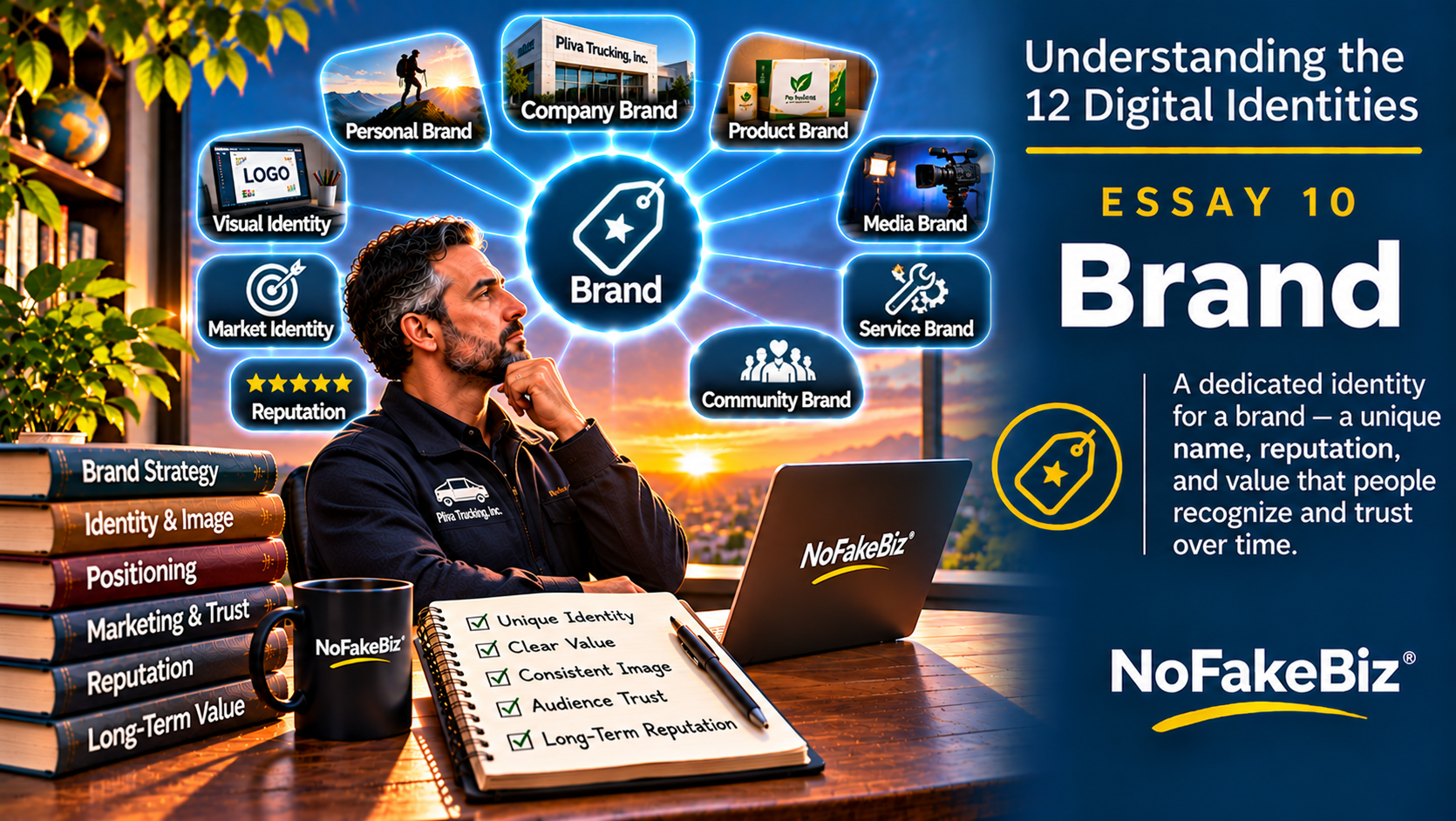
People often recognize a name long before they know the complete story behind it. They hear it in conversation, see it on a product, encounter it in a video, or associate it with a particular person or company. Over time, that name begins to mean something to them. It may represent quality, creativity, reliability, entertainment, experience, or simply something familiar. Sometimes the name becomes so recognizable that people know it without knowing much about the person, business, or organization behind it.
This is why I believe Brand deserves its own Digital Identity on NoFakeBiz. A brand is not necessarily the person who created it, the company that owns it, or the product that carries its name. It is the recognizable name and the meaning people have come to associate with it. Brand Identity is intended to give that name its own public place, where people can discover what it represents, what is connected to it, and what is communicated under that name.
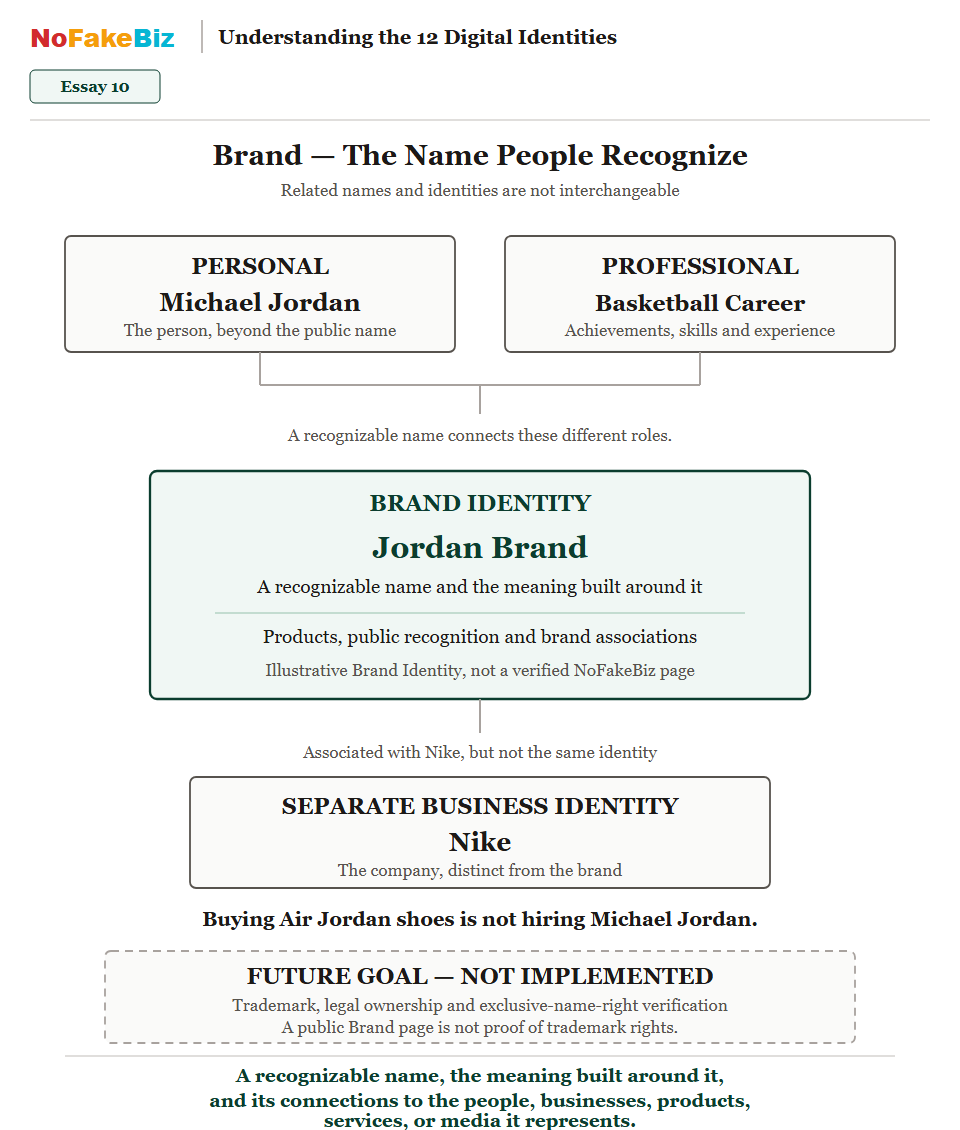
Consider Michael Jordan or Madonna. There is the human being, with a personal life that exists beyond public attention. There is also the public work that made the name recognizable: Michael Jordan as a basketball player, Madonna as a performer. But the name developed another dimension. It became a recognizable commercial identity associated with products, advertising, and an image that extended far beyond the court or the stage.
Then there is Jordan Brand, the well-known brand associated with Nike. It has its own products, visual identity, and commercial presence. Someone purchasing a pair of Air Jordan shoes is not personally hiring Michael Jordan to play basketball, nor are they necessarily interested in every part of his private life. They are purchasing a product connected to a brand whose name carries a particular meaning.
These identities are related, but they are not interchangeable. Michael Jordan as a person, his professional career, his personal public name, Jordan Brand, and Nike as a business represent different things. One name may connect them, but each has its own role. This is exactly the kind of distinction I want people to understand when they encounter Brand Identity on NoFakeBiz.
The same principle applies to companies and their products. Consider Mercedes-Benz. People recognize the name, the three-pointed star, and the automobiles associated with it. Behind that recognition are business operations, products, services, employees, and a long commercial history. But the brand itself is what many people immediately recognize when they see the symbol or hear the name.
A person may be interested in the Mercedes-Benz brand without wanting to learn about every business operation of the company behind it. Someone else may be interested in a particular vehicle model, while another person may want to know more about the manufacturer. Those interests overlap, but they are not identical. A Business Identity represents the business itself, while a Brand Identity represents the recognizable name and the public meaning associated with it. A particular product may also have its own recognizable brand, even when it belongs to a much larger company.
This distinction becomes even clearer when we look at companies that manage several brands. A single business may develop different product lines, each with its own name, audience, reputation, and history. Customers may know one brand very well without recognizing the name of the parent company. In other cases, a company's name and its main brand may be almost identical. That does not eliminate the conceptual difference between the business carrying out commercial activities and the brand through which people recognize its products or services.
Brands are not limited to physical products or large corporations. They also exist in entertainment, publishing, and other forms of media. Consider The Joe Rogan Experience. It is a recognizable name associated with a particular podcast and its host. Joe Rogan is a person with his own life and professional activities, while the show has a name, an audience, a history, and a recognizable public presence.
The show can be understood as a media brand, while Joe Rogan's public name can also function as a personal brand. Someone may follow the podcast because they enjoy its conversations without being interested in everything its host does outside the program. Another person may recognize Joe Rogan from his other professional activities without regularly listening to the show. The person and the media property are connected, but they are not the same identity.
This is also why NoFakeBiz has separate Podcast and Brand categories. A Podcast Identity represents the podcast as a form of published media, including its episodes and related content. A Brand Identity represents the recognizable name and the public meaning developed around it. A podcast may have a brand, just as a book, a video series, or a company may have one. The categories describe different aspects of something that can be connected without being treated as identical.
I do not want Brand Identity to be understood as something reserved for celebrities or multinational companies. A small business can develop a recognizable brand within one neighborhood or county. Imagine a family bakery that becomes known for a particular product. Customers may begin asking for that product by name, recommending it to friends, or recognizing its packaging before they know much about the bakery itself. The business may remain small, but the name associated with its product has begun to develop its own recognition.
A local craftsman, designer, musician, writer, or independent creator may experience something similar. Their work may become known under a particular name that people recognize and follow. Sometimes that name is the person's own name. Sometimes it is a name created for a product, service, publication, or creative project. The audience may be small, but recognition does not have to be worldwide to be meaningful. A name that matters to a few hundred people in one community can still function as a brand.
This brings us to an important distinction between a brand and the thing it represents. A brand does not replace the underlying person, business, product, or media property. It gives people a recognizable way to identify and understand it. A company may own several brands, while a person may be associated with more than one recognizable public name. A brand may also be used across several products or services. These relationships can become complicated, especially when businesses grow, ownership changes, or different parties become involved.
For NoFakeBiz, I see five useful forms of Brand Identity: a personal brand, a company brand, a product brand, a service brand, and a media brand. These are different ways a recognizable name may be used, not five additional Digital Identity categories beyond the twelve. The purpose is to help people understand what kind of name they are encountering and how it relates to the person, business, or other identity behind it.
There is also a difference between using a name publicly and having the legal right to control it. A recognizable name may be protected by trademarks or other rights, and ownership may belong to a person or a company. Creating a Brand Identity on NoFakeBiz should not automatically establish trademark ownership, legal authorization, or an exclusive right to use that name. Those questions require appropriate evidence and, where necessary, legal verification. The public identity is intended to represent the brand, not to replace the legal systems that determine rights to it.
Another important consideration is that a brand's meaning is not created entirely by the person or company behind it. A business may want its name to represent reliability, but customers develop their own opinions through experience. A creator may want a public name to represent creativity, while audiences may associate it with particular works or ideas. The owner can explain what the brand is intended to represent, but public recognition and reputation develop through the relationship between the name and the people who encounter it.
I think this distinction is important because we often speak about brands as though they were simply logos or marketing campaigns. A logo can help people recognize a brand, but the brand is more than the symbol. It is the name, the associations people develop around it, and the history of what has been communicated or offered under that name. Two products may look similar, yet people recognize and respond to their brands differently because of the experiences and expectations connected to them.
On NoFakeBiz, Brand Identity is intended to give that recognizable name a public place of its own while maintaining meaningful connections to the other identities involved. A company can have its Business Identity and a separate Brand Identity. A person can have a Personal Identity, one or more Professional Identities, and a brand associated with their public work. A podcast or other media property may develop a brand that people recognize independently of the individual episodes or publications.
These connections should help people understand what they are looking at without requiring every name, product, profession, and activity to be placed on one page. The person remains a person. The business remains a business. The product or media property has its own purpose. And the brand represents the recognizable name that people associate with those activities.
I hope that one day NoFakeBiz itself becomes a widely recognized brand. Not simply because people have seen its name or logo, but because the name comes to represent something meaningful to them: a place where people, businesses, organizations, and their different Digital Identities can be represented clearly and connected without losing what makes each one distinct.
That kind of recognition cannot be created merely by declaring that a name is important. It has to develop through what the platform actually does, the experiences people have with it, and the trust it earns over time.
That is what Brand Identity is meant to represent on NoFakeBiz: a recognizable name, the meaning built around it, and its connections to the people, businesses, products, services, or media it represents.
---
AMIR BASIC
Founder & CEO, NoFakeBiz
ABOUT THIS SERIES
Understanding the 12 Digital Identities is a connected series about the ideas behind NoFakeBiz. Each essay explores one part of the larger picture. For a complete understanding, we recommend reading the entire series, beginning with the Introduction.
PREVIOUS ESSAY
Project — Giving Every Idea and Effort Its Own Place
NEXT ESSAY
Blog — A Home for Your Writing and Ideas
READ THE COMPLETE SERIES