
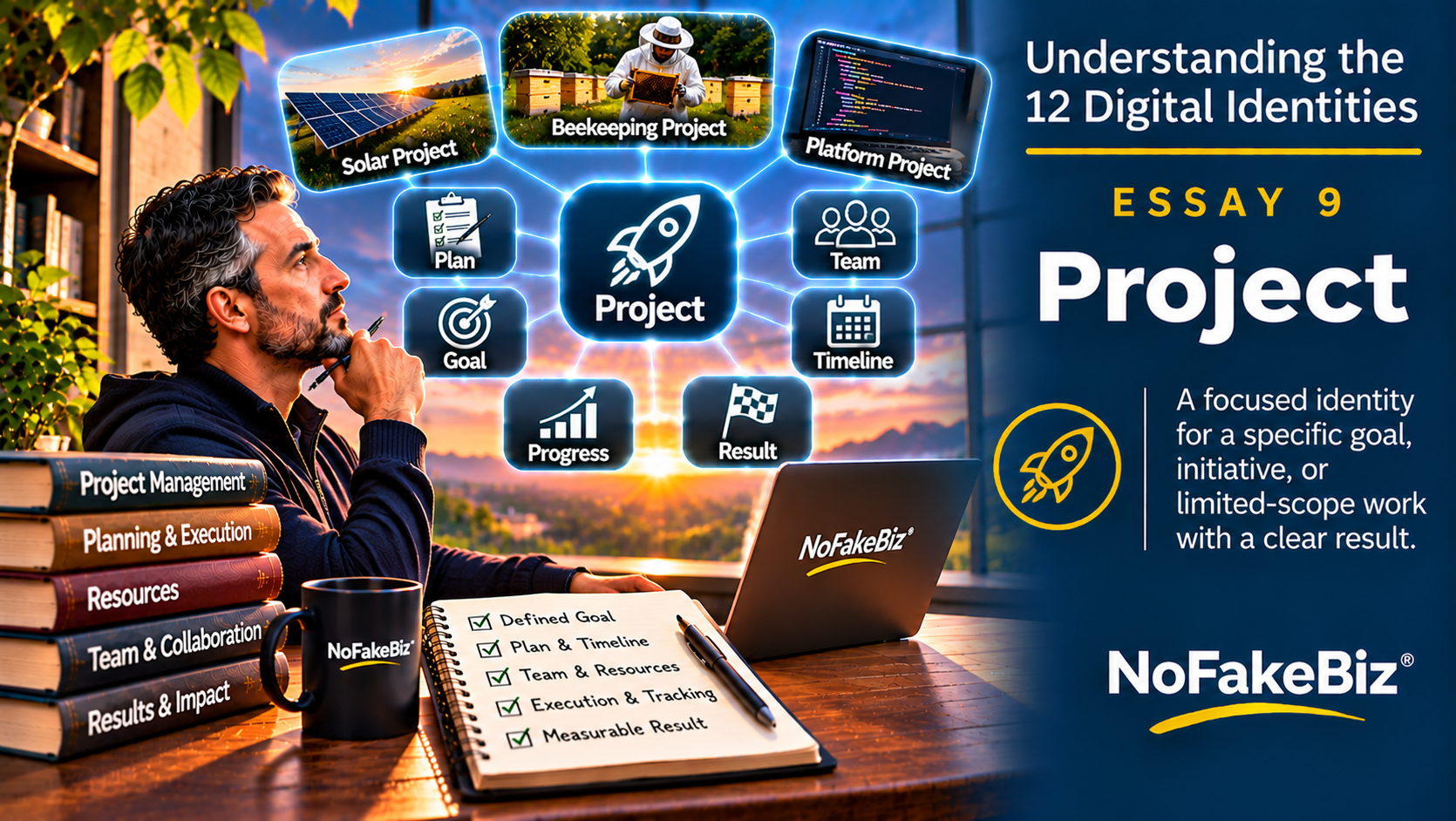
In my twenties, I found myself working on several projects at the same time. They were not all connected to my regular work, and they were not simply different chapters of the book I was writing. Each project had its own purpose, its own problems to solve, and its own direction. Sometimes I would spend time developing one idea, then turn to another that required completely different thinking. Although I was the same person working on them, the projects themselves were not the same. I began to realize that each one needed a place of its own, where its purpose, progress, and history could be presented without being mixed with everything else I was doing.
That experience helped me recognize why Project should be one of the Digital Identity categories on NoFakeBiz. A project is a particular effort directed toward accomplishing something. It may begin with an idea, a problem someone wants to solve, something people want to create, or a change they hope to bring about. It can involve one person, a small team, a business, an organization, or an entire community. What gives it a separate identity is the work itself: the goal people are pursuing and the activities connected to that goal.
Imagine someone developing a new invention. At the beginning, there may be nothing more than an idea, a few drawings, and experiments carried out in a garage. The person may already have a job, a profession, and a personal life, but the invention is a separate undertaking. As the work develops, other people may become involved, prototypes may be built, problems may appear, and the original idea may change. A Project Identity would give that undertaking a public place where interested people could understand what is being developed, why it matters, and how the work is progressing.
Now consider something completely different: a group of neighbors wants to restore an abandoned public space. They may need to speak with local officials, organize volunteers, gather resources, and develop a plan. The people involved have their own lives and responsibilities. Some may own businesses, some may belong to local associations, and others may simply care about their neighborhood. The project brings them together around one particular goal. It is not the personal identity of the neighbor who first suggested the idea, and it is not automatically a new organization. It is the work they have decided to pursue together.
This distinction becomes important when we compare Project with the other identities we have already discussed. A Business Identity represents a business and its ongoing commercial activities. An Organization Identity represents an institution and the mission it carries out. An Association Identity represents people brought together by a shared interest or purpose. A Government Identity represents a public institution and its responsibilities. Any of these may participate in a project, but the project itself is a particular undertaking with its own objective, activities, and history.
For example, a city may plan to build a new public park. The government office responsible for the work has its own identity and public responsibilities. A construction company involved in the project has its own Business Identity. A neighborhood association may support the effort, while residents may contribute ideas or raise concerns. But the park project is something distinct from all of them. It has a location, a purpose, plans, participants, and a series of developments that people may want to follow. Someone interested in that park should be able to find information about the project itself without having to reconstruct its history from the separate pages of every institution involved.
A Project Identity should help answer a few basic questions. What is this project trying to accomplish? Why was it started? Who is involved? Where is the work taking place? What has been done so far, and what remains? How can someone learn more, offer help, or follow its progress? Not every project will need to publish all of this information, and some work may need to remain private until the people responsible are ready to share it. But when a project is presented publicly, its identity should make the purpose of the work understandable.
One of the things I find particularly important is that a project has a history even before it is completed. People often see the final result without knowing what happened along the way. They may see a finished building, a published piece of software, a community garden, or a new product, but not the problems that had to be solved, the ideas that were rejected, or the work that changed direction. A project develops through decisions, attempts, mistakes, improvements, and sometimes unexpected discoveries. That process can be meaningful in its own right.
And not every project succeeds. Some are completed exactly as planned, while others take longer, change direction, or never reach their original goal. A person may spend years trying to develop something and eventually decide that it is not practical. A community project may lose funding. A technical project may reveal that the original approach does not work. Those outcomes do not mean that nothing happened. People may have learned something valuable, developed useful knowledge, or discovered a better way forward. The history of the attempt should not automatically disappear simply because the project did not produce the result everyone hoped for.
This is one reason I do not think Project Identity should be understood as nothing more than an announcement or advertisement. An announcement tells people that something is happening. A Project Identity is intended to represent the undertaking itself, including its purpose and the history that develops around it. A project may be active, completed, delayed, or discontinued, but it can still be recognized as the same project. The work may end, yet the record of what was attempted can remain meaningful.
Another important point is that one person may have many projects. That was part of my own experience. I could be working on one idea related to technology, another related to writing, and a third involving something entirely different. They might share the same creator, but that does not make them one project. Each has its own purpose and deserves to be understood on its own terms. The fact that the same person is involved should create a connection between the projects, not force them into a single public identity.
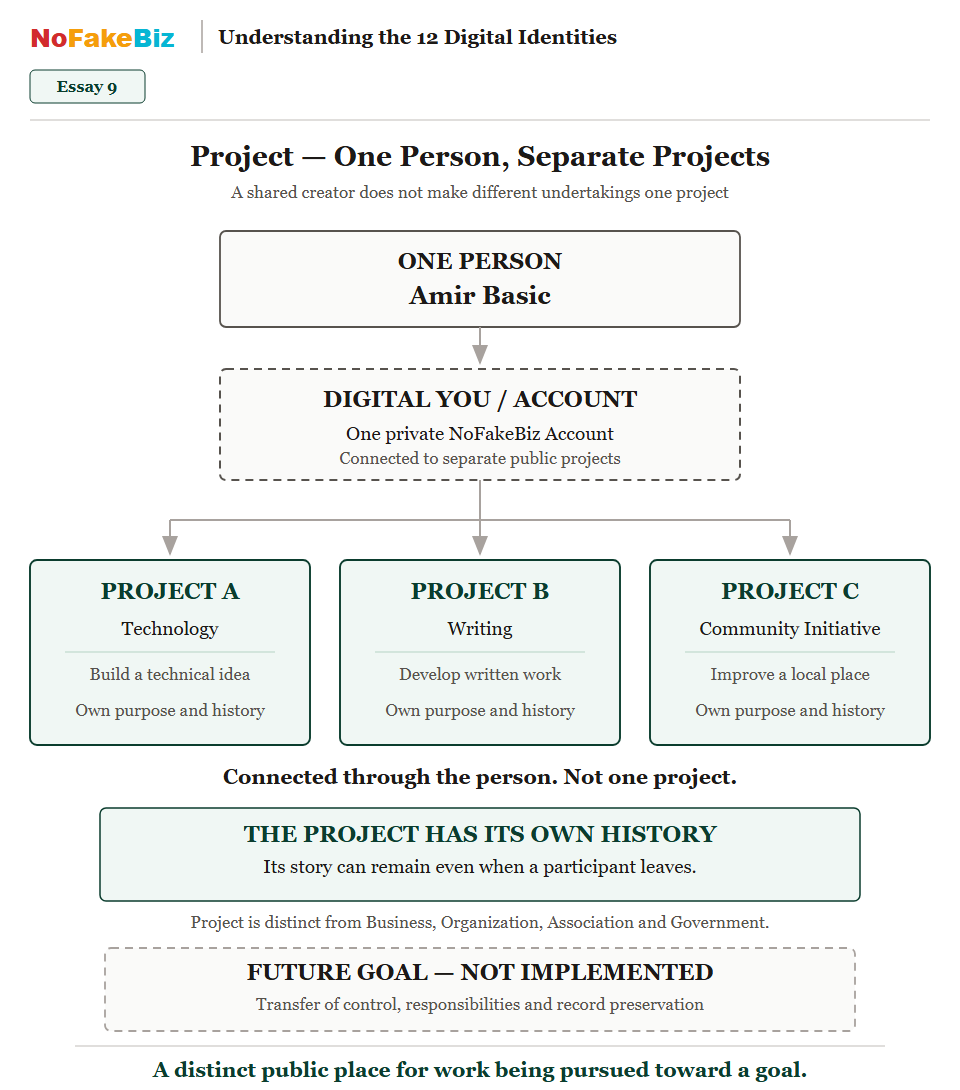
The same applies when several people work together. A project may begin with one person's idea and gradually attract collaborators. Someone may contribute technical knowledge, another may help organize activities, and someone else may provide resources or practical experience. Each participant remains a separate person, with their own Personal and Professional Identities where appropriate. A participating business or organization also retains its own identity. The project is the common work that connects them for a particular purpose.
Over time, the people involved may change. Someone who helped start the project may step away, while others continue the work. A project may be taken over by a team or become part of a larger institution. The goal is for its public identity and history to remain understandable through those changes, rather than forcing the work to begin again under a different personal profile. The complete rules for transferring control, assigning responsibilities, and preserving records are still part of the longer-term development of NoFakeBiz, but the underlying principle is important from the beginning.
Project Identity also fits naturally with the geographic structure of NoFakeBiz. Some projects are connected to a particular neighborhood, town, or county. A new playground, a community garden, a local restoration effort, or an improvement to a public space matters especially to the people who live nearby. Other projects may have no single geographic center. A software project, research effort, or creative collaboration may involve people in several states or countries. The identity should represent the project according to the nature of the work, rather than assuming that every undertaking must belong to one location.
I think about how often people hear that something is being planned in their community but have difficulty finding out what happens afterward. A project may be announced, discussed for a while, and then disappear from public attention. Was it completed? Was it postponed? Did the plan change? Is someone still working on it? A clearer public identity for the project could help people understand its development, provided the people responsible choose to publish reliable updates. NoFakeBiz is not yet claiming to offer a complete project management or public accountability system. The idea is to establish a distinct public identity around which such information and relationships can develop.
The same principle can help someone working alone. A person with a promising idea may not be ready to form a company, establish an organization, or present the work as a finished product. They may simply be trying to build something. Project Identity gives that effort a conceptual place of its own without requiring it to pretend to be a business or an institution before it has become one.
Looking back at the different projects I was working on in my twenties, I can see why this distinction mattered to me. I was one person, but I was not working on one thing. Each effort had a different purpose, and I wanted people interested in one project to be able to understand it without sorting through all the others. The projects were connected through me, but they were not interchangeable.
A project may begin as a simple idea and eventually become something much larger. It may succeed, fail, change direction, or inspire another project. Whatever happens, it represents an effort to accomplish something, and that effort has a story worth keeping separate from the other activities of the people involved.
That is what Project Identity is meant to represent on NoFakeBiz: a distinct public place for work being pursued toward a goal, connected to the people and institutions involved without losing its own identity.
---
AMIR BASIC
Founder & CEO, NoFakeBiz
ABOUT THIS SERIES
Understanding the 12 Digital Identities is a connected series about the ideas behind NoFakeBiz. Each essay explores one part of the larger picture. For a complete understanding, we recommend reading the entire series, beginning with the Introduction.
PREVIOUS ESSAY
Government — Connecting Public Institutions with the People They Serve
NEXT ESSAY
Brand — The Name People Recognize
READ THE COMPLETE SERIES