
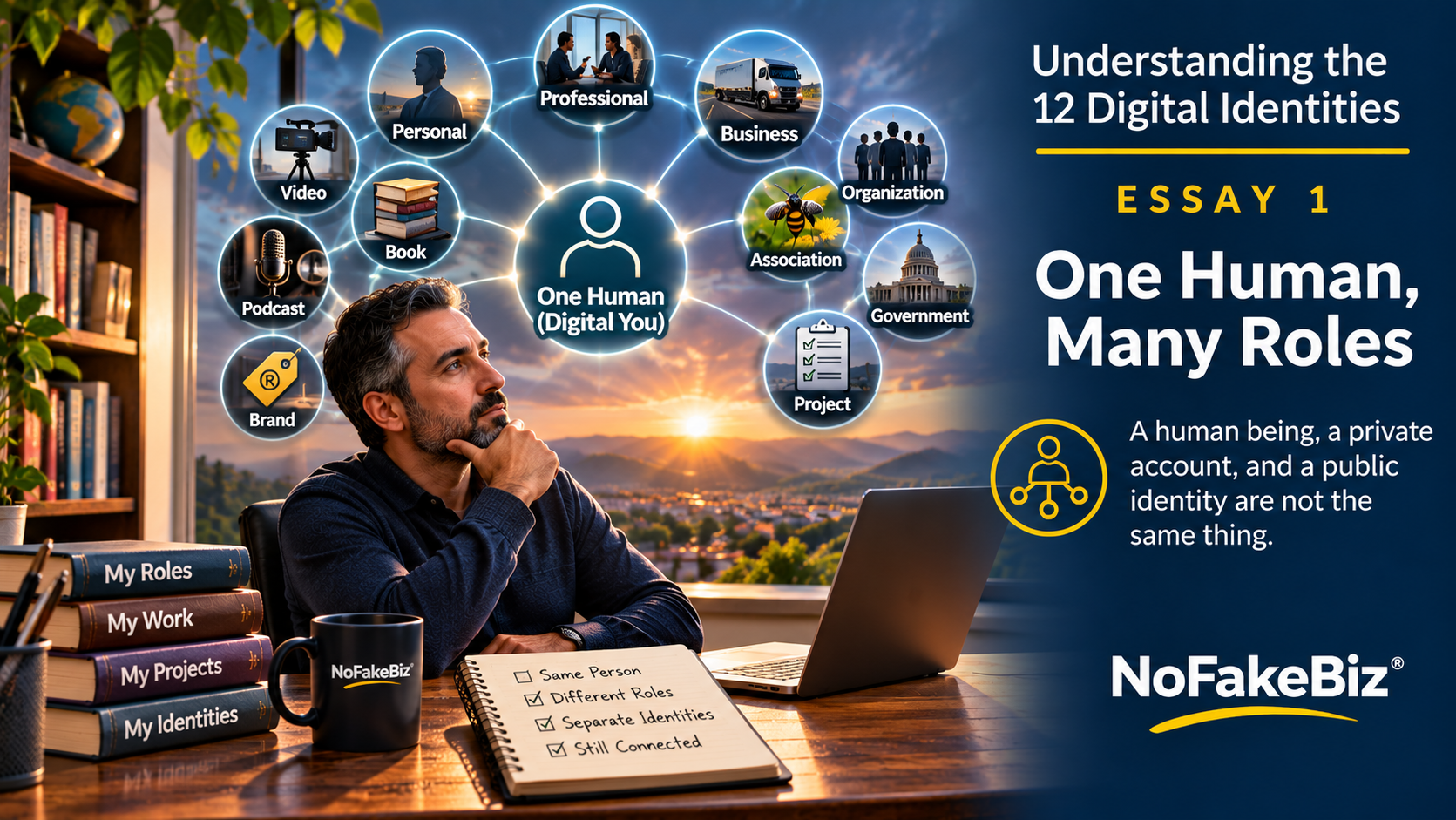
People often treat several different things online as if they were one thing. But they are not. There is the human being, the Account, and the public Digital Identities. To understand NoFakeBiz, we first need to understand the difference between these three.
The human being comes first.
That is the real person, the one who exists whether the internet exists or not. In my case, it is Amir Basic, the same person who arrived in the United States at seventeen, went to school, worked, and eventually began building NoFakeBiz. The human being is not a login, a username, or a profile.
Then comes the Account.
This is where NoFakeBiz takes a different approach from platforms such as X, Facebook, LinkedIn, Reddit, Substack, Medium, and YouTube.
Those platforms serve different purposes. Some focus on personal connections, others on professional networking, publishing, discussions, or video. You register, create a profile or channel, and use the services that platform provides. But when you want to do something different, you often have to move to another platform, create another account, and build another presence.
NoFakeBiz starts with a different question: What if one person could bring the different parts of their life together without forcing them into one public profile?
When you register on NoFakeBiz, you create one Account. It is your private space within the platform, where you manage your information, settings, and the different parts of your digital life. This is the foundation of what we call your Digital You.
Your Digital You is not another human being. It is you, represented within NoFakeBiz, with the ability to manage the different public roles you have in real life. Your private information stays within the Account unless you choose to make particular information public.
Let me use myself as an example.
When I register as Amir Basic, I do not need to choose whether I am joining as a private person, a professional, a business owner, or a writer. I am already all of those things in real life. My Account gives me one place from which to manage them without pretending they are all the same thing.
That brings us to the public Digital Identities.
From one Account, you can create different public identities for different purposes. My Personal Identity represents me as a person. My Professional Identity represents my knowledge and professional work. Pliva Trucking has its own Business Identity. A book I am writing can have its own Book Identity.
Each identity has its own public place, its own purpose, and its own information. But they can remain connected through the same Account.
I do not become four different human beings because I have four different roles. And I do not need four separate NoFakeBiz accounts to represent them.
One human being. One Digital You. Many Digital Identities. Separate, but still connected.
Why the Numbers Matter
Every person has a name, but names alone are not always enough to find the right person. Thousands of people can share the same name, and even when a name is unique, it may be difficult for someone else to spell or pronounce. I have experienced this many times in the United States, where people from different countries speak different languages and bring names from different parts of the world. Sometimes, during an ordinary phone conversation, I would spend more time trying to understand or write down a name, an email address, or a business address than discussing the reason for the call. One misunderstood letter could send me looking for the wrong person or business, or leave me unable to find them at all, because I was no longer sure which word I had heard.
I kept thinking there had to be a simpler way. What if, instead of spelling names and addresses back and forth, two people could exchange a number and immediately find the right public information? That question became one of the reasons I introduced unique identification numbers into NoFakeBiz.
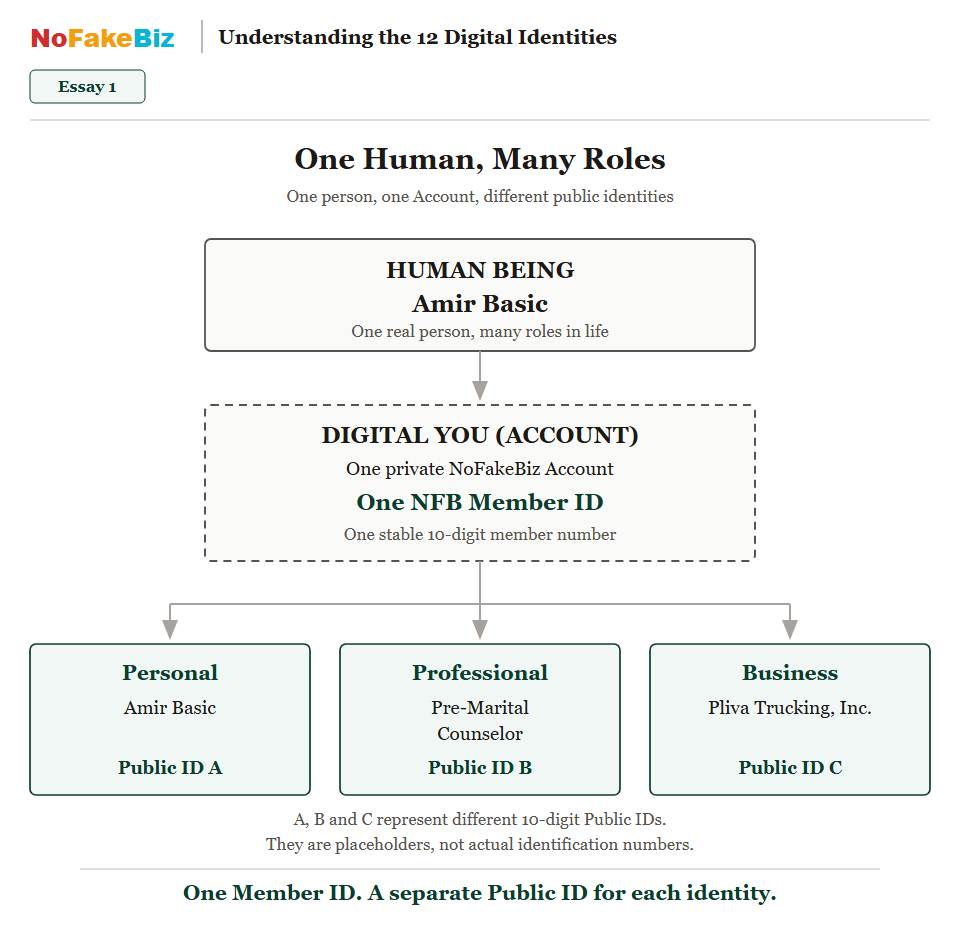
When someone registers on NoFakeBiz, the platform assigns their Account a permanent ten-digit number called the NFB Member ID. This number belongs to the Account, not to a particular profession, business, or other public role. It stays with the member as their life changes. They may change careers, open another business, write a book, or begin several projects, but they do not need a new Member ID for each of those activities.
The purpose of this number is simple. If someone wants to find me on NoFakeBiz, I can give them my ten-digit Member ID instead of asking them to spell my name or search through dozens of similar profiles. They enter the number and open my public member profile, where they can discover the Digital Identities I have chosen to make public. The Member ID is not a password or a secret. It is a public reference number that helps someone find the right member without confusion.
But finding a person and finding a particular part of that person's life are not always the same thing. Someone may not be looking for Amir Basic as an individual. They may be looking for Pliva Trucking because they need transportation services, or for a book I am writing because they are interested in its subject. Those are different public identities, and each needs to be found independently.
That is why NoFakeBiz gives every public Digital Identity its own unique ten-digit Public ID, including Personal and Professional. I have one Account and one Member ID, but my Personal Identity has its own Public ID, my Professional Identity has another, and Pliva Trucking has a separate Public ID as a business. They can all be connected through my Account without losing their individual identities.
This gives people two ways to find what they need. Someone who knows my Member ID can open my public member profile and explore the identities connected to me. Someone who knows the Public ID of Pliva Trucking can go directly to that business, without first searching for Amir Basic. The same principle applies to a professional, a book, a project, an organization, or any of the other Digital Identity types.
I also wanted this system to work beyond one country or one language. A name written in Arabic, Chinese, Russian, or another writing system may be difficult for someone unfamiliar with that language to enter correctly. Ten digits are much easier to exchange. People do not have to speak the same language or know how to pronounce each other's names to find the public identity they are looking for.
The distinction is simple: the Member ID identifies the member's Account, while the Public ID identifies one particular Digital Identity. The numbers do not replace names, and they do not turn one person into several people. They simply give every member and every public identity a clear, consistent way to be found.
One human being can have many roles in life. NoFakeBiz allows those roles to remain connected while giving each one its own public identity, its own number, and its own place.
A Person Is More Than a Job Title
One of the reasons I started building NoFakeBiz is that I grew tired of being asked to present myself as something smaller than I really am. I am Amir Basic, one human being with different experiences, interests, responsibilities, and professions. But when I go to LinkedIn, I feel as though I have to choose which part of my life should represent the whole person. Should I present myself as a web developer, a premarital counselor, a business owner, or a writer? Which one is supposed to be the most important? And why should choosing one mean that the others become less visible, when all of them are part of the same life?
This is not just a question about how a profile looks. It is about what happens when a platform encourages people to organize their public lives around one professional identity. LinkedIn was built primarily for professional networking, and I understand that purpose. But a person does not stop being a person when they open a professional profile. We do not leave our other knowledge, interests, or experiences at the door when we go to work. I may have five, seven, or ten different roles in my life, and I should not have to pretend that only one of them matters.
While writing these essays, I came across a post discussing LinkedIn engineers, its recommendation algorithm, and the relationship between what people put in their profiles and the content they publish. I cannot independently confirm every claim made in that post, but it raised a question I had been asking for years: what happens when a platform's system begins influencing not only what people see, but also how people describe themselves? If users believe their posts will reach fewer people unless their profile matches a particular subject, they may begin rewriting their biographies, narrowing their interests, or presenting themselves differently just to satisfy what they think the algorithm wants.
Think about the amount of time people spend trying to understand these systems. They change headlines, rewrite descriptions, adjust their posts, follow advice from supposed experts, and try to guess what will work this week. Then the recommendations change, and they may feel they have to start all over again. How much time, energy, and money does that consume? More importantly, why should a person have to reorganize the story of their own life every time a platform changes the way it distributes content?
Let me give you a simple example from my own life: Bosnian grah, a traditional Bosnian bean stew, the dish I grew up eating.
Suppose one afternoon I decide to write about how I learned to cook grah. Maybe I want to share a recipe, explain how my mother prepares it, or tell a story about the food we ate growing up. What does that have to do with my professional title? I may be a web developer, a premarital counselor, or the owner of a trucking company, but I am also a man who knows how to cook a pot of beans. That knowledge does not disappear because I have never worked as a professional cook.
Now imagine that a platform gives greater visibility to content that closely matches the professional subject of a person's profile. Under that kind of system, my story about grah might be considered less relevant to the audience associated with my professional work. I am not saying LinkedIn has a rule that forbids me from talking about cooking, or that every post about food will be hidden. My objection is to the larger idea that a person's professional label should become the main measure of what they are expected to know, discuss, or contribute.
Just think about how strange that is. A child can understand that the same man who builds a website can also cook dinner, raise a family, write a book, and run a business. Why should the digital world have such difficulty making room for something that is completely normal in real life? A job title tells you something about a person, but it does not tell you everything that person knows.
This is where the difference in NoFakeBiz becomes practical rather than theoretical. I do not need to squeeze all my interests and responsibilities into one public identity. If I want to share how I make Bosnian grah, I can open my Personal Identity and write about it there. People interested in that side of my life can follow it. My Professional Identity can continue representing my professional work, and Pliva Trucking can continue representing the business. Nothing about those identities needs to change because I decided to write about beans.
And here is the question that has bothered me for a long time: Who the hell are these platforms, their engineers, or the companies behind them to decide which parts of my life deserve to be seen? They may design the systems through which information travels, but they do not know everything about the people using those systems. They do not know everything I have learned, everything I have done, or why I may have something worthwhile to say about a subject that does not appear in my professional biography.
I have lived in America for almost thirty years, and I have met people with all kinds of skills that no diploma or job title could fully describe. My mother has been cooking Bosnian grah for more than sixty years. She does not have a culinary degree, and she does not need one. If I want to learn how to make that dish properly, I would rather learn from her than from a highly educated engineer or chief executive who has never cooked it. Their degrees may qualify them to do remarkable things in their own fields, but those degrees do not make them authorities on everything else.
That is the point I want people to understand. A person's knowledge is not limited to the title written on a profile. Real life does not divide us into neat categories where an engineer may speak only about engineering, a counselor only about counseling, and a cook only about food. We learn, work, create, and experience many different things throughout our lives.
I did not create the twelve types of Digital Identities because I wanted to divide people into twelve boxes. I wanted to give the different parts of their lives room to exist without forcing them to compete for space on one public page. The identities can remain separate where separation makes sense, and connected where the relationship matters. The human being behind them remains the same.
Now imagine that you are working on NoFakeBiz under your Professional Identity. You may be writing about your profession, answering questions, or preparing something related to your work. Then you remember that you wanted to share how you make Bosnian grah, or perhaps write about something else from your personal life. You do not need to sign out, open another account, or change anything about your professional profile. You simply switch from Professional to Personal and continue writing. The platform already supports switching between your identities. When you are finished, you can return to Professional and continue your work. The recipe belongs to your Personal Identity, while your professional work remains under Professional and your business activities remain under Business. All of them are managed through the same Account, without turning that private Account into a public profile.
This also helps explain something important about the number twelve. NoFakeBiz has twelve types of Digital Identities, but that does not mean a member is limited to twelve identities. Think about your own life. You may own two businesses, work on three different projects, or write several books. Each business, project, or book may need its own public identity, even though they belong to the same category. The twelve types describe the different kinds of public roles and activities that NoFakeBiz is designed to represent. They are not twelve empty boxes that you are allowed to fill only once.
Personal and Professional, however, have a special relationship to the human being behind the Account. My Personal Identity represents me as Amir Basic, while my Professional Identity represents me and my professional work. They are different public identities, but both remain connected to the same person. Unlike a business that may change ownership or a project that may be handed over to someone else, my Personal and Professional identities cannot simply be transferred to another person. If I stop working in one profession or begin another, I am still the same human being. My professional life may change, but that does not turn me into someone else.
Why the Number Exists
The United States is a country where people from almost every part of the world live and work together. They bring different languages, accents, names, and ways of writing those names. I have experienced this throughout my life here, especially in business. Many times, during an ordinary phone conversation, I needed someone to give me a name, a business address, or an email address. In my own experience, I would write something down incorrectly more than eight times out of ten. Sometimes it was a single letter, sometimes a number, and sometimes a name I simply could not understand. What should have been a simple exchange of information became another problem that needed to be solved.
Over the years, I kept asking myself why we were still doing things this way. If two businesses need to exchange information, why should one person have to dictate the company name, street address, email, phone number, and everything else while the other person struggles to write it all down correctly? What if the entire exchange could begin with just ten digits? One business gives the other its Public ID, and the person receiving it enters that number on NoFakeBiz to find the business and the information it has chosen to make public. No spelling mistakes, no guessing how to pronounce a name, and no need to repeat the same address three times.
Now imagine that the conversation is taking place between people in different countries. I do not read Chinese, Arabic, Japanese, Korean, or Russian, and I certainly cannot pronounce every name written in those languages. But I do not need to. Ten digits can provide a common way to look up a public identity, regardless of the language its owner speaks. The name may be unfamiliar, and the writing system may be completely different from mine, but the number gives us a starting point that both sides can use.
This is one of the ideas behind NoFakeBiz that matters most to me. Today, a logged-in member can already enter another member's NFB Member ID and open that person's public member profile, including the public identities the member has chosen to show. The larger goal is to make it just as straightforward to find a particular business, organization, book, project, or other public identity directly through its own Public ID, with the information its owner has made available. I want a person on one side of the world to be able to exchange a number with someone on the other side and find the right public identity without first having to overcome a language barrier.
Of course, a number cannot translate an entire conversation or solve every problem between people who speak different languages. But it can remove one unnecessary obstacle: the difficulty of finding the right person or organization in the first place. That may sound like a small improvement, but anyone who has spent twenty minutes trying to understand an email address over the phone knows how valuable it can be.
If you want to see how these identities are connected in a real example, you can visit my public NoFakeBiz member profile. There you can see how one person can have different public identities without needing a separate account for every part of life.
One human being can have many roles, and each role may need its own public place. The numbers make those places easier to find. But finding an identity is only part of the story. We also need to understand why those identities should remain separate, how they stay connected, and why the person speaking through an identity is not always the person who owns or manages it.
That is where the next essay begins.
AMIR BASIC
Founder & CEO, NoFakeBiz
ABOUT THIS SERIES
Understanding the 12 Digital Identities is a connected series about the ideas behind NoFakeBiz. Each essay explores one part of the larger picture. For a complete understanding, we recommend reading the entire series, beginning with the Introduction.
PREVIOUS ESSAY
Understanding the 12 Digital Identities
NEXT ESSAY
READ THE COMPLETE SERIES