
One person can have many roles in life, but not every role belongs to that person in the same way. Some identities represent who we are as human beings, while others represent businesses, organizations, projects, or institutions that may continue to exist long after the people who started or managed them have moved on. This is why separating Digital Identities is about more than keeping personal stories away from professional work. It is also about understanding who created something, who owns it, who speaks on its behalf, and who is responsible for managing its public presence.
Think about an ordinary company. A director may leave on Friday, and a new director may arrive on Monday. The employees still come to work, the trucks still need to move, the customers still need answers, and the company continues doing business. The director has changed, but the company has not become a different company. Its history, relationships, responsibilities, and public identity should not disappear or start over simply because someone new has taken charge.
Now imagine that everything the company ever published was attached only to the personal profile of the director who happened to be running it. When that director leaves, what happens to the company's public history? Does it follow the director? Does the new director have to start from nothing? And what happens to the customers who were following the company but now find themselves connected to someone who no longer works there? These questions reveal why a business needs a public identity of its own, separate from the personal identities of the people involved in it.
The opposite problem is just as important. A company should not have to carry every personal opinion, family story, or private interest of the person managing it. If I want to write about how I cook Bosnian grah, that belongs to my Personal Identity. If Pliva Trucking wants to announce transportation services, that belongs to its Business Identity. Both may be connected to me, but they are not speaking for the same purpose. What belongs to one identity should remain with that identity. Its public record should not move into another person's profile simply because management or ownership changes.
But separation does not mean isolation. I did not create NoFakeBiz so that people would have to scatter their lives across twelve disconnected websites. That would only recreate the problem I was trying to solve. The purpose is to give each public identity its own place while allowing people to understand the relationships between them. Someone may discover my Professional Identity and learn that I am also connected to Pliva Trucking or to a book I am writing. A local business may be connected to an association, an organization, or a project in the same community. Those connections can be visible without pretending that every connected identity belongs to the same person or speaks with the same authority.
Let me explain this through my own experience.
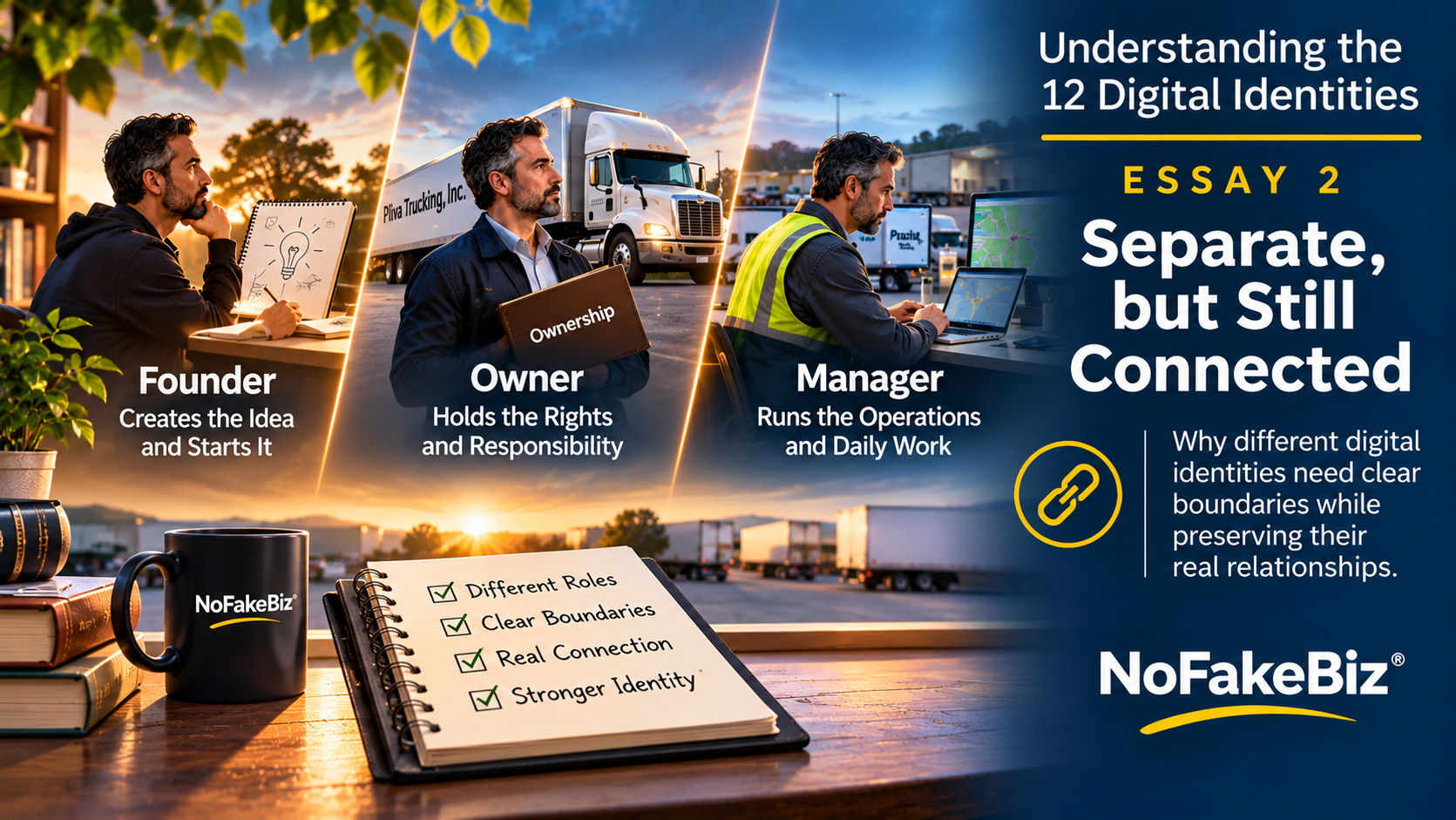
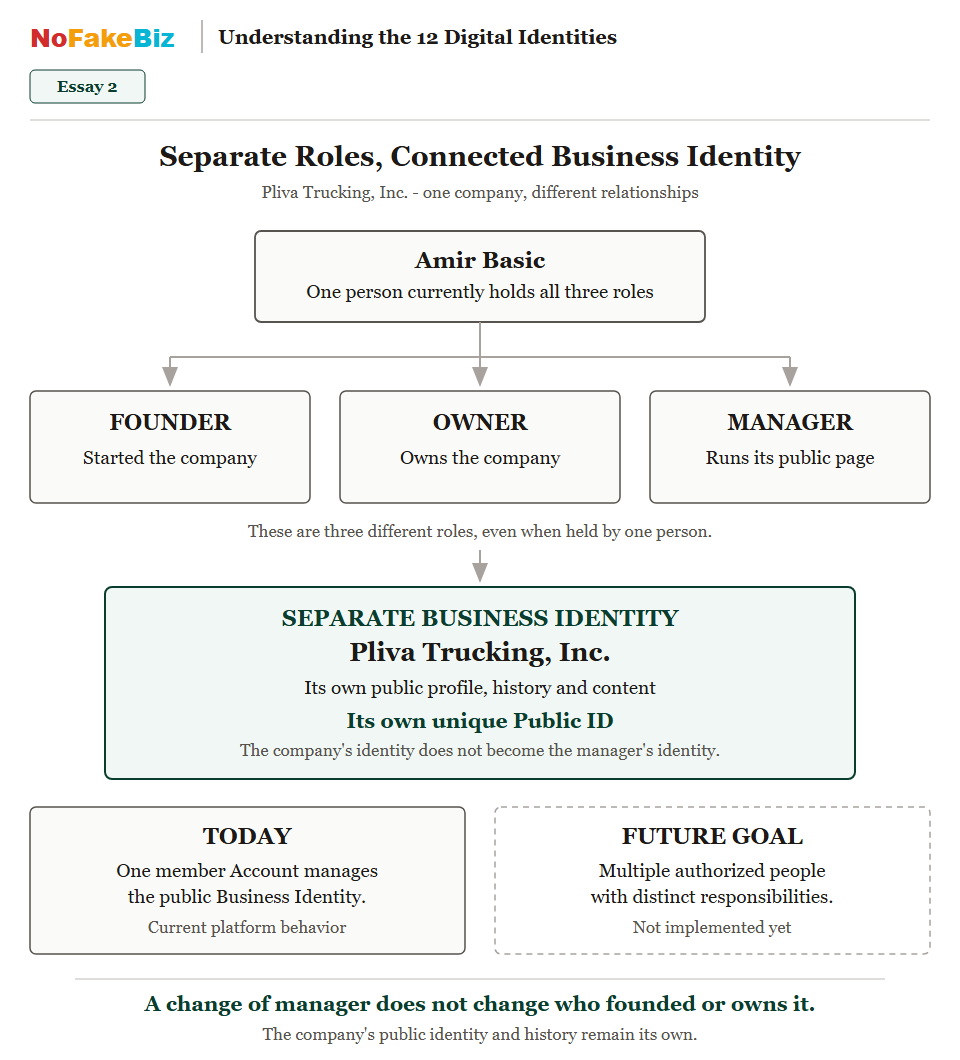
I started NoFakeBiz, I own the project, and I currently manage its public presence. Because I perform all these roles myself, it may seem as though founder, owner, and manager mean the same thing. But they do not. They describe different relationships to the same work, and those differences become much easier to understand when another person becomes involved.
Pliva Trucking is an even clearer example. I founded the company, I own it, and I can publish information on its behalf. Suppose tomorrow I hire someone to manage the company's public page, publish available transportation services, and respond to inquiries. That person would be operating the page, but they would not become the founder or owner of Pliva Trucking. They would simply be acting on behalf of the company, within the responsibilities I had given them.
Now imagine that years later I decide to sell Pliva Trucking. The buyer becomes the new owner of the company, but that does not change the fact that I founded it. The trucks, the business operations, and the legal ownership may pass to someone else according to the sale, while the company's public identity should remain associated with the company itself. Its history, published information, and unique Public ID should not automatically become part of the buyer's Personal Identity, nor should they follow me as though the business were still mine.
This is an important distinction. Founding a company, owning a company, and managing its public identity are three different things. Giving someone permission to publish on behalf of a business is not the same as transferring ownership of that business.
And selling a business is not simply a matter of giving the buyer a password. The public identity should be able to reflect who is responsible for the business without erasing the people and events that came before.
Personal and Professional Identities are different. My Personal Identity represents me, Amir Basic, as a human being. My Professional Identity represents my professional knowledge, experience, and work. Those identities remain attached to me because another person cannot become Amir Basic simply by taking over my account or buying my company. My personal experiences do not transfer with the trucks, and neither does my professional history. I may change professions, develop new skills, or stop practicing a particular occupation, but the human being behind those experiences remains the same.
Businesses, organizations, associations, government institutions, projects, and brands raise different questions because their ownership, leadership, or management can change over time. Their public identities may need to continue even when the people responsible for them change. For blogs, books, podcasts, and video identities, the rules of transfer and continuity still require further decisions. They should not automatically be treated as either personal identities or transferable business property without considering what each one represents.
I also want to be clear about the difference between the principle and what NoFakeBiz already supports. The platform has separate public identity types, but the full system for allowing several people to manage one identity, assigning different responsibilities, transferring control, and preserving a clear history of those changes has not yet been completed. Today, an identity is still managed through one member Account. The larger goal is to build a system where these relationships can be represented clearly rather than hidden behind shared passwords or informal arrangements.
That is the principle behind Separate, but Still Connected. A person should not have to mix every part of life into one public profile, and a company should not lose its history because the person running its page has changed. Each identity needs its own purpose, its own public record, and a clear relationship to the people or organizations behind it. The connections matter, but so do the boundaries.
In the next essay, we begin with the identity closest to the human being: Personal. It represents the person publicly, but it is still not the private Account or the human being themselves.
AMIR BASIC
Founder & CEO, NoFakeBiz
ABOUT THIS SERIES
Understanding the 12 Digital Identities is a connected series about the ideas behind NoFakeBiz. Each essay explores one part of the larger picture. For a complete understanding, we recommend reading the entire series, beginning with the Introduction.
PREVIOUS ESSAY
NEXT ESSAY
Personal — Your Identity as a Person
READ THE COMPLETE SERIES