

We spent the first three essays avoiding a definition on purpose. Before saying what we believe Digital You should mean, I wanted to see what had already happened to the term.
We found profiles, personal brands, digital footprints, digital twins, and AI representations. All of them describe something real. But we also found the same problem again and again: the person was missing from the center.
So let’s put the person back.
Start with something we already know
You are a human being. That sounds like a strange place to begin a technology discussion, but I think it is the most important place to begin.
Before you had an email address, you existed. Before your first account, before Google knew your name, before a social network made a profile for you — and long before an AI could learn how you write or speak — you existed.
Technology did not create you. It created another environment in which you can act. That distinction is the foundation of how we understand Digital You.
In the physical world, you can be a parent, employee, business owner, customer, writer, neighbor, friend, or member of an organization. You can own things, create things, make agreements, build relationships, develop a reputation, and take responsibility for what you do. None of that requires you to become a different human being every time your role changes. You remain you.
So why should the digital world begin with a different assumption?
Digital You is not your copy
Our definition starts here:
Digital You is the extension of a real human being into the digital world.
Not a copy of the human being. Not a replacement. Not a simulation. And not a collection of profiles pretending to be a person.
It is the same person continuing to exist, act, create, communicate, build relationships, and develop a reputation in another environment.
I think the word extension matters. Your hand is part of how you act in the physical world. Your voice is part of how you communicate. A document can carry your words somewhere you are not. A telephone can carry your voice across the world. None of those things becomes another you. They extend what you are able to do.
The digital world does something similar, on a much larger scale. It gives the same human being another place to act.
Physical You and Digital You
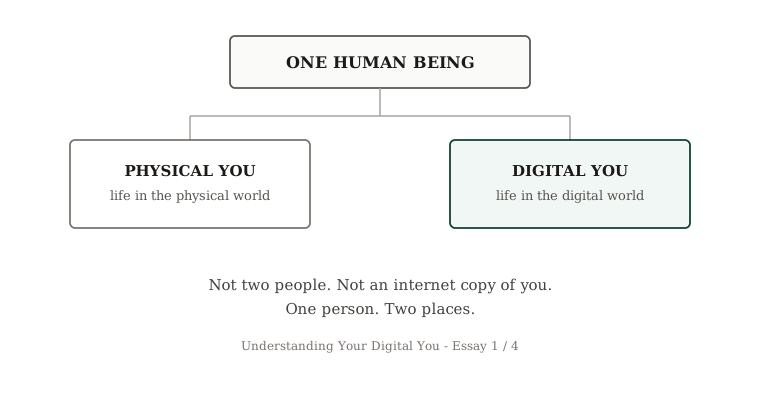
One simple picture:
One human being.
From that human being, we can think about two environments:
Physical You — the person as they live and act in the physical world.
Digital You — the same person as they live and act in the digital world.
These are not two separate people. They are two expressions of one continuous human life.
If you make a promise online and break it, the physical person is still responsible. If you build a strong professional reputation online, that reputation came from the actions of a real person. If you create something digitally, there is still a human creator behind it. If you own a business that operates online, the business did not become imaginary because the work happened through a screen.
The environments are different. The person is continuous. That continuity is one of the most important parts of Digital You.
You have more than one role
Once we start with the person instead of the profile, another problem gets easier to see. Human beings do not have only one role in everyday life.
I am Amir. That single fact does not describe everything I may do. I can act as an individual. I can act professionally. I can represent a business. I can write an article. I can join an organization. I can work on a project. I may one day write a book. These can all belong to the same human life without being the same role.
This is not only theory for me. When I looked at my own life honestly, I saw how many different interests and responsibilities I actually have. I may want to write a book under one identity. I may want a blog for things I care about. One day I may need a podcast or a video presence — and for some people, that is already a whole business. I may want to found an organization, join an association, or represent a company. The more I looked at it, the clearer it became: all of that cannot live under one mixed name or one mixed identity without becoming a mess.
That personal problem is one of the reasons we later built different public identities into NoFakeBiz. If I needed that kind of clarity, I believed other people would need it too. We will look more carefully at that structure later in the series. For now, the important point is simpler: one human being can have many roles without becoming many people.
The physical world handles this fairly naturally. Nobody gets confused because the person who owns a company is also someone’s neighbor. We understand context.
The digital world has not handled this nearly as well. It usually gives us another profile, another login, another page, another account. Eventually one person becomes scattered across many disconnected representations.
If Digital You begins with the human being, we can think differently. The person stays at the center. The roles can exist around the person. That distinction will become very important later in this series.
Digital You should not be public by default
Here is another distinction. If Digital You is the extension of a human being into the digital world, that does not mean everything about that person should become public. The opposite should be true.
Human beings have private lives — private conversations, private information, private relationships, private records, and things that simply do not belong in public. Living digitally should not require giving that boundary away.
This also shaped how we think about NoFakeBiz. Some platforms make money by collecting and using people’s private information. We did not want to build that kind of business. Privacy should not be treated as raw material for someone else’s success — financial or otherwise. A person’s private center should remain theirs.
So Digital You should not mean: “Put your entire life online.” It should mean that the human being remains at the center and decides what parts of their digital life become public, and in what context.
This is where the difference between the person and their public identities begins to matter. The person is not a public profile. A public profile is something the person may choose to create. That is a very different relationship.
Your reputation should follow what you actually do
If the same person continues from the physical world into the digital world, reputation matters too. In physical life, reputation grows over time. You do something. Other people experience the result. Patterns form. People may learn that you keep your word, do good work — or the opposite. Reputation is connected to actions.
The digital world should not change that basic relationship. But it does create a new problem. If one person can act in several roles, should everything be mixed into one reputation score? I do not think so.
Imagine someone who is an excellent mechanic and also writes terrible poetry. Customers care about the mechanic. Poetry readers can judge the poetry. Or imagine someone who owns two businesses. The actions of one should not automatically become the history of the other simply because the same human being is behind both.
The person connects the roles. The roles still need their own context. That is why Digital You cannot simply be one giant public profile containing everything about a person. Structure matters.
The person should remain above the technology
There is one more reason this definition matters. Technology will change. Platforms we use today may not exist in twenty years. AI will get more capable. New devices and new ways of communicating will appear. Some things that feel essential today will look outdated later.
But the basic relationship should survive those changes. There is a human being. Technology serves that human being — not the other way around.
An AI can assist the person. A profile can represent the person. Data can describe something about the person. A digital twin can model the person. A platform can provide infrastructure for the person. None of them should replace the person at the center.
That gives us a definition that does not depend on today’s technology.
So what is Digital You?
After everything we have explored so far, this is the simplest definition I can give:
Digital You is the extension of a real human being into the digital world — a structured digital existence through which the same person can act, create, communicate, build relationships, take on different roles, and develop reputation without becoming disconnected from the human being behind it.
That definition is longer than two words. The idea underneath it is simple. You already exist in the physical world. Now part of your life also exists in the digital world.
Digital You is not something a technology company invents for you. It is not something that begins when you create a social media account. And it is not something AI will create sometime in the future. It begins with you. Technology comes afterward.
Once we understand that, another uncomfortable question appears. If your Digital You already exists — even in a scattered and unstructured form — who currently controls it?
That is where we go next.