
I wrote this series because I wanted people to understand how NoFakeBiz came to be, why I decided to build it, how I believe it should work, and what they can expect from it. Over the years, I looked at different kinds of websites and platforms, the purposes they were built to serve, and the ways people use them to communicate, publish, conduct business, and participate in their communities.
I found many useful services. Some were designed for professional networking, others for publishing, business promotion, social communication, video, or other activities. Many became extremely successful at what they were created to do. But I could not find one that brought the different parts of a person's life together in the way I had been imagining.
The more I thought about it, the more I began to believe that the problem was not simply a missing feature or a missing type of website. It was something more fundamental: the way digital platforms organize people and their activities.
In the physical world, we already live with different roles, responsibilities, professions, businesses, and relationships. We may be parents, neighbors, professionals, business owners, writers, volunteers, or members of associations. We can participate in several of these activities on the same day without becoming different human beings every time we move from one role to another.
But in the digital world, those same activities are often organized according to the purposes and limitations of separate platforms. A professional network asks us to present ourselves through our professional lives. A publishing platform gives us a place to write. A video platform gives us a channel. A business directory gives a company a listing. Other services provide spaces for organizations, community activities, or personal communication. Each may be useful, but the person behind those activities remains the same human being. I began asking myself why our digital lives could not reflect that reality more clearly.
I did not believe people should have to become someone else simply because they move from the physical world to the digital world. Nor did I believe every part of their lives should be forced into one public profile. I wanted to explore a different approach: a digital environment that recognizes the distinct roles, responsibilities, and creations people already have, while preserving the relationships that connect them.
That became one of the foundations of NoFakeBiz. My own life helped me understand the problem. I am one person. At home, I am the man my family knows. In my professional life, I have spent years studying and thinking about relationships, marriage, education, and what young people should understand before beginning a shared life. I have a trucking business, Pliva Trucking, Inc. I have spent years working on the Pre-Marital Handbook, a book organized into 146 chapters. I have been involved in organizations and associations, and I have worked on several different projects.
These activities do not all have the same purpose. They involve different responsibilities, different kinds of work, and sometimes different people. A person interested in my professional work may have no reason to learn about my trucking business. Someone looking for my book may not be interested in the projects I am developing. A person doing business with my company needs information about the company, not every part of my personal life.
Yet all of those activities are connected to the same human being. I could not see why they should have to be squeezed into one public profile or scattered across unrelated services where the connections between them are difficult to recognize. And this is not a problem unique to me. An engineer may also own a business, write books, participate in a community organization, and produce educational videos. A farmer may also be an inventor. A teacher may operate a small business. A student may begin developing a project long before choosing a profession. A retired person may no longer have a business or employer but may still have knowledge, experience, and interests worth sharing.
The number of roles a person has is not a measure of that person's importance. Someone who needs only a Personal Identity should have just as meaningful a place in the digital world as someone who manages several businesses, publications, and projects. What matters is that people should be able to represent the parts of their lives that are relevant to them, without pretending those parts are all the same thing.
Instead of asking people to organize their lives around the structure of a website, I wanted to build a platform that could better recognize the structure of their lives.
To understand how NoFakeBiz approaches this, we need to return to the distinction introduced near the beginning of this series: Human, Account, and Digital Identity.
A human being exists independently of any website. That person has a real life, relationships, responsibilities, experiences, and a history that no digital platform can fully contain.
An Account, which I call Digital You in the context of NoFakeBiz, is the private place through which that person accesses and manages participation on the platform. It is the account that connects the person to the identities and activities they choose to maintain.
A Digital Identity is different. It is a distinct public representation of a particular role, activity, institution, publication, or work. These are connected concepts, but they are not interchangeable.
My Personal Identity represents me as a person. My Professional Identity represents my professional knowledge and work. Pliva Trucking has its own Business Identity. The Pre-Marital Handbook belongs under Book Identity. An organization or project may have its own identity even when I am involved in creating or managing it.
The same person may be connected to all of them, but that does not make them one identity. This distinction becomes even more important when we move beyond activities that belong to one individual.
A business may have employees, customers, managers, and owners. An organization may continue long after its founder leaves. An association may have members who come and go. A project may involve several businesses or institutions working toward a common goal. A book may remain recognizable long after its author has moved on to other work.
Those identities cannot always be understood as extensions of one person's personal profile. They represent things that may have their own histories, responsibilities, and relationships.
That is why I did not want NoFakeBiz built around one public profile trying to represent everything. I wanted different parts of life to have their own places, without losing the relationships that connect them. I also want to make something clear about the number twelve.
I did not begin with twelve categories and then try to find activities that would fit inside them. The idea developed over many years, as I encountered different needs in my own life and observed how other people, businesses, organizations, and communities function.
Some categories came directly from my experiences. Professional reflected the distinction between a person and the work they do. Business reflected the need for a company to have an identity separate from its owner. Project grew out of my experience working on several different undertakings at once. Book came from my long effort to develop the Pre-Marital Handbook. Blog reflected my experiences writing on websites that sometimes disappeared, taking years of people's work with them.
Other categories emerged as I considered the needs of associations, public institutions, creators, publishers, and people whose work takes the form of podcasts or videos.
Eventually, those needs formed twelve categories:
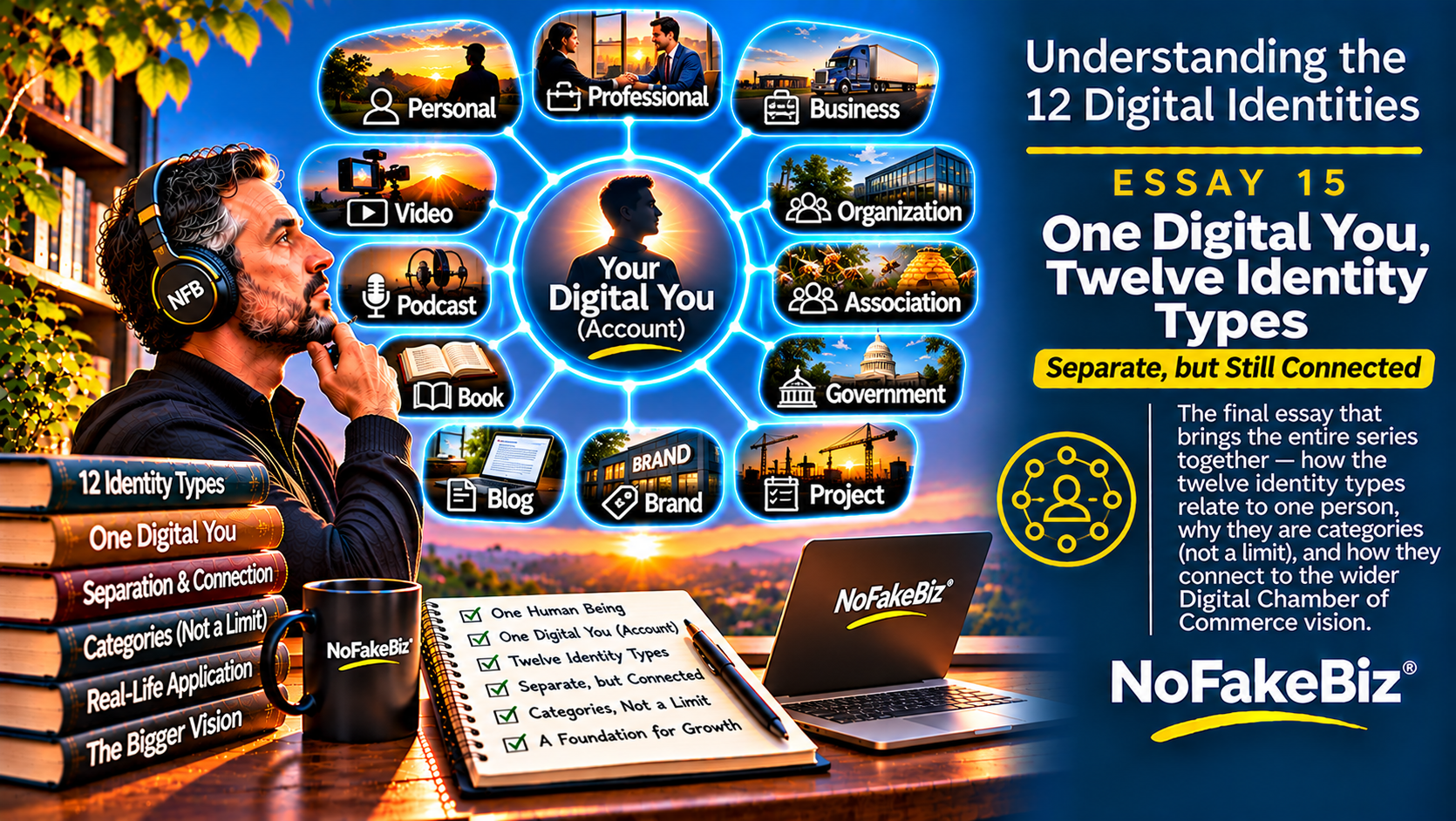
Personal, Professional, Business, Organization, Association, Government, Project, Brand, Blog, Book, Podcast, and Video. These are twelve types of Digital Identity, not a limit of twelve identities per person.
A person may have one Personal Identity and no others. Someone else may have several businesses, multiple projects, two books, and more than one blog or video channel. The purpose of the categories is to identify what each public identity represents, not to encourage people to create as many identities as possible.
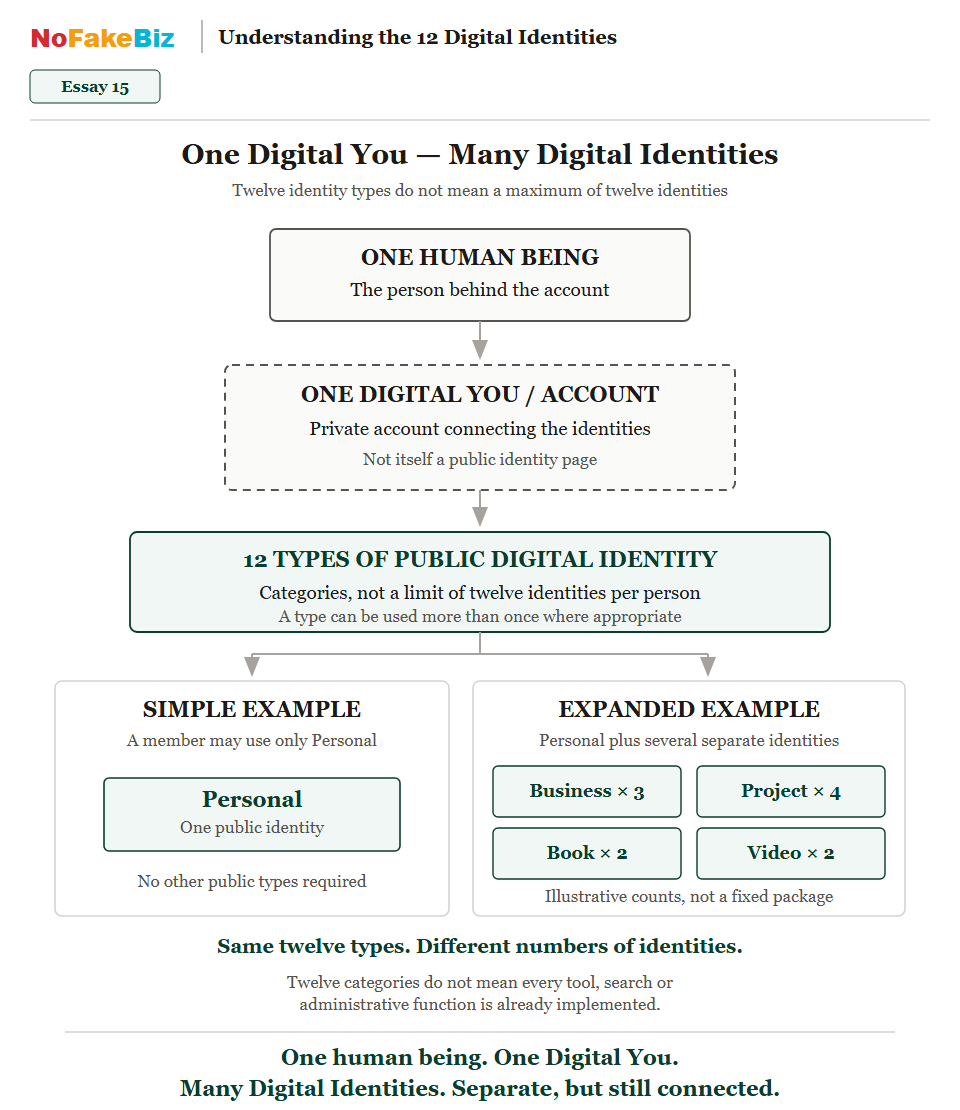
Having more identities does not make someone more important. Having fewer does not make someone less interesting or less valuable. The purpose is not to collect identities. It is to represent real life more accurately. There is another distinction I consider essential. Separate identities should not mean disconnected identities.
A reader interested in the Pre-Marital Handbook should be able to find the book under its own title. Someone interested in my professional work should be able to find that work. A person who needs to contact Pliva Trucking should be able to find the company. When those identities are genuinely connected, the relationship between them should be understandable without confusing what each identity represents.
This principle reaches beyond one person's account. A business is connected to people, other businesses, and the communities where it operates. An association is connected to its members and their shared interests. A project may connect several organizations, companies, and individuals. A public institution serves people within its jurisdiction. A publication connects writers and readers who may live on opposite sides of the world.
These relationships already exist in the physical world. The challenge is finding a way to represent them digitally without losing the distinctions between the people and institutions involved.
For me, this is one of the most important ideas behind NoFakeBiz. The same question appears when we look at an entire community. A town is not simply a collection of businesses. It is made up of people, professions, companies, organizations, associations, public institutions, projects, publications, and countless relationships among them.
Someone may need a mechanic, a teacher, or a local contractor. Another person may want to join a beekeeping association, learn about a community project, find a local organization, or understand which public office is responsible for a particular service.
In the physical world, these are all parts of the same community. Online, they may be scattered across different directories, social networks, government websites, business platforms, and publishing services.
I began imagining a digital environment where those different parts of community life could be represented in a more connected way. That wider vision became the Digital Chamber of Commerce. I did not envision it as simply another directory where businesses pay to display their names. I imagined a digital environment built around the people, work, institutions, and relationships that make a community function.
Businesses are important, but they are not the whole community. People have professions. Organizations serve different purposes. Associations bring people together around shared interests. Public institutions have responsibilities to the people they serve. Projects create opportunities for cooperation, while publications and other media help people communicate and share knowledge.
The twelve Digital Identity categories provide one foundation for representing those different parts of community life.
NoFakeBiz also uses geographic information as part of its structure, because many of these relationships are connected to real places. A person may want to find something in their county, while another may be interested in a service, association, or publication operating across a state, country, or the world.
Not every identity is local, and not every relationship depends on geography. But location matters in many parts of everyday life, and I wanted the platform to recognize that rather than treating every search and connection as though it existed nowhere in particular.
The complete Digital Chamber of Commerce vision will require continued development. The existence of twelve identity categories does not mean every planned relationship, discovery tool, administrative capability, or community feature is already implemented. Some parts of NoFakeBiz are operational today, while others remain work in progress or longer-term goals.
I believe it is important to make that distinction clear. A vision explains what we are trying to build. It should not be confused with a claim that everything has already been completed. I also want to explain what NoFakeBiz is not trying to do. I do not believe the internet lacks tools for writing articles, publishing books, sharing videos, hosting podcasts, promoting businesses, or connecting people. Those tools already exist, and many work extremely well.
I am not suggesting that every person should abandon the services they already use or that NoFakeBiz must replace every platform on the internet. What I wanted to change was the underlying approach. Many platforms begin with a particular activity and ask people to create profiles that fit that activity. NoFakeBiz begins with the human being and recognizes that the same person may participate in many different activities. It provides distinct public identity categories for those activities and seeks to preserve the relationships among them.
The difference is not that NoFakeBiz invented professions, businesses, books, podcasts, or videos. Those existed long before the platform. The difference I am trying to establish is how those parts of life can be represented together without being treated as the same thing.
I want people to be able to look for what they actually need. If someone is looking for a business, they should be able to find the business. If they are looking for a book, they should be able to find the book. If they are looking for a professional, an association, a project, or a publication, those should be recognizable as distinct kinds of identities.
And when there is a meaningful connection between them, that connection should be possible to understand. Looking back at these fifteen essays, I hope readers can see more than the names of twelve categories. I wanted to explain where the idea came from, why I spent years thinking about it, and why I believe it matters. Some of the identities emerged from my own experiences. Others came from observing how people, organizations, businesses, and communities actually function.
Together, they represent an approach to the relationship between our physical lives and our digital lives. I do not expect everyone to need all twelve categories. I do not expect everyone to agree with every decision behind them. And I do not expect the system to remain unchanged as we learn from the people who use it.
But I do believe the digital world should make more room for the roles, responsibilities, and relationships people already have.
We did not build NoFakeBiz to tell people how they should live on the internet. We built it because I wanted the internet to better represent the way people already live.
I did not start with the number twelve.
I started with a life that would not fit on one page.
And I came to believe that the problem was not the life.
It was the page.
One human being. One Digital You. Many Digital Identities. Separate, but still connected.
---
AMIR BASIC
Founder & CEO, NoFakeBiz
ABOUT THIS SERIES
Understanding the 12 Digital Identities is a connected series about the ideas behind NoFakeBiz. Each essay explores one part of the larger picture. For a complete understanding, we recommend reading the entire series, beginning with the Introduction.
This is the final essay in the series.
PREVIOUS ESSAY
Video — A Public Identity for the Channel People Follow
READ THE COMPLETE SERIES