
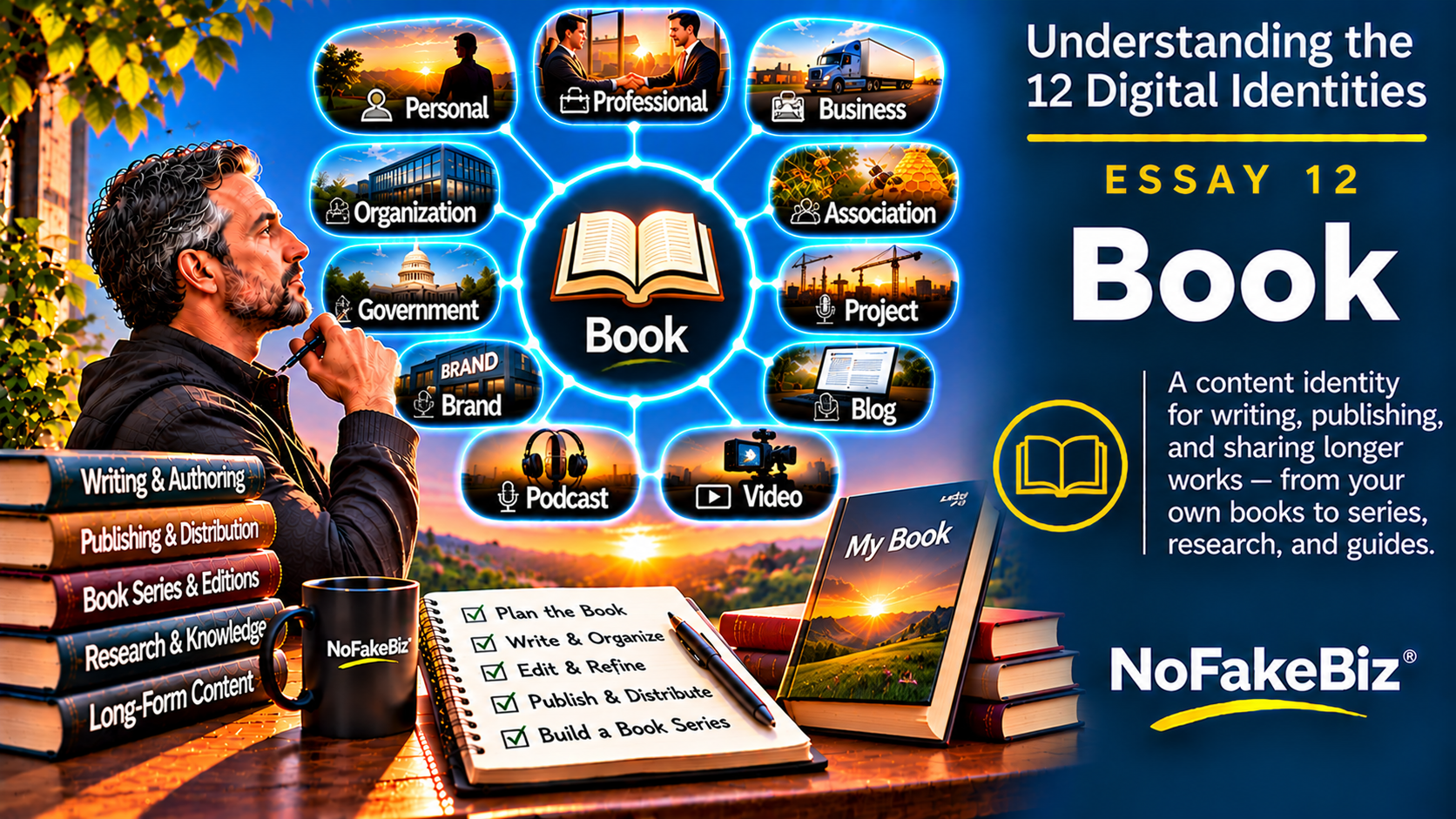
The first book I wanted to write was the Pre-Marital Handbook. My interest in the subject began when I was about eighteen or nineteen years old. I wanted to understand relationships, marriage, family life, and the institutions that influence them. Why do some marriages last for decades while others fall apart? What leads two people who once wanted to build a life together to separate? What happens to the children, the family, and the wider community when a marriage ends? These were questions I kept returning to, long before I had a clear plan for writing a book.
Over time, my interest developed into a broader effort to understand human relationships and the social conditions surrounding them. I studied criminology and sociology, looking at how individual behavior, families, and institutions interact within society. Later, my master's studies focused on education, counseling, and psychology. But the particular field I wanted to explore was not marriage counseling in the usual sense. I was interested in premarital counseling: helping people understand the responsibilities, expectations, and challenges of marriage before they enter it.
I kept asking myself a simple question. Why do we spend so much time discussing the problems that arise after people get married, while giving comparatively less attention to what they should understand before making that commitment?
There are countless books, articles, lectures, videos, and podcasts about marriage and relationships. Many discuss communication, conflict, family responsibilities, divorce, or the experiences of couples who have been married for years. But in the two languages I knew, my native language and English, I could not find the kind of comprehensive guide I was looking for. I wanted a work that would bring together the many subjects young people should have an opportunity to consider before marriage, rather than treating each question as an isolated topic.
That is how the idea for the Pre-Marital Handbook took shape. I wanted to write a book for young people who were considering marriage and preparing to begin a shared life. My goal was not to tell people whom to marry or to guarantee that a marriage would succeed. It was to help them think more carefully about the commitment they were considering, the questions they should ask, and the responsibilities they might one day share.
I had already begun collecting material when I was about eighteen. Over the years, that collection grew to include written texts, videos, audio recordings, research, observations, and ideas that I wanted to examine further. At first, collecting information was something of a personal interest or hobby. But as the material accumulated, I began organizing it into subjects and questions that could eventually become chapters of a book.
What started as an interest gradually developed into a much larger undertaking. The Pre-Marital Handbook grew into a work organized around 146 chapters. Some chapters require extensive discussion because the subjects are complicated and deserve careful examination. Others may be much shorter. Sometimes a young person only needs to be introduced to a particular question, to know that it exists and deserves consideration before marriage. Not every important subject requires the same number of pages.
As the work expanded, I encountered a practical problem that many writers eventually face. Where should all of this material belong? How should it be organized? How could I keep the different chapters connected without turning the work into a collection of unrelated articles?
A blog was not quite what I needed. A forum was not the right place either. I was not simply publishing occasional thoughts about marriage or responding to questions from other people. I was building one work with a particular purpose, a structure, and many parts that needed to fit together. The material belonged to a book, and the book needed a place of its own.
When I began developing NoFakeBiz, this experience strongly influenced my thinking. I knew that Book had to be one of the Digital Identity categories. In fact, I felt so strongly about it that I wanted Book to be part of the platform even if half of the other things I was trying to build were not yet working.
That decision was not simply about giving authors another place to advertise books. I wanted to recognize the book itself as a distinct public work, separate from the personal identity of its author, the author's profession, and the other publications or projects the author might be involved in.
A reader who wants to learn about that particular book should not have to search through every other activity of the person who wrote it.
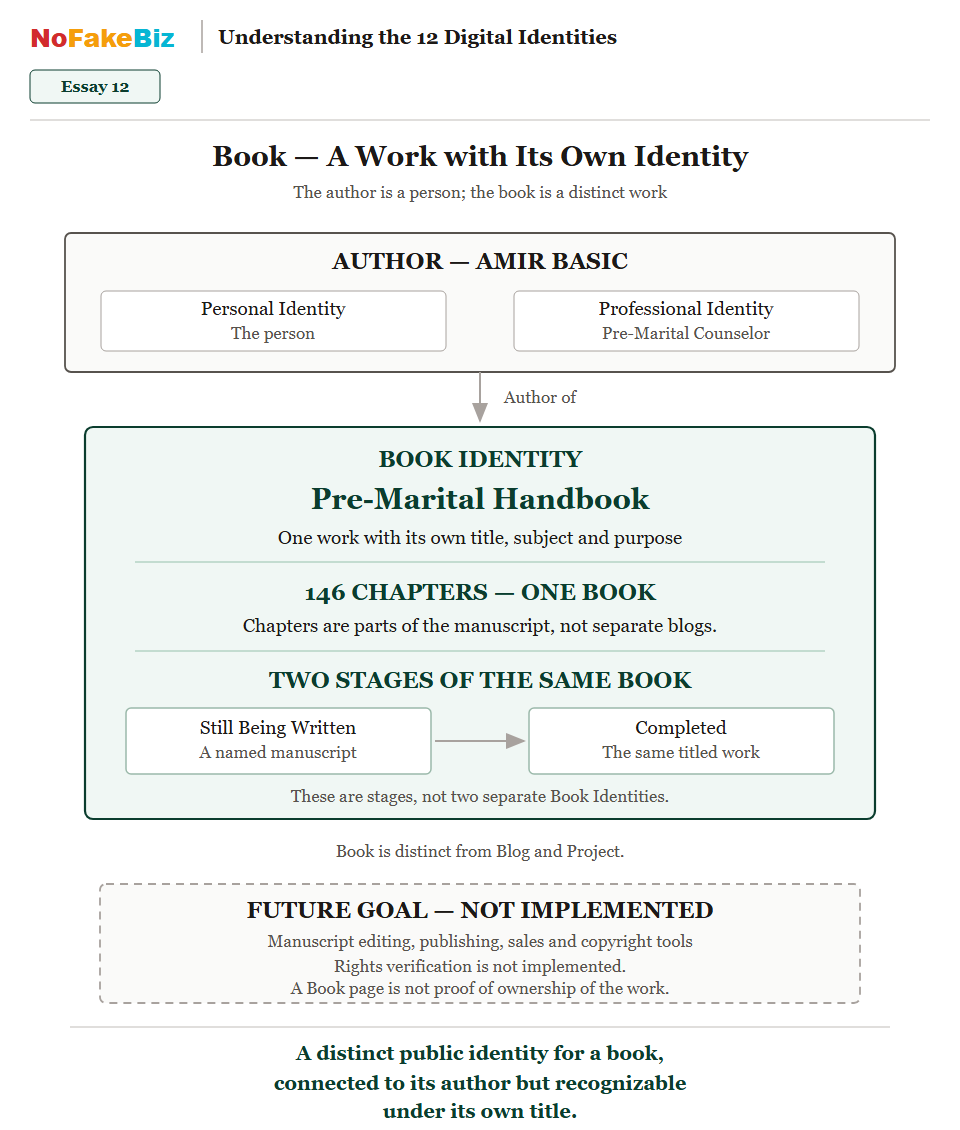
That is what Book Identity is meant to address on NoFakeBiz. It gives a book its own public place, under its own title, where people can discover what the work is about, who wrote it, and how it relates to the author's other identities.
I also wanted Book Identity to recognize two important stages of a book's life.
The first is a book that has already been written or published. An author may want to introduce the work, explain its purpose, discuss particular subjects, answer readers' questions, publish related information, or direct interested readers toward available editions. The book may have been completed years earlier, but it can continue to attract new readers and generate new conversations. Its public identity can remain useful long after the writing itself has ended.
The second is a book that is still being written. This distinction matters to me because I know from experience that some books take years to develop. An author may begin with a few chapters, continue researching, revise the structure, and gradually build the work into something larger. There may be long periods when the book is not ready for publication as a finished volume, yet the work already has a title, a purpose, and an identity.
I envisioned a place where an author could introduce a book in progress and, if they chose, share parts of it with readers as the writing develops. A chapter might be published for readers to consider, followed by another chapter later. The author might explain what the book is trying to accomplish or discuss questions raised by the work. Readers could follow its development without confusing an unfinished manuscript with a completed edition.
This does not mean every author should publish a manuscript before it is finished. Some writers prefer to keep their work private until the final version is ready. Others may want to share selected chapters or develop a relationship with readers while they are still writing. The decision belongs to the author. The important point is that a book does not have to be completed before it can have an identity of its own.
There is also an important distinction between a Book Identity and the tools used to write or publish the book. A public identity is not automatically a complete manuscript editor, publishing house, bookstore, or distribution service. Those are different functions, each requiring its own technical and operational systems. The longer-term vision for NoFakeBiz includes ways to support books at different stages, but the existence of a Book Identity should not be mistaken for a promise that every publishing or sales function has already been implemented.
The relationship between Book and Blog is another distinction worth explaining. In the previous essay, we discussed blogs as continuing publications that may contain many separate articles. A writer can explore different ideas over time, respond to events, or write about subjects that do not necessarily lead toward a finished work.
A book is different. It is a particular work with its own structure, even when that structure is still developing. Its chapters are intended to belong together as parts of a larger whole. An author may write blog articles about subjects related to a book, but those articles do not automatically become chapters. Likewise, a chapter belongs to the book because of the role it plays within that work, not simply because the same person wrote it.
The distinction also applies to Project Identity. Writing a book can certainly be a project. It involves research, planning, drafting, editing, and eventually reaching a particular result. But the book itself is more than the work required to produce it. Once completed, it remains a recognizable publication that people can read, discuss, recommend, and return to. The writing project may end, while the book continues to have a public life of its own.
An author may also write more than one book. Each book may address a different subject, serve a different audience, or develop over a different period of the author's life. Those books should not have to share one identity simply because they have the same author. Each can have its own title, description, history, and connection to the readers interested in that particular work.
This is consistent with the larger idea behind NoFakeBiz. One human being may create many things, but those creations do not all have to be presented as one undifferentiated collection of personal activity. The author remains connected to the work, while the book is recognizable as something distinct.
There is another reason this matters to me. A book can outlive the circumstances in which it was written. The author may change professions, move to another country, or begin working on entirely different subjects. New editions may appear, readers may discover the book years later, and discussions about its ideas may continue. The book has a history that is related to its author but not identical to the author's personal biography.
Of course, questions about authorship, copyright, publishing rights, editions, and ownership must be treated carefully. Creating a Book Identity should not automatically establish that someone owns the rights to a particular work or is authorized to publish it. Those are separate matters that require appropriate rules and, where necessary, verification. The purpose of the identity is to represent the book and its connections, not to replace the legal framework surrounding creative works.
When I think about the Pre-Marital Handbook, I see more than a manuscript divided into 146 chapters. I see years of questions, reading, collecting information, studying, and trying to understand a subject that has interested me since I was a young man. The book grew out of that personal history, but it is not the same thing as my Personal Identity or my Professional Identity as a premarital counselor. It is a particular work I have been trying to create.
That is why I wanted it to have its own place on NoFakeBiz.
Someone who hears about the Pre-Marital Handbook should be able to look for the book by its title, learn what it is intended to accomplish, and understand where it stands in its development. They should not have to search through my trucking business, my personal profile, or everything else I may have written to discover that the book exists.
The same should be true for any other author. Whether a book is a short work, a long study, a collection of stories, or a manuscript that is still taking shape, it represents something the author has chosen to bring together under one title. It deserves to be understood as a work of its own.
That is what Book Identity is meant to represent on NoFakeBiz: a distinct public identity for a book, connected to its author but recognizable under its own title, whether the work is still being written or has already been completed.
---
AMIR BASIC
Founder & CEO, NoFakeBiz
ABOUT THIS SERIES
Understanding the 12 Digital Identities is a connected series about the ideas behind NoFakeBiz. Each essay explores one part of the larger picture. For a complete understanding, we recommend reading the entire series, beginning with the Introduction.
PREVIOUS ESSAY
Blog — A Home for Your Writing and Ideas
NEXT ESSAY
Podcast — A Public Identity for a Show and Its Voice
READ THE COMPLETE SERIES