

I have wanted to write since I was about twenty years old. Over the years, I tried expressing my thoughts on different internet forums, websites, and blogs. Sometimes I wanted to discuss something happening in the world. Other times I had an idea, an observation, or a question that I wanted to explore through writing. I was not always trying to write a book or produce something formal. Often, I simply wanted a place where I could put my thoughts into words and share them with people who might be interested.
But I kept encountering the same problem. The places where I wrote belonged to someone else, and I had to work within whatever tools, rules, and limitations those platforms provided. Sometimes the editor did not allow me to present an idea the way I wanted. Sometimes the structure of the website made it difficult to organize what I had written. And sometimes the platform itself eventually disappeared.
Many of the forums and blogs I remember from earlier years no longer exist. Some closed, some changed direction, and others simply vanished from the internet. With them, a great deal of what people had written disappeared as well. Those were not necessarily famous authors or important public figures. They were ordinary people sharing their experiences, asking questions, explaining things they had learned, and recording their thoughts about the world around them.
Think about what that means. Someone may have spent years writing about a particular subject, answering questions, or sharing practical knowledge with others. Another person may have documented events in a local community, described an experience that could help someone else, or preserved memories that would otherwise never have been recorded. When the website disappears and no usable copy remains, all that effort can disappear with it.
To me, losing those writings is not so different from someone burning a book. The comparison is not about how the loss happened, but about what is lost. A book contains more than paper and ink. It may contain knowledge, experiences, arguments, memories, and ideas that took years to develop. A blog or forum can contain those same things. When the words disappear, part of the record of what people thought, learned, and experienced can disappear too.
That loss stayed with me. When I began developing the idea for NoFakeBiz, I knew that writing needed to have a meaningful place on the platform. I did not want blogs to be treated merely as another feature for posting occasional updates. I wanted them to be recognized as publications with identities of their own, where writers could organize their work, develop a recognizable name, and build a continuing relationship with their readers.
This is why Blog became one of the twelve Digital Identity categories on NoFakeBiz.
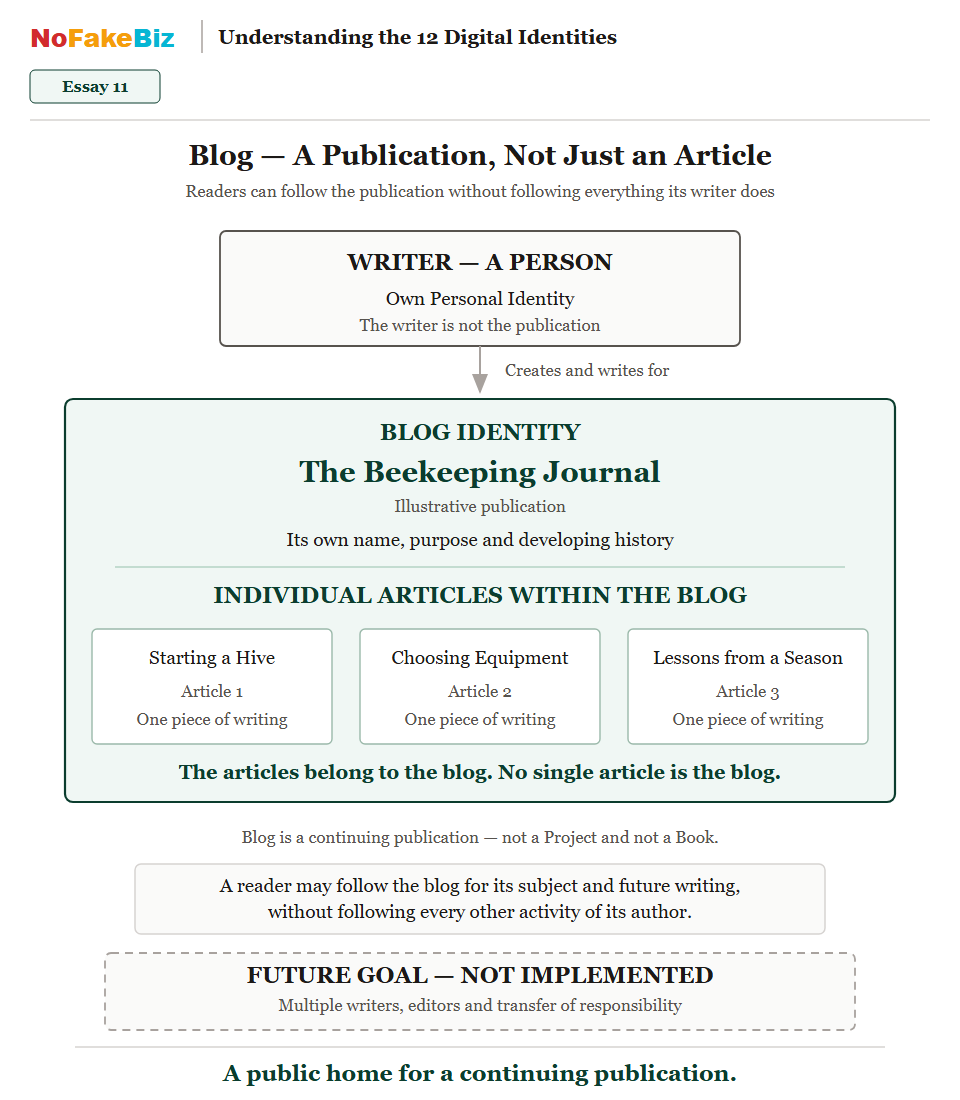
To understand the distinction, think about the difference between an article and a blog. An article is one piece of writing. It may explore a question, explain an idea, tell a story, or present an argument. A blog is the publication to which those articles belong. It may contain ten articles or hundreds of them, written over months or years. Readers may discover one article first, but later become interested in the publication itself because they want to follow what comes next.
A Blog Identity gives that publication its own public place. It can have a name, a subject or range of subjects, a description of its purpose, and a growing collection of writing. The writer may be known through a Personal or Professional Identity, but the publication does not have to be reduced to either one. Someone who follows a blog may be interested in its articles without wanting to follow every other activity of the person who writes them.
For example, imagine a person who writes regularly about beekeeping. The blog might begin with a few articles about starting a hive, choosing equipment, or learning from mistakes. Over time, the writer may explore more complicated questions, share observations from different seasons, or discuss what other beekeepers have taught them. A reader who is interested in that subject should be able to find the blog as a publication and follow its development, rather than searching through everything else the writer has posted online.
Another person may write about local history, documenting the stories of a town or county. Someone else may write about technology, education, religion, or social questions. Some blogs may be devoted to one subject, while others may bring together many different interests. A writer might discuss a public issue one day, share a personal observation the next, and explore an entirely different idea a week later. There is no reason every change of subject must require a new blog.
That freedom is important to me because writing does not always fit neatly into professional or commercial categories. A person may have something worth saying without speaking on behalf of a company, promoting a service, or presenting a formal professional opinion. Sometimes an idea simply deserves to be explored. A Blog Identity gives writers a place to develop those ideas as part of a publication they have chosen to create.
At the same time, some writers may prefer to keep different subjects separate. A person who writes seriously about technology may want one publication for that work and another for personal essays about history or culture. Someone may publish in more than one language or write for different audiences. On NoFakeBiz, the concept allows a member to have multiple Blog Identities, each with its own name, purpose, and collection of writing, while remaining connected to the same person.
This is different from the way we discussed Project Identity. A project is organized around something people are trying to accomplish. It may have a beginning, a goal, and eventually an outcome. A blog is organized around continuing publication. It may develop for years without having a particular final result in mind. Its purpose is not necessarily to complete one undertaking, but to provide a recognizable home for the writing that appears under its name.
It is also different from Book Identity, which we will discuss in the next essay. A book is a particular work with its own structure and identity, even while it is being written. A blog is an ongoing publication that may contain many separate pieces of writing. An idea that does not belong in a book may still deserve an article. A question that arises while working on a project may lead to a blog post without becoming part of the project's official public history. These forms of writing can be connected without being treated as the same thing.
I also want to emphasize something about the relationship between writers and readers. When someone spends years developing a blog, they are not simply creating a collection of files on a server. They may be building a readership that returns because it values the writer's perspective, knowledge, or style. Readers begin to recognize the publication's name. They remember articles they found useful, share them with others, and look forward to new writing.
I believe that relationship should belong as much as possible to the writer and the publication, rather than depending entirely on the decisions of an outside platform. This is part of the larger philosophy behind NoFakeBiz. A platform can provide the infrastructure for publishing and discovery without needing to make itself the center of every relationship between a creator and an audience.
But there is a difficult question here that I do not want to ignore: what happens to the writing if the platform itself changes or disappears?
My experiences with lost forums and blogs are part of the reason this question matters to me. No website can honestly promise that everything published on it will exist forever. Servers can fail, businesses can close, technologies can become outdated, and mistakes can happen. Simply creating a Blog Identity does not solve those problems.
What I want NoFakeBiz to work toward is a publishing environment that takes the continuity and portability of writing seriously. That means thinking about how content is stored, how it can be organized, how it can be preserved through reliable backups, and how writers can eventually take usable copies of their work elsewhere if necessary. These are technical and operational responsibilities that must be implemented and tested, not promises that can be fulfilled by a public page alone.
There is another reason I believe blogs deserve their own identities. Over time, a publication develops a history that is different from the biography of its author. A writer may change jobs, move to another city, begin a business, or take on new professional responsibilities. The blog may continue through all those changes. Readers may recognize the publication by its name and the writing it contains, even when they know very little about the author's other activities.
A blog can also become something larger than the person who originally started it. A publication may eventually involve contributors, editors, or collaborators. Whether and how those responsibilities can be shared or transferred requires rules that NoFakeBiz has not yet fully developed. But the distinction remains important: the publication has an identity of its own, while the people involved retain their own identities.
I often think back to the writing that disappeared from the websites I used years ago. Some of it may have been ordinary conversation. Some may have contained valuable knowledge or experiences that other people could have learned from. I cannot recover all of it, and I do not know how much has survived elsewhere. But I know how much time and thought people can put into words that seem temporary when they first appear on a screen.
That experience shaped what I want Blog Identity to mean. I do not want writing to be treated as disposable simply because it was published online. A short article, a personal reflection, or a continuing series may become meaningful to someone years after it was written. A publication should have the opportunity to develop its own name, its own history, and a lasting relationship with the people who read it.
That is what Blog Identity is meant to represent on NoFakeBiz: a public home for a continuing publication, where writing can be organized, discovered, and connected to its readers without losing the identity of the publication itself.
---
AMIR BASIC
Founder & CEO, NoFakeBiz
ABOUT THIS SERIES
Understanding the 12 Digital Identities is a connected series about the ideas behind NoFakeBiz. Each essay explores one part of the larger picture. For a complete understanding, we recommend reading the entire series, beginning with the Introduction.
PREVIOUS ESSAY
Brand — The Name People Recognize
NEXT ESSAY
Book — A Public Identity for a Work of Its Own
READ THE COMPLETE SERIES