
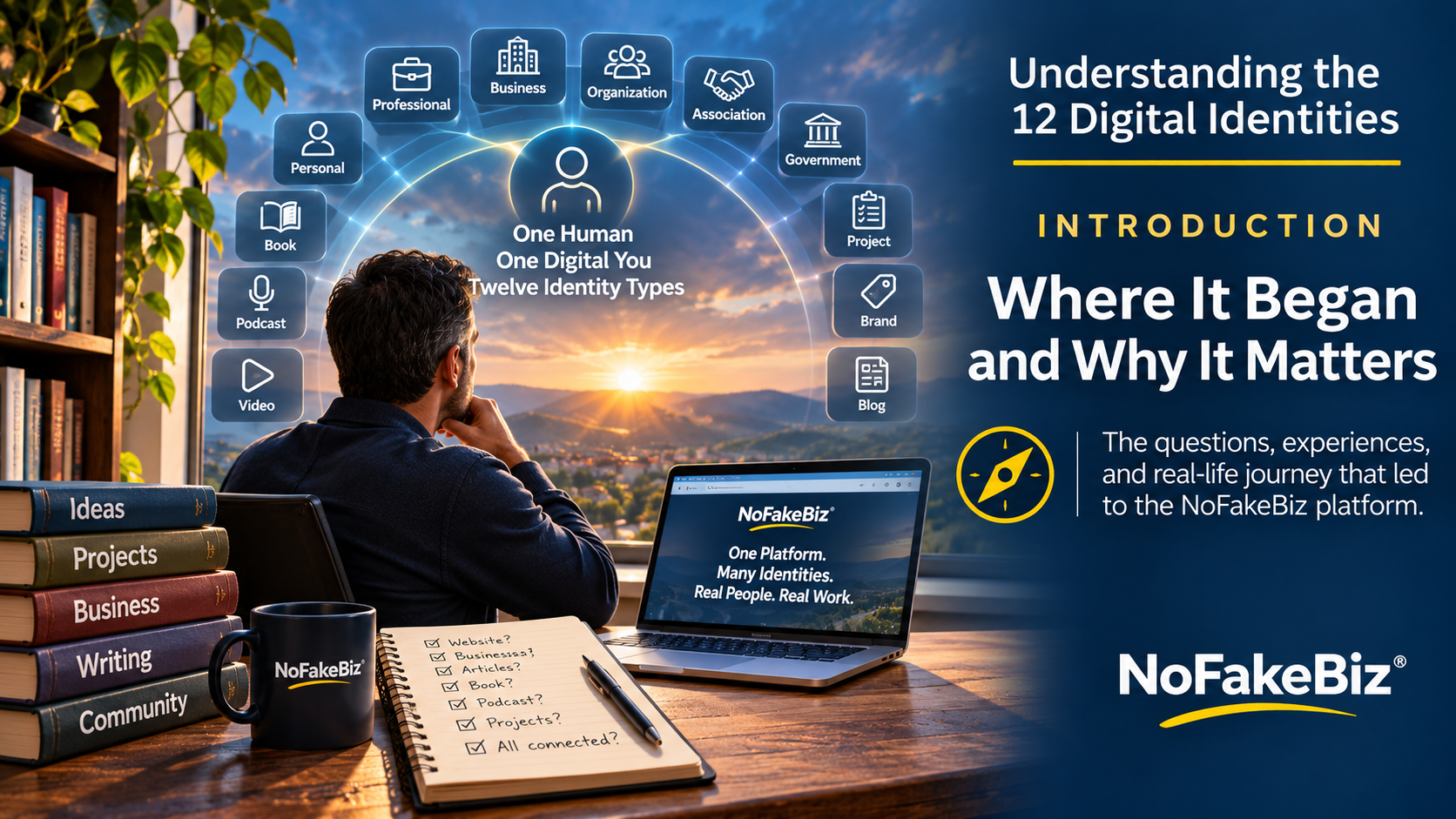
NoFakeBiz did not begin with a list of twelve Digital Identities. It began with a series of ordinary questions that followed me for years as I used the internet, worked, learned, and tried to bring different parts of my life into the digital world. At the time, I was not thinking about building a platform. I was simply trying to do things that millions of other people were also trying to do.
Over the years, the internet became a place where almost anything seemed possible. You could build a website, publish an article, advertise a business, join an organization, share a video, start a podcast, or communicate with people on the other side of the world. I watched these possibilities develop and used many of them myself. They were useful, and some changed the way we live. But I kept noticing something strange: almost every new possibility came with another website, another registration, another profile, and another set of rules.
If you wanted to present your professional work, you went to one platform. If you wanted to advertise a business, you went somewhere else. Writing articles, publishing videos, and producing podcasts often meant creating several more accounts. Finding a local association, organization, or government office could send you through directories and websites that had not been updated in years. Before you could even begin the work you came to do, you might spend an entire evening registering, entering the same information again, confirming email addresses, and remembering passwords. Sometimes you would forget one, reset it, and start over. The internet had given us countless places to do things, but very few ways to keep those things connected around the people, businesses, and communities they belonged to.
That was one of the first problems I wanted NoFakeBiz to address. But as I thought more seriously about bringing different activities together, I encountered a second problem that was much more personal. I began asking myself a question that sounds simple but becomes complicated when you try to answer it online: Who am I, and how should the digital world represent me?
In real life, one person can be a professional, own a business, write a book, work on several projects, belong to an association, and create videos or podcasts. Those activities may belong to the same human being, but they are not the same thing. A person is not a company, a company is not a brand, and an association is not simply another business. A book has a different purpose from a blog, just as a community project has a different purpose from a person's private interests. Each has its own work, its own history, and its own relationships with other people. Yet online, we are often encouraged to compress those differences into one profile or scatter them across several unrelated platforms.
I recognized this problem in the way I worked and thought. I could be concentrating on one project when an idea for another would suddenly appear. Sometimes I was thinking about something personal and remembered a passage I wanted to write in my book. Other times, while working on a business problem, I would think of something that belonged to an entirely different project. My mind could move between these subjects almost instantly, but the websites I used could not. I had to leave one place, open another, sign in, find the correct page, and remember what I had wanted to say. More than once, by the time I reached the right place, part of the idea was already gone.
I wanted a simpler way to work, one where I could move between the different parts of my digital life in a click or two without confusing them with one another. But that idea did not arrive fully formed. To explain how it developed, I need to go back to the beginning of my own experience with the internet.
I arrived in the United States in 1997, when I was seventeen years old. I started working almost immediately, attended school, and saved money to buy my own computer. I was already using the internet that year, and for the first time I felt that I had a way to reach people far beyond the place where I lived. Around 1998, I bought my computer, an all-in-one printer, and the equipment I wanted to go with them. As I remember it, the total cost was about $4,000, which was a significant amount of money for someone working and going to school at the same time.
By 1999, I was asking questions that seem ordinary today. How could I build a website? Where could I advertise something? Where could I publish an article or an essay? How could I communicate with people and make my work available to others? Blogs, YouTube, podcasts, and social networks had not yet become the everyday tools we know today. I was not sitting there with a plan to create twelve Digital Identities. I was simply trying to find ways to do the things I wanted to do.
As more online services appeared, some of those questions received answers. Blogs gave ordinary people a place to publish. Social networks connected people. Video platforms made it possible to reach audiences without owning a television station, and podcasts gave people another way to share their knowledge and experiences. I used these tools and appreciated what they made possible. But each new opportunity still depended on another company's platform, another account, and another set of rules.
I also experienced the limitations of those systems. On some forums, what I wrote could be removed by someone else. A moderator could ban me, and the time I had spent writing and participating could suddenly mean very little. I understood that websites needed rules, but I also began thinking about what it meant to build your public presence in a place where someone else controlled whether that presence could continue.
Around 2015 and 2016, these questions became more serious for me. I was no longer thinking only about a deleted forum post or a suspended account. I was watching public arguments about freedom of expression, professional consequences, and the power that online platforms had acquired over people's reputations. Why could one person express an opinion and continue with life as usual, while another person might face serious consequences for expressing something similar? Later, as discussions about what became known as cancel culture grew, I saw more examples of online disputes affecting people's work and personal lives. These were my observations, not a claim that every platform or every situation was the same, but they made me think more deeply about the relationship between a person's private life, professional life, and public presence.
One question became especially important to me: Why should something a person says in a personal capacity automatically be treated as though it represents their employer, business, or profession? In real life, we understand that people have different responsibilities and speak in different roles. A conversation with friends is not the same as an official company statement. A personal opinion is not automatically the position of an organization. Yet online, those boundaries can become difficult to recognize when everything appears under one public profile.
I began to believe that a person's Personal Identity, Professional Identity, and Business Identity needed separate places. Not because the person was hiding who they were, but because the different parts of their life deserved to be understood in their proper context. A business should be able to speak as a business, a professional as a professional, and a person as a person. They could remain connected without being forced to speak through the same public page.
By that time, I had already spent years developing my professional interests and pursuing different activities. I completed my master's degree in 2011, but my questions about how to organize these different parts of life online continued to grow. I was writing a book connected to my profession, working on multiple projects, and thinking about subjects that did not always belong in either my professional work or the book. Some ideas were personal, some were social, and some concerned religion or the communities around me. I could see why a Blog, a Book, and a Project each needed a different place. I was also paying attention to people who were building careers around videos and podcasts, sometimes creating recognizable public names around a channel or a show.
Other kinds of identity became clearer as I considered how people participate in communities and institutions. Businesses, organizations, associations, government bodies, projects, and brands all have different purposes, even when their work overlaps. I had also become involved with a beekeeping association, which helped me recognize how local associations connect to wider networks at the state, regional, national, and international levels. These were not abstract categories I invented for a diagram. They were activities and relationships I could see in ordinary life.
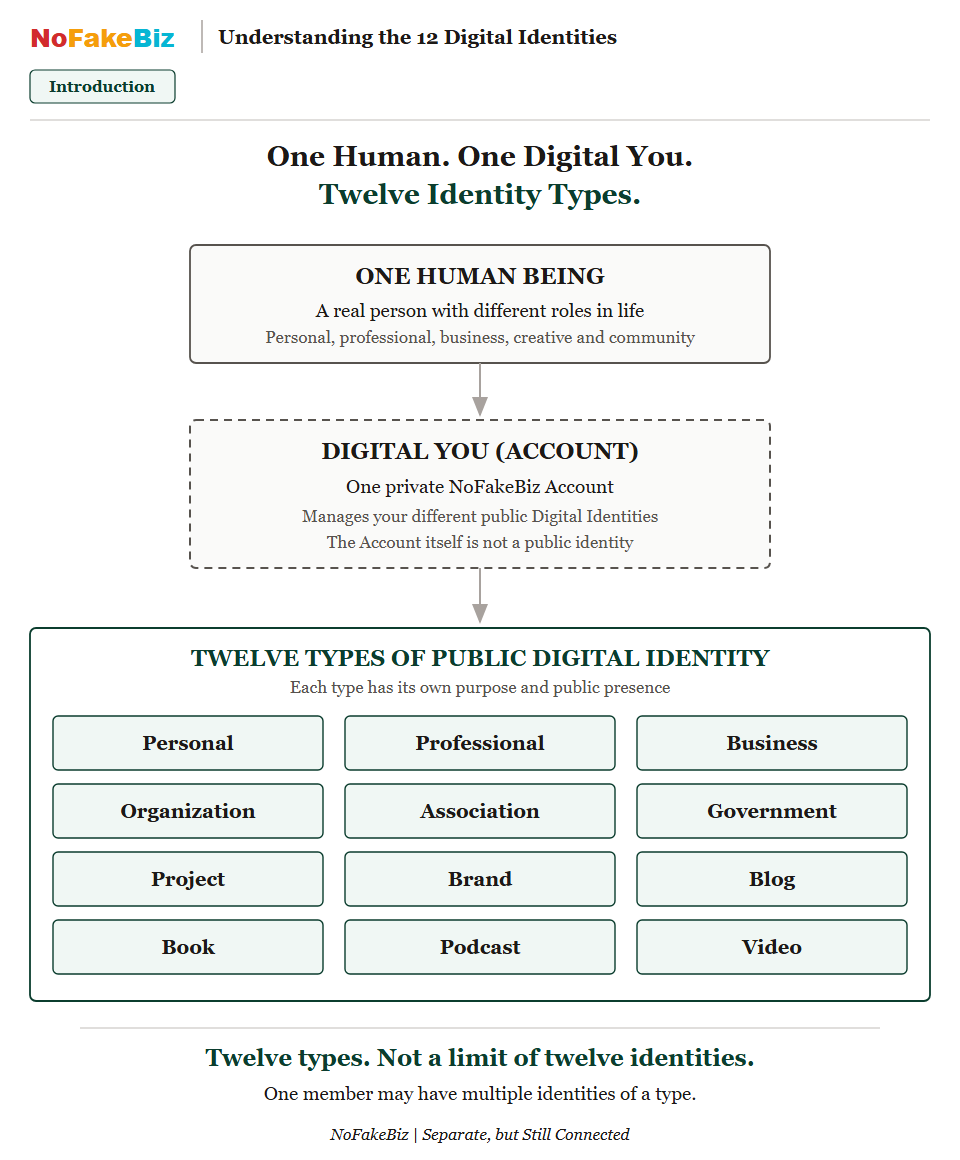
Over time, those observations developed into the twelve types of Digital Identities that form the foundation of NoFakeBiz. The number twelve was not chosen first, with the rest of the system built around it. The categories emerged as I tried to understand what people already do in real life and how those activities could be represented more clearly online. And twelve does not mean that a person can have only twelve identities. It means there are twelve different kinds of public identity, with room for multiple businesses, projects, books, and other identities where they are needed.
I still consider whether other kinds may become necessary in the future. A Vlog, for example, can currently fit within a Video Identity or a Blog, depending on how someone uses it. I can imagine circumstances where a separate Vlog type might make sense, especially for people who build a public presence around documenting their daily lives. But that is a question for the future, not a thirteenth identity in this series.
Looking back, I can see that NoFakeBiz grew from two connected problems. The first was fragmentation: the need to move between countless websites, accounts, and profiles to carry out different parts of ordinary life. The second was representation: the difficulty of showing the different roles of one human being without mixing them together or pretending they were all the same thing.
My answer was not to create twelve disconnected places. It was to build one platform where a person could have one private Account and different public Digital Identities, each with its own purpose, while keeping the relationships between them clear.
That is what this series is about. We will begin by separating three things that are often confused: the human being, the private Account or Digital You, and the public Digital Identities. Then we will look at why those identities need to remain separate but connected, before exploring each of the twelve types individually.
To understand the system, we first need to understand the human being behind it.
AMIR BASIC
ABOUT THIS SERIES
This Introduction begins Understanding the 12 Digital Identities, a connected series about the ideas behind NoFakeBiz. Each essay builds on the larger picture. We recommend reading the series in order.
NEXT ESSAY
READ THE COMPLETE SERIES