
In the last essay, Digital You finally became more than an idea. We looked at the structure we have been building at NoFakeBiz: one human being at the center, with different identities so that person can participate in digital life without becoming a pile of disconnected accounts.
Not everyone needs all twelve. Some people may need only one or two. The important part is that the structure can grow around the human being instead of forcing the human being into one profile.
But once those identities begin doing things, another question appears.
What happens to the value they create?
Digital activity creates real value
We don't always think about our online activity as creating value. Sometimes we are simply using the internet. We write something. We answer a message. We publish a photograph. We review a business. We make a connection. We build a customer relationship. We create a video. We write an article. We complete a project.
Individually, these actions may seem small. Over time, they become something larger. A writer builds a body of work. A business builds a customer history. A professional develops a reputation. A podcast builds an audience. A person builds connections with other people. A creator develops years of material.
These things have value. Sometimes that value is directly financial. Sometimes it isn't. A good reputation has value even when nobody can put an exact price on it. A ten-year professional history has value. A relationship with a customer has value. Trust has value. History has value.
The digital world did not make those things worthless. It simply changed where some of them are created and stored.
There is more than one kind of value
This is where discussions about digital ownership often become too narrow. We immediately start talking about data. Data matters. But Digital You creates much more than data.
Consider a small business owner. Over several years, the business may create customer relationships, reviews, transactions, documents, photographs, communications, work history, business reputation, articles, followers, and knowledge about how the business operates. A platform might describe many of these things as data. The business owner probably doesn't think about them that way. To the owner, they are part of the history of the business.
The same is true for a person. Your professional history is technically information. But to you, it is also years of your life. Your writing may be stored as data. But you created the work. Your reputation may be represented through records and interactions. But that reputation came from things you actually did.
Reducing all of this to “data ownership” misses something important. We should also be talking about value created through digital life.
Ownership is not the same for everything
At this point, it would be easy to say: “If it is about me, I should own it.” But that would create another problem. We already touched on this earlier in the series. Not everything connected to you belongs to you.
If a customer writes an honest review of your business, you don't own the customer's opinion. If a newspaper writes an article about you, you don't own the newspaper's article. If a government agency creates a legitimate public record, you don't own the public record simply because your name appears in it. If another person sends you a message, the relationship between the two of you cannot be reduced to one side owning the entire interaction.
Digital life involves other human beings. Their rights do not disappear because we want more control over our own Digital You. So ownership needs to be more precise than: Everything about me belongs to me. I don't believe that.
A better starting point is:
What you create, what you own, what you are responsible for, and what others create about or with you are different kinds of things and should be treated differently.
That distinction matters if we want digital ownership to be meaningful rather than just another slogan.
Your work should remain your work
Some cases are much clearer. If you write an original article, the fact that you publish it through a platform should not change who created it. If you take a photograph, uploading it somewhere should not erase the relationship between the work and its creator. If your business creates its own records, documents, or materials, those things should remain connected to the business that created them. If you write a book, the platform used to sell or discuss the book does not become the author.
This sounds obvious. But digital platforms can make the boundaries feel less obvious because the work, audience, analytics, comments, and distribution often exist inside the same system. The platform provides infrastructure. The creator provides the work. Both may contribute value. We should be able to recognize both without confusing them.
Relationships create value too
I think this is one of the most overlooked parts of digital life. A relationship itself can become valuable.
Suppose a business spends ten years serving customers. Those customers return. They recommend the business. They communicate with it. Trust develops. That relationship did not appear because a database row exists. It developed through repeated human activity.
Now imagine that most of those relationships happen through one platform. Suddenly the platform is not just providing communication tools. It has become the place where the relationship exists.
That takes us back to the Facebook experience earlier in this series. What bothered me was not simply paying for advertising. The deeper issue was realizing that a platform could remain between me and people who had already chosen to connect with me. The relationship had value. But the infrastructure around that relationship determined how easily the two sides could continue communicating.
That is a very powerful position for infrastructure to occupy. It made me ask a different question:
What would happen if the relationship belonged first to the people in the relationship?
The platform could still provide tools. It could still provide discovery. It could still create value and charge for services. But it would not need to become the permanent owner of the connection itself.
Reputation is a kind of accumulated value
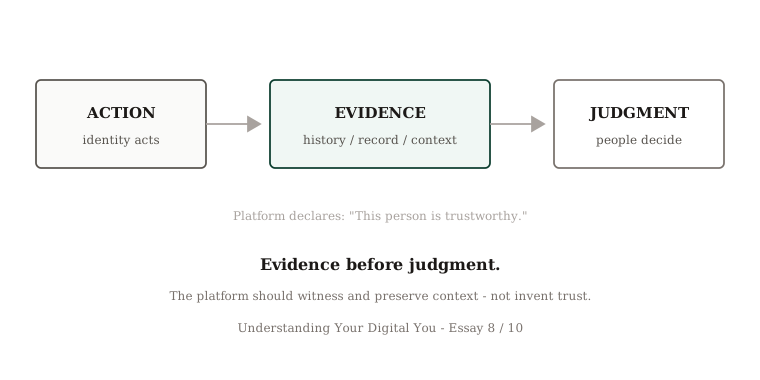
Reputation creates another interesting case. You cannot simply declare yourself trustworthy. At least, the declaration does not make it true. Reputation develops from history. Did you do what you said you would do? Did you complete the work? Did you pay? Did you deliver? How did other people experience their interactions with you?
Over time, those events can create trust. That trust has value. For a business, it may be one of its most valuable assets. For a professional, reputation may take decades to build.
That is also why false damage hurts so much. Earlier in this series I mentioned Carrier411 — a freight reporting system where a single post could injure a business reputation that took years to build, or even help destroy it. What made it worse was not only that the claim could be wrong. It was that the business could not fully defend itself. The platform was built in a way that decided who could speak and who could not. When reputation is that valuable, the right to answer with evidence is not a small feature. It is part of whether the value itself is treated fairly.
But reputation is different from content. You can own an article you wrote. You cannot own other people's judgment of your behavior. So a good digital system should not let a person simply manufacture or edit their own reputation. At the same time, reputation should not have to begin from zero every time the person enters another digital context.
There has to be a better balance. The person or identity performs the actions. Evidence of those actions creates history. Other people can evaluate that history. Reputation grows from the relationship between them.
That makes reputation something different from both personal property and platform property. It is earned value. And that earned value should stay connected to the identity whose actions created it.
Platforms create value too
There is another side of this conversation that is easy to ignore. Platforms create value.
Facebook built infrastructure that allowed billions of people to find and communicate with one another. Google built technology that helps people find information. YouTube provides enormous infrastructure for storing and distributing video. Marketplaces help buyers and sellers find one another. Publishing platforms help writers reach readers.
Those things cost money to build and operate. It would be unreasonable to say that a platform should provide all of that infrastructure while receiving nothing in return. That is not the argument.
The question is about the relationship. Can the platform create value without requiring the human being to surrender the center of their digital life? I think it can. A healthy digital relationship should allow both sides to create value. The platform can earn money for providing useful services. The person can retain meaningful control over their identity, work, relationships, and history. Those ideas are not incompatible.
That is where the idea of fairness entered our own work. While building NoFakeBiz, we kept asking how to be fair to both sides — fair to the people using the platform, and fair to the platform itself. Users should not be treated as raw material. The platform should not be expected to operate as if useful infrastructure has no cost and no right to a clear exchange. Fairness, for us, meant designing a relationship both sides could live with.
From extraction to exchange
Maybe the distinction we need is between extraction and exchange.
Exchange is understandable. You provide something valuable to me. I provide something valuable to you. Maybe I pay you. Maybe you charge a fee. Maybe there is another clearly understood arrangement. Both sides know what is happening.
Extraction feels different. Value is created through someone's activity, relationships, work, attention, or history, but the person has little understanding of how that value is being used or little ability to influence the relationship.
The internet has made this distinction difficult to see because many services appear free. But “free” does not mean no value is being exchanged. Sometimes money is the value. Sometimes attention is the value. Sometimes data is the value. Sometimes the network itself becomes more valuable because you joined it. Sometimes it is several of these at once.
While building NoFakeBiz, we learned something else about “free.” Things people treat as free are often among the most expensive ideas in the digital world. Whole multi-billion-dollar industries have been built on activity, attention, relationships, and history that users never experienced as a clear exchange. That realization pushed us to try another approach: make the relationship more honest about what is being given, what is being received, and what remains with the person.
There is nothing automatically wrong with any of those models. The important thing is that the relationship should be understandable. People should know what they are giving, what they are receiving, and what they retain.
That sounds less revolutionary than saying everyone should “own their data.” I think it is also much more useful.
Digital value should remain connected to its source
This brings us back to Digital You. If we put the human being at the center, then the value created through that person's digital life should not become disconnected from its source without a clear reason.
Work should remain connected to its creator. Business history should remain connected to the business. Reputation should remain connected to the identity whose actions produced it. Relationships should remain centered on the people or organizations participating in them. Content should remain connected to the identity that created it. And when a platform contributes value, its role should be clear too.
This is one reason the identity structure from the previous essay matters. If everything is mixed into one profile, it becomes difficult to understand who created what. Was this Amir acting personally? Professionally? Through a business? A blog? A project? Structure gives value context. And context makes ownership and responsibility easier to understand.
Maybe ownership is not enough
When I started thinking about these questions, ownership seemed like the obvious word. Who owns the data? Who owns the content? Who owns the audience? Who owns the relationship? Those are useful questions.
But after working through the architecture, I think there is an even better question:
Who has authority over what?
Ownership is part of that. But authority also includes permission, responsibility, representation, access, and control. I may own something but give another person permission to use it. A business may authorize an employee to act for it. I may authorize an AI system to perform a task for me. A public record may contain information about me without belonging to me. A customer may have the right to express an opinion about my business even though I strongly dislike the opinion.
These relationships cannot all be explained by ownership alone. Digital You needs governance. It needs a way to understand: Who is the person? Which identity is acting? What does that identity control? What belongs to someone else? Who has permission to do what? What is private? What is public? And who is responsible when an action is taken?
That is where ownership becomes something larger. It becomes digital self-governance.
And that is where we go next.