
Throughout this series, we have kept coming back to one idea: the human being should remain at the center of their digital life.
That sounds good. But eventually we have to ask what it actually means. If Digital You belongs around the person rather than around a platform, what decisions should that person be able to make?
To me, that is what digital self-governance is really about. Not controlling the internet. Not controlling what everyone else says about you. And not hiding from the digital world. It is something much more practical.
You should have clear authority over your own digital existence.
You decide how you appear
In the physical world, context matters. You don't introduce yourself exactly the same way everywhere you go. At a business meeting, your professional role matters. At home, it probably doesn't. If you represent a company, people need to know which company you are representing. If you write a book, the book can have a public identity without becoming your entire identity.
Digital life should allow the same kind of clarity. If you have a Personal identity and a Professional identity, you should decide which one you are using. If you represent a Business or Organization, that relationship should be clear. If you create a Blog, Book, Podcast, or Project, it should be possible to connect that work to you without turning the work into you.
Governance begins with being able to say:
This is me. This is the role in which I am acting. And this is what that role is allowed to do.
Private should actually mean private
The second part is privacy. One of the mistakes we can make when talking about Digital You is assuming that a better digital identity means putting more of ourselves online.
I believe the opposite. A human being needs a private center. Not everything should become a profile. Not every relationship should become public. Not every record should be searchable. Not every action needs an audience.
This principle has influenced how we think about NoFakeBiz:
The account is private. Public identities are what the person chooses to present to the world.
That separation matters. Your private account exists to serve you. Your public identities exist to represent you in specific contexts. The public should not need access to your private center in order to understand who is speaking.
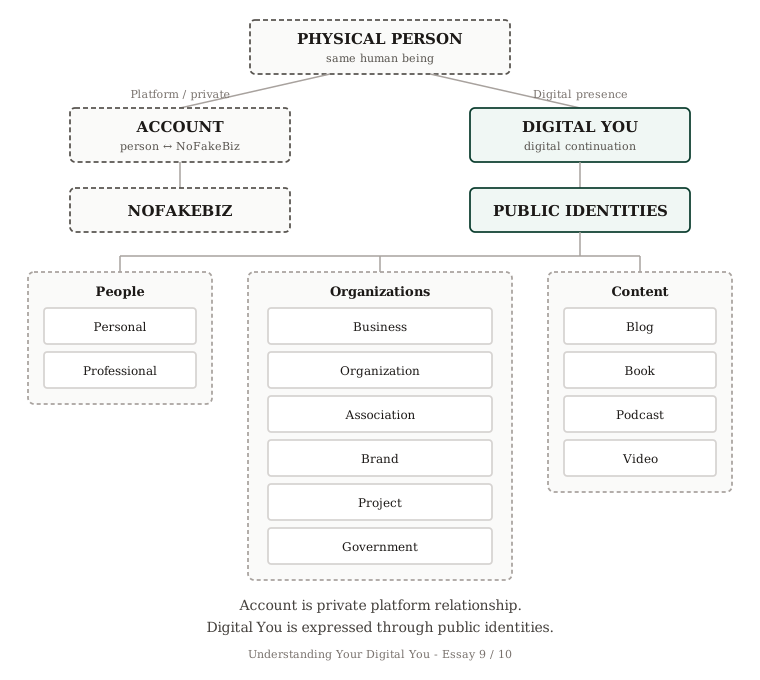
Authority can be shared without being surrendered
Governance also means being able to give someone else permission to act. This already happens constantly in the physical world. A business owner authorizes an employee. An organization gives an officer certain responsibilities. A company may authorize an accountant to handle financial matters. An author may allow a publisher to distribute a book.
Authority can be delegated. The important part is knowing: Who gave the authority? What authority was given? To whom? For what purpose? And can it be changed or withdrawn?
This will become even more important with AI. An AI system may eventually answer messages, organize work, communicate with customers, or perform other actions for a person or business. The important question should not be: “Has this AI become the person?” It hasn't.
The better question is:
What has this person authorized the AI to do?
That keeps the human being in the center even as the tools become more capable.
Authority also creates responsibility
There is another side to control that is not discussed nearly as often. If you want authority, you also have to accept responsibility.
You cannot say, “This is my identity when something good happens,” and then, “That was just the internet when something goes wrong.”
If your Professional identity makes a commitment, there should be a real person behind it. If your Business enters an agreement, the business should be responsible for that agreement. If someone acts with authority on behalf of an Organization, that authority should mean something. If an AI performs an action because you authorized it, using AI should not magically erase responsibility for the decision to give it that authority.
This is one reason I don't think Digital You should be built around anonymity between disconnected accounts. There needs to be continuity. Not necessarily public exposure of the human being in every situation. But there should be a meaningful chain of responsibility.
Look at what happens when that chain is missing. Online, it is getting harder to know who is actually writing — a real person, an AI agent, spam, or something pretending to be all three. At the same time, people are often willing to write almost anything, especially insults, when they do not have to put their own name under it. Fake ratings. Fake followers. Fake customers. Empty noise dressed up as public opinion. That kind of environment damages trust for everyone, including honest people who do show up as themselves.
This is another problem NoFakeBiz is trying to solve — not by forcing every private detail into the open, but by making digital participation clearer: who is acting, under which identity, and with what responsibility attached.
Authority without responsibility is not self-governance. It is just control.
You do not govern everyone else
This is equally important. Your Digital You belongs around you. Other people have theirs.
A customer has the right to form an opinion about your business. A journalist can write about you. A government agency may maintain legitimate public records. Another person owns the things they create. Governance over your Digital You does not give you authority over their Digital You.
That boundary is essential. Otherwise, “digital ownership” quickly becomes the ability to rewrite reality whenever we don't like what reality says.
A trustworthy system has to protect both sides. You should have authority over what is yours. Other people should have authority over what is theirs. And where people interact, the system should preserve enough context to understand what actually happened — evidence before judgment, not power before truth.
Governance is mostly about boundaries
The more I think about digital self-governance, the less it looks like a complicated technical idea. It is mostly about clear boundaries.
What is private? What is public? What belongs to the person? What belongs to an identity? What belongs to someone else? Who can act? Who gave permission? Who is responsible?
Those questions already exist in normal human life. The digital world did not invent them. It simply made them harder to see because so much activity became buried inside accounts, platforms, databases, and terms of service.
A better digital structure should make those boundaries clearer, not more complicated.
The technology should serve the structure
This also changes how we think about technology itself. We don't need Digital You because we have AI. We don't need it because social media exists. We don't need it because blockchain exists, or because some new technology will appear next year. Those are tools.
Digital You begins with the human being. Then we decide what structure that human being needs. Only after that should we ask which technologies can help.
That order matters. Otherwise, every new technology will give us another definition of who we are. I would rather define the human relationship first and let technology adapt to it.
Your digital life should have a constitution
Maybe there is a simple way to think about all of this. A country has rules about authority. A business has rules about who can act for it. Organizations have governance. Even a family has understood boundaries about what belongs to whom and who is responsible for what.
Our digital lives deserve some structure too. Not hundreds of pages of rules. Just clear principles.
The human being remains at the center. Private stays private unless the person chooses otherwise. Public identities have clear purposes. Authority can be granted. Authority can be withdrawn. Actions have responsibility. Other people's rights remain their own. And technology serves these relationships instead of defining them.
That is what I mean by governing your Digital You. Not becoming the ruler of the internet. Becoming the responsible authority over your own place within it.
For nine essays, we have been working toward that idea. We started with a person living in two places. We looked at the different things people already call Digital You. We put the human being back in the center. We looked at control, rented platforms, multiple identities, ownership, value, and now governance.
One question remains.
Where does a Digital You built around these principles actually live?
For us, that question stopped being theoretical a long time ago.
We decided to build it.