
In the last essay, I used a simple phrase:
Own the home. Use the roads.
Your Digital You should have a stable home. The rest of the internet can stay connected to it. Google can help people find you. Social networks can help people discover your work. Marketplaces can connect you with customers. AI can help you do tasks. Those are roads.
But once we started thinking seriously about the home, we ran into another problem. What exactly are we supposed to put inside it?
The obvious answer would be: create a profile. That is exactly where the old problem starts again. A human being is not one profile.
I ran into this problem myself
When we were building NoFakeBiz, this stopped being a philosophical question very quickly.
I needed to exist there as a person. That was simple enough. But I also needed a professional identity. I am involved with businesses. I am involved with projects. I write. I may want to publish a book. I may create a blog. I may participate in an association. I may build a brand. Tomorrow, I could start a podcast or create a video publication.
All of those things can be connected to me. But they are not all me in the same role.
Putting everything into one giant profile would create a mess. Imagine opening someone's page and finding their personal information, professional work, company activity, blog posts, book, podcast, association activity, business reputation, projects, and everything else mixed together. Technically, you could build that page. Humanly, it would make very little sense.
So we had to find another solution.
One person does not mean one identity
There is one human being at the center. But that human being can participate in digital life through different identities.
That is not unusual. We already understand this in the physical world. Suppose I walk into a store to buy something. I am acting as a customer. Later that day, I may be working through my business. Then I may attend a meeting representing an organization. That evening, I may write an article under my own name.
I did not become four different human beings during the day. The human being remained the same. The context changed. That is the distinction we wanted the digital architecture to preserve.
One person can have many digital identities without becoming many people.
The solution we built
Once we understood the problem this way, we could stop trying to design one perfect profile. Instead, we built NoFakeBiz around a different structure. The person remains at the center. That person can then create and manage the identities they actually need.
So far, we have built the model around twelve identity types. They fall into three broad groups.
People
Personal — you as an individual. Not your business. Not your employer. Not a brand. You.
Professional — you in your professional capacity. It allows your professional life to exist without requiring your entire personal identity to become your professional profile.
Organizations
Business — a business can have its own identity rather than being treated as another page attached to a person's profile.
Organization — an organization may have its own purpose, activity, history, and public presence.
Association — another kind of organized activity, with its own identity and purpose.
Brand — a recognizable public identity without being confused with the human being or organization behind it.
Project — a project may have a beginning, purpose, work, participants, and eventually an end. It can exist as its own identity while remaining connected to the people or organizations responsible for it.
Government — government entities also need to exist as themselves, rather than pretending to be people or generic pages. Even public institutions can have a clear identity online.
Content
Then we discovered another category. Sometimes the thing that needs an identity is not a person or organization at all. It is something a person creates.
So we included Blog, Book, Podcast, and Video.
A book can have an identity without becoming the author. A podcast can have an identity without becoming its host. A blog can develop its own body of work without becoming the person who writes it. The relationship remains visible. But the things remain distinct. That distinction turned out to be surprisingly useful.
What this looks like
The easiest way to understand the structure is probably to see it.
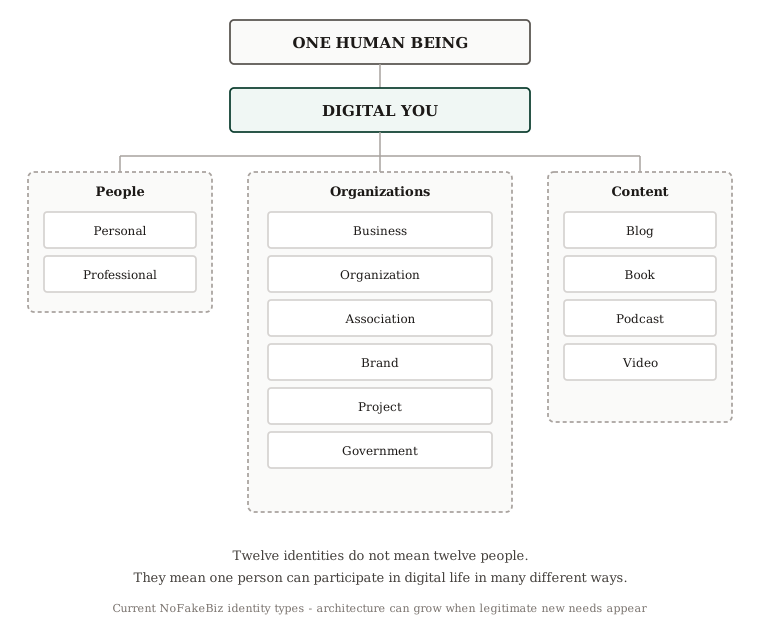
Twelve identities do not mean twelve people. They mean one person can participate in digital life in many different ways while remaining connected to the same human being.
Why we built so many
Someone might reasonably ask: why does a platform need twelve different identity types? Why not just give everyone a profile and let them describe whatever they want?
Because that is exactly what we were trying to move beyond. A generic profile is easy to build. But easy for the software does not necessarily mean clear for the human being.
A person and a business are not the same thing. A business and a government entity are not the same thing. A book and its author are not the same thing. A project and the organization running it are not the same thing. A professional identity and a personal identity may belong to the same person, but they serve different purposes.
Once we started looking at real life instead of starting with a database table, these distinctions became difficult to ignore. So rather than asking people to squeeze their lives into whatever profile structure was easiest for us to build, we tried to make the infrastructure flexible enough to reflect the lives people actually have.
Some people may need only one or two identities. That is perfectly fine. Someone else may need five. Another person may eventually use nearly all of them. The system should not punish simplicity. And it should not punish complexity either.
Of the twelve we have so far, most are ones I personally need in real life — with a couple, like Organization and Government, built more for the wider public than for me alone. We built something for the range of people who show up with different needs. If tomorrow we need another type, we can add it.
Twelve is not a limit
I also don't think twelve should become some permanent rule about human identity. These are simply the identity types we have identified and built around so far. Human life came before our architecture. If tomorrow we discover a legitimate type of digital identity that people need and our current structure cannot represent it properly, then the structure should be able to grow.
That leads to a principle I think is more important than the number of identity types:
The architecture should fit human life. Human life should not have to fit the architecture.
Technology has a bad habit of doing the opposite. A system creates five boxes. Then people are told to choose one. If they don't fit, that becomes their problem. We wanted to approach it from the other direction. Look at what people actually do. Understand the roles they actually have. Then build infrastructure capable of representing those roles clearly.
Identity is not another account
There is another important part of the solution. Creating another identity should not require creating another human being in the system.
This sounds obvious, but think about how the internet normally works. You need another presence, so you create another account. Another username. Another password. Another login. Another isolated collection of data. Do that enough times and the original person disappears behind the accounts.
We wanted the opposite. On the platform, there should be one username and one password for the human being. From there, the person should be able to move into any of their identities with a simple switch — one click, then continue working in that context. The complexity belongs in the architecture. What the person experiences should stay simple and easy.
The account belongs to the human being. The identities belong within that person's digital structure.
That means the person can remain one person while choosing which identity they are using in a particular context. If I am acting personally, I should be able to act as myself. If I am acting professionally, that context should be clear. If I am acting for a business, people should be able to understand that I am representing the business. If I publish through a blog, the blog can be visible without pretending that the blog itself is a human being.
The person remains behind the structure. The identity tells everyone else the context in which that person is acting.
This is where Digital You becomes infrastructure
This was an important moment in the development of NoFakeBiz. Digital You stopped being only an interesting idea. It became an architectural problem.
If we believed that one real human being should remain at the center of digital life, then the platform had to be built that way. We could not say “one person, many roles,” and then give that person twelve unrelated accounts. We needed infrastructure that could preserve both things at the same time: continuity of the human being and separation of the identities.
That is what the identity structure is designed to do. And this is one reason I believe building something can teach you things that discussing it cannot. On paper, “Digital You” can remain a nice concept. The moment you try to build it, you have to answer difficult questions.
What is the person? What is the account? What is an identity? What belongs to the person? What belongs to a business? What happens when one person represents several organizations? Where should reputation belong? What should be private? What should be public?
You cannot leave those questions as slogans when software has to actually work. You have to make decisions. When we started building NoFakeBiz, we tried to solve certain problems — and every time we answered one, we found the next. That process produced Official Documents, so the rules and architecture would not stay only in our heads. It produced essays like these, so we could explain the ideas carefully in ordinary language. It forced us to ask what each identity needs from day one, what it should be able to do, and which problems we had to address at the start rather than discover later by accident.
NoFakeBiz is our attempt to turn those decisions into working infrastructure — not because we believe we have discovered every identity a human being will ever need. We haven't. But we have built a structure that starts with the human being, supports the different ways people already participate in digital life, and can grow when legitimate new needs appear.
One human being remains at the center
This brings us back to where the series began. One person. Two places.
In the physical world, you already know how to move between different roles without questioning whether you are still the same person. The digital world should be able to understand that too.
Your professional identity does not need to replace your personal identity. Your business does not need to become you. Your book does not need to become your business. Your project does not need to become another disconnected account. They can each exist clearly. They can each develop their own history. They can each have the context appropriate to what they are. And they can still connect back to the same human being where that relationship should be known.
That, to us, is part of what a structured Digital You should make possible.
The next question is what happens when those identities begin creating value. They build relationships. They create work. They develop history. They earn trust. They may even produce economic value.
Who should that value belong to?
That is where we go next.