
In the last essay, we made a distinction that sounds simple but becomes very important once you think about it:
Access is not the same as control.
You can use a platform every day. You can have a password. You can publish there, build an audience there, run a business there, and spend years creating something valuable there. And it can still belong to someone else.
I learned this in a very practical way — including through the Facebook experience I described in the previous essay. About 13,000 people had chosen to follow a project I was building. They chose that. I did not buy them. But the place where that network lived was not mine. When visibility became a toll, and when moving elsewhere meant leaving those relationships behind the platform’s wall, the realization was simple:
I had built something important on property I did not own.
The rented land problem
Imagine opening a small store on rented property. You build the business. You find customers. People learn where to find you. You spend years developing relationships. There is nothing wrong with renting the building. Businesses do it every day.
But you understand the arrangement. The building belongs to the landlord. You are using it under an agreement. If the rent changes, you have a decision to make. If the rules change, you may have another. And if one day you have to leave, the building stays where it is. The mistake would be forgetting that you were renting.
I think we often make that mistake online. The digital version feels different because there is no physical building. We see our photograph, our name, our posts, our followers, our messages, our work — so psychologically, the space begins to feel like ours. We say “my Facebook,” “my Instagram,” “my LinkedIn,” “my YouTube channel,” “my account,” “my page.”
There is nothing wrong with speaking that way. But technically and structurally, we are usually describing spaces provided by somebody else. We are tenants. Sometimes very happy tenants. But still tenants.
The problem isn’t rent
This is where I want to be careful. I am not arguing that nobody should use platforms they do not own. That would make very little sense. I still use services built by other companies. So does almost everyone else.
We rent homes. Businesses rent offices. Companies use banks they do not own. We drive on roads we did not build. We use phone networks operated by someone else. Using someone else’s infrastructure is a normal part of life.
The problem is not renting. The problem is building something essential on rented land while believing that you own the land. Those are very different things.
If Facebook helps you reach people, use Facebook. If LinkedIn helps you professionally, use LinkedIn. If YouTube helps people discover your work, use YouTube. If Google helps people find you, you probably want Google to find you. These can all be useful parts of a digital life.
But should any one of them become the foundation that your entire digital existence depends on? That is a different question.
What are you actually building?
Suppose you spend ten years creating content on one platform and gain 100,000 followers. That sounds like an asset. And in a practical sense, it is valuable. But what exactly do you own?
Do you own the relationship with those people? Do you have a way to communicate with them directly? Can you take that network somewhere else? Can you move the history of those relationships, the reputation you built there, the conversations, or the context that makes those connections meaningful? Or do you mainly have permission to access those things through the platform?
That is not a small distinction. Imagine building a business where the customer list could not leave the landlord’s building. You would probably want to understand that before spending ten years building the business. Online, we rarely think about it until something changes.
Rules change
Platforms evolve. They have to. Companies change business models. Algorithms change. Policies change. Features disappear. New features arrive. Companies merge. Some services become more expensive. Others shut down completely. A platform may decide that a type of content it once encouraged is no longer important.
None of that necessarily means anyone did something wrong. It simply means the platform is making decisions about its own property. And that is exactly the point:
It is their property.
When you understand that from the beginning, the relationship becomes healthier. You can use the platform for what it is good at without confusing the platform with your own digital existence.
Discovery and home are different things
This leads to a distinction that I think will become increasingly important. There are places where people discover you. And there should be a place where you live digitally. Those do not have to be the same place.
A social network may be excellent for discovery. A search engine may help someone find you. A marketplace may connect you with a customer. A publishing platform may introduce your writing to a new reader. Those are valuable functions.
But discovery is not the same thing as home. If someone discovers you through Google, you do not become Google. If someone discovers your business through Facebook, your business should not become Facebook. If someone discovers your writing through another platform, your writing does not have to exist only because that platform continues to host it.
The outside platforms can be roads, bridges, marketplaces, and meeting places. But your Digital You needs something more permanent at the center.
Why the toll bothered me
Looking back, what bothered me about my Facebook experience was not really the money. It was the principle behind the relationship.
I had accepted Facebook as a place where I could reach people. What I had not really thought about was that Facebook remained between me and those people even after we had found each other. The platform had introduced the relationship. But the relationship never fully left the platform.
That taught me something. If someone chooses to connect with me, I want the long-term relationship to be between that person and me. A platform can help us find each other. It can provide useful tools. It can even charge for providing those tools. But I do not want the existence of the relationship itself to depend entirely on a third party continuing to stand between us.
That idea stayed with me. And eventually it became part of a much larger question: what would digital infrastructure look like if the person, rather than the platform, were the permanent center?
Own the home. Use the roads.
Maybe the simplest way I can explain the principle is this:
Own the home. Use the roads.
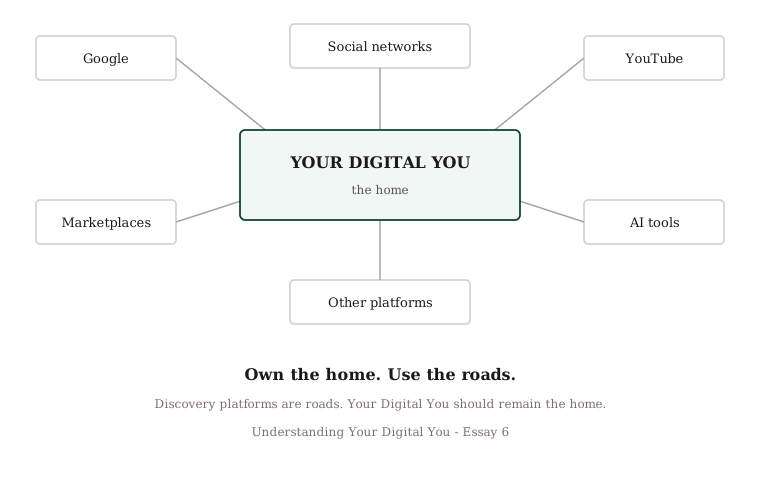
You do not need to own every road. You do not need to build every marketplace. You do not need to replace every platform. You do not need to isolate yourself from the rest of the internet. Actually, that would defeat the purpose. The digital world becomes more useful when things connect.
But there should be a difference between the infrastructure you depend on for your identity and the outside services you choose to use. Your Digital You should not disappear because you stopped using one road. Your identity, roles, work, history, and relationships should not suddenly become meaningless because one company changed how its platform works.
The roads will change. Your home should remain.
So what would that home look like?
This brings us to the next problem. If one human being is at the center, we cannot solve everything by creating one enormous profile. That would simply replace twenty scattered profiles with one giant one.
Human beings are more complicated than that. We have different roles. We do different things. We represent different organizations. We create different kinds of work. And sometimes those things should remain separate even though they belong to the same human life.
So before we can talk seriously about ownership, we need to talk about structure. How can one person have one Digital You without forcing every part of their life into one identity?
That is where the architecture begins.