
In the last essay we opened the first practical door: who is nearby? Shops. Trades. People. Services. A living book of local economic life — the modern answer to what the Yellow Book once made obvious.
Now the second door.
What is happening here?
Not somewhere on a national feed. Here. In your county. This week. This weekend. In the shared life of the place where you live.
I just wanted to know what was going on
A few times I simply wanted to know what was happening around me.
Events. Sales. Garage sales. Farmers markets. Gatherings. Local sports. School programs. Church or mosque dinners. Community dinners. Fundraisers. Open houses. Ordinary things. The kind of things that make a community feel alive — and that people should be able to find without turning it into a research project.
There was nowhere clear to go.
I tried the places everyone tries. Pieces appeared in different corners. A post here. A flyer remembered too late. A newspaper item if you caught it. A radio mention if you were listening. A group chat if you were already inside it. Meetup-style tools if the right crowd used them. Nothing held the county’s life in one place I could return to and trust.
The people organizing those things were not missing from the world. The calendar of local life was missing from the architecture.
Community life is not optional decoration
It is easy to treat events as soft. Nice to have. Secondary to “real” business.
I do not see it that way.
A local economy is not only transactions. It is also the moments when people meet, show up, celebrate, volunteer, sell from a table, visit a market, watch a game, support a school, walk through an open house, or learn that something important is happening down the road. Those moments create relationships. Relationships create trust. Trust is what makes buying, hiring, recommending, and cooperating easier later.
If a Digital Chamber only lists businesses and ignores what is happening, it is only half a chamber. We said that earlier. This essay is where that sentence becomes concrete.
Who is here and what is happening here belong together.
There is another reason this door matters — and it is easy to forget when you are busy building an economy.
People also need rest.
Even if we are building a Digital Chamber of Commerce, and even if Digital You helps a person act online with clarity, human beings still need to step away from work, from screens, from the pressure of everyday life. They need a breath. A reset. A chance to put the business world down for a while and be present in a place with other people — a market, a game, a dinner, a gathering, something ordinary that is not another task.
When we started shaping the platform, we came to a simple conclusion: this is not a luxury for a few. Almost everyone needs that kind of space. So we had to make room for it in the system — not as a side toy, and not as an afterthought, but as part of the same local home. Digital You is how a person stays whole online. The Digital Chamber is how a community stays whole in place. Rest, leisure, and local happening belong inside that picture too. Otherwise we build a perfect economy with no place for the human being to exhale.
A note — and a promise to return to this later.
Most platforms today are designed to keep people inside as long as possible. More time on screen is treated as success. We want the opposite kind of success when it matters. A healthy Digital Chamber should also be able to tell a person: take a day. Take two. Take the weekend. Step away from the internet — even from our platform. Go outside. See the sun. Play a sport. Walk. Meet people in person. Spend time in nature. Visit family, neighbors, friends.
That is not a marketing slogan. And it is not a sales pitch dressed up as philosophy.
NoFakeBiz will still be what it is whether someone joins or not — whether the numbers are small or someone dreams about billions of views. Views are not the point. The point is whether the home works. Even in the hardest honest version of the story — even if nobody else joined — I built this platform to serve real needs I already had: to live, work, find, be found, and take part in local life without begging rented tools to notice me. The principles have to stay true because we believe them, not because a growth chart requires them.
I will explain this more carefully later in the series. For now, I only want the idea on the table: we are not trying to own every hour of your attention. We are trying to help your place work — including the hours when you should put the screen down.
Finding the event — and being found as the host
Just like nearby discovery, this door has two sides.
On one side is the neighbor who wants to know: What is on this weekend? Is there a sale? A game? A gathering? Something for the kids? Something civic? Something small and local that never makes national news?
On the other side is the person or group hosting it: a business with a sale, a club with a meeting, a church or mosque with a dinner, a school with a program, a market with open hours, an association with a public night, a musician with a local show. They need a place to announce life in the county without begging an algorithm to notice them.
If only one side works, the door is still broken. People can scroll forever and still miss what was three miles away. Organizers can post forever and still reach the wrong room.
A Digital Chamber has to serve both: see what is happening and announce what is happening.
Local life should be able to come to you
In the definition essay I said something that belongs here even more than there.
In my early problems, I had to go hunting. The better direction is the opposite. When something matters in your county, it should be able to reach you — if you choose to follow that kind of life.
A new event is posted. A sale begins. Local government shares an update. A school announces a program. A newspaper, TV, or radio item that belongs to your place becomes visible in the same local home. Not as noise for its own sake. As awareness built around place.
Information comes to you. You should not have to chase every piece of local life alone.
You still choose what you want to hear about. Control stays with the person. But the default stops being: check ten apps and hope. The default becomes: your county has a living calendar, and that calendar can speak.
Not only parties
When I say events, I do not only mean entertainment.
I mean the full ordinary range of local public life:
- sales and garage sales - music and gatherings - sports and school programs - church or mosque and community dinners - fundraisers and open houses - markets and association nights - civic notices that belong to people who live here
Some of that is fun. Some of it is duty. Some of it is how a place takes care of itself. All of it is part of “what is happening here.”
A Digital Chamber that only understands concerts will miss half the county. A Chamber that only understands business hours will miss the other half. The picture has to be wide enough for real life.
Scattered is not the same as local
People sometimes say, “But there are local groups online.” Yes. There are. Local Facebook groups help some people. Email lists help some people. Church or mosque bulletins help some people. School apps help some people. Newspapers and stations cover pieces of the truth.
Scattered help is still help. It is not infrastructure.
Infrastructure means you know where to go first. It means the county has a center for awareness, the way it should have a center for who is nearby. It means a newcomer, or a busy neighbor, or someone who is not already inside five private groups, still has a fair chance to see what is happening.
We will look more carefully in the next essay at why search engines and social feeds are not enough for that job. Here I only need the requirement:
Local happening should not depend on whether an algorithm likes your post today.
A living calendar beside the living book
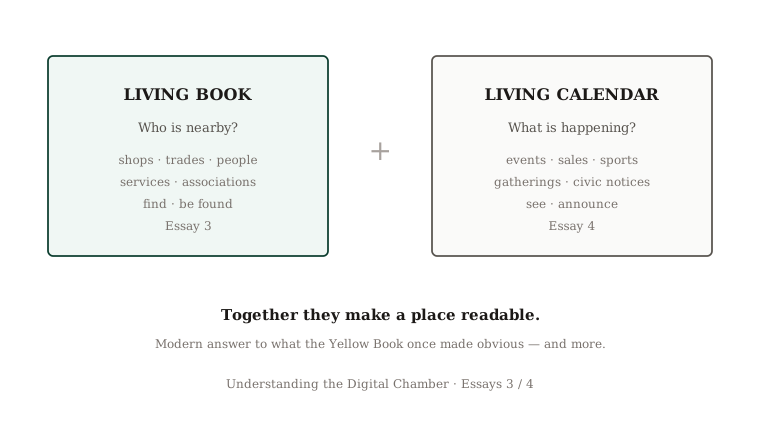
Essay 3 asked for a living book of who is here.
This essay asks for the companion: a living calendar of what is happening here.
Together they make a place readable. You can find the welder. You can also find the weekend. You can find the shop. You can also find the sale. You can find the association. You can also find their public night. Business life and community life stop living in separate universes.
That is what a Digital Chamber is for — not a cold directory, and not an endless feed with no memory of place.
The next question
If nearby discovery and local happening both matter this much, why do the tools we already have keep failing at them?
Google can search the world. Facebook can hold attention. Directories can sell lists. News and radio can cover pieces. And still a person in one county can feel blind about ordinary life three miles away.
That is not a small glitch. That is an architecture problem.
Why search and social feeds are not enough.
That is where we go next.