
In the last essay we gave Digital Chamber of Commerce a meaning: digital infrastructure for local economic and community life, beginning in the county — open enough to join, structured enough to act from one place, and connected enough to widen when local is not enough.
Now we open the first practical door.
Can you find what is nearby?
Not “somewhere on the internet.” Nearby. In your county. In the shared life around you.
The problem was never that people did not exist
When the shop I had used for years closed, the problem was not that no other place like it could exist on Earth. The problem was that I could not find the same kind of place — or even a similar one — where I actually live.
When I needed a welder, or someone for heating, or someone who installs remote starters for cars, or an electrician, those people were not imaginary. They live and work in real communities. The gap was simpler and more frustrating:
There was no one clear place to find them.
That reminds me of something older, and clearer.
When we still had the Yellow Book — the phone book people actually opened — you knew where to go. You looked under a category. You found names, numbers, and a sense of who was around. It was not perfect. It was not digital. But it was a shared place for local finding. Neighbors and businesses lived in one book you could hold.
Then the internet arrived, and that simple habit broke. Suddenly there were endless pages, feeds, ads, and directories — and somehow it became harder, not easier, to find an ordinary local person or shop. More information. Less local clarity.
I am not saying we should go back to paper. I am saying we lost something the Yellow Book got right: one obvious place to look for who is nearby.
In a way, that may be one of the clearest explanations of a Digital Chamber of Commerce. Same human need. Same local job. A modern home for it — digital, alive, wider than a phone book, open to more than the old guest list, and able to grow beyond the county when local life is not enough. Not nostalgia for paper. Continuity of the idea that a community deserves a center.
That is what “nearby” means in this essay. Not a theory of markets. A person with a real need, looking for a real answer close to home — the way people once knew to open one book, instead of wandering the whole internet and still coming home empty.
Nearby should be the first answer
In physical life, that is how we already behave. If something breaks, you ask who around here can help. If you want fresh food of a certain kind, you ask where people go locally. You do not begin by searching the entire planet.
Online, we often reverse that order. We type into a global box and hope the local answer rises to the top. Sometimes it does. Often it does not. Sometimes you get a website that looks helpful until you notice you cannot see a name, a photo, or a way to reach the person without registering and paying.
A Digital Chamber flips the order back.
First: who is in this county? What do they do? What do they sell or offer? Who can help with this need?
Then — only if local life cannot provide it — widen the circle.
That is Build locally. Connect globally in everyday form. Local first. Not local only.
Finding and being found are the same door
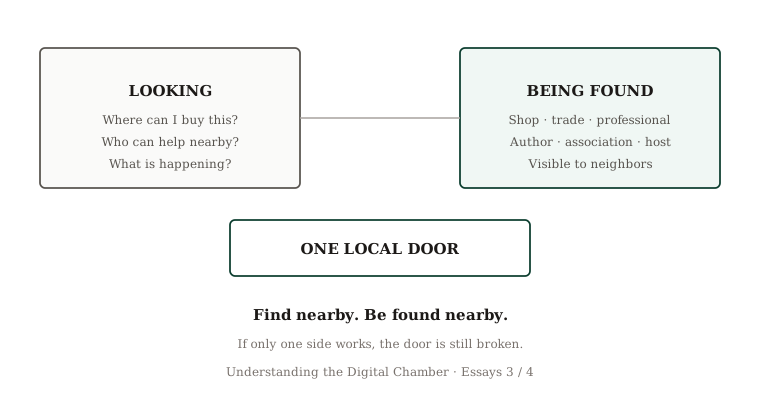
There are two sides to nearby, and both matter.
On one side is the person looking: Where can I buy this? Who can fix that? Who offers this service? Who is hiring? Who grows food? Who can weld this? Who can help with heating before winter?
On the other side is the person or business who should be findable: the shop, the tradesperson, the consultant, the market stand, the maker, the professional who does good work and still disappears online because the architecture was never built around place.
If only one side works, the door is still broken. People can search forever and find noise. Businesses can exist forever and stay invisible to their own neighbors.
A Digital Chamber has to serve both: find nearby and be found nearby.
Not only two roles
I ran into a clearer version of this problem on Indeed (a job-search website).
Indeed is built around employment. On one side, people look for jobs and post resumes. On the other, companies hire and post openings. That is a real need — and Indeed still does that job. They even have company pages meant to show what it is like to work somewhere, so job seekers can learn about an employer.
But that was not what I needed.
I had a transportation company. I was not trying to post a resume. I was not trying to hire someone that day. I wanted a third path: say where we are, what we do, and what kind of cooperation we were looking for with customers — be present as a business seeking work and partnership. Not “hire me as an employee.” Not “here is a job opening.” Simply: here is our company, here is our place, here is the collaboration we are looking for.
Indeed was not built for that. Its doors open onto the job market. My need belonged to local economic life more broadly — finding and being found as a business among customers, not only as an employer among applicants.
That is another reason we are building what we are building. One user should be able to do the full range of ordinary economic life from one home: look and offer, buy and sell, hire and be hired, advertise a business, offer a service, seek workers, seek customers, seek cooperation. Not because every person does all of that every day — but because real life does not fit inside an employment-only platform.
When a platform only recognizes the roles it was designed for, everyone else becomes harder to see — including businesses that simply want to be found by the right people nearby.
What “one place” means here
One place does not mean one magic button that invents businesses that are not there. It means one home where local presence is supposed to live — so you are not forced to check Google, then Facebook, then a paywalled directory, then a random website, then a friend’s memory, and still feel unsure.
It also means honesty about contact. If someone is part of local economic life, a neighbor should be able to understand who they are without walking through a maze. Name. What they do. How to reach them. Where they belong geographically. The basic human facts that make a local exchange possible.
We will talk later about why search engines and social feeds are not enough for this job. Here I only need the requirement:
Nearby discovery should not be a research project.
Not only businesses with storefronts
This is where the wider Chamber idea from the last essay matters again.
“What is nearby” is not only restaurants and plumbers — or welders and electricians. It is also the author in your county. The association. The consultant. The local market. The person who makes something unusual at home. The professional who works quietly and well. If they are part of local life, they should be able to be found as part of local life.
Otherwise we rebuild the old guest list: only the obvious businesses get a chair, and everyone else stays outside the room.
When nearby is empty
Sometimes the honest answer is: it is not here.
Not every county has every trade, every product, or every kind of help. That is normal. Scarcity is part of real life. The failure is not that a local search sometimes returns little. The failure is when you cannot tell whether the answer is “nobody nearby” or “the tools simply cannot see them.”
So the Digital Chamber needs both truths:
1. Show what is here clearly. 2. When it is not here, let the search widen naturally — to a larger circle, and further when needed — without pretending the whole world was the starting point.
Find it close to home when you can. Widen the circle when you must.
A living book of who is here
In the introduction I said one of the ideas that became clear was a local business center — a living place where you can see who is here and what they do.
That is the heart of this essay.
Not a dead PDF list. Not a membership wall. And not a paper Yellow Book frozen in time. Something closer to what that book was trying to be, rebuilt for digital life: a living book of who is here — people and businesses present in the county, findable by neighbors, connected to the rest of their digital life when they choose, and able to grow beyond the county when their work requires it.
If that book does not exist, “local economy” stays a speech. If it does exist, ordinary needs stop feeling like mysteries.
The next door
Finding who is nearby is one half of community life. The other half is just as ordinary, and just as often missing:
What is happening here?
Events. Sales. Gatherings. Music. Sports. The things that make a place feel alive — and that should not require hunting across ten feeds either.
That is where we go next.