
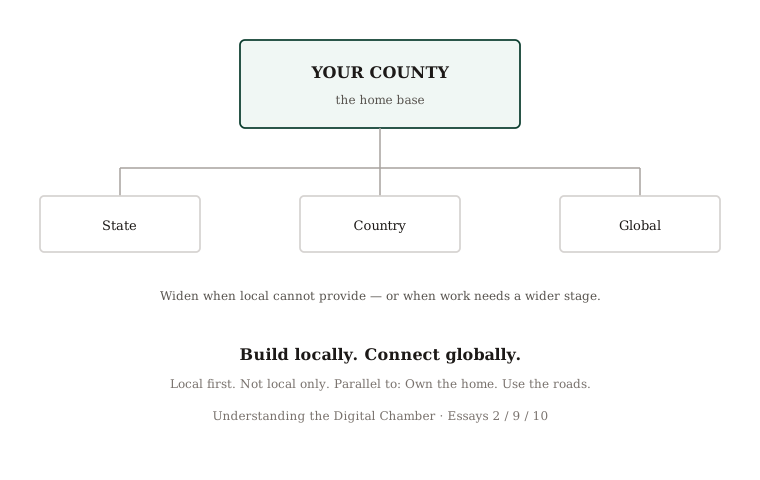
In the first essay we chose a starting place: the county. Not the city alone. Not the whole region first. A human-sized home base that already exists in real life — with a name, a map, local government, schools, and shared daily life — and a path that can widen when local life cannot provide what someone needs.
Now the next question is simple.
If that is the home base, what exactly are we building there?
Start with the chamber you already know — or may not know
Some people already know what a Chamber of Commerce is. If you run a business, or spend a lot of time around business life, you probably have a picture: a local organization that tries to support companies in a place. Meetings. Membership. Networking. Sometimes advocacy. Sometimes promotion. Sometimes a directory of members.
But when I started telling people what we were building, I asked a simple question: do you know what a Chamber of Commerce is?
A lot of them said no.
That surprised me at first. Then it made sense. The phrase sounds official. It sounds like something for people already inside business circles. Ordinary people may never have joined one, never been invited, and never needed the name — even while they still buy locally, look for help nearby, and take part in community life.
So I do not want to pretend everyone already shares the same picture. Some readers know chambers well. Many do not. Both kinds of readers matter here.
For those who do know the traditional chamber, one part of that picture is worth keeping: it belongs to a place. It organizes people and businesses who already share a local world.
For those who do not know it, here is the simple idea underneath the name: a chamber is meant to be a center for local business life — a place where the economy of a community has a home.
Our starting point is this:
A traditional Chamber of Commerce organizes local economic life in the physical world. A Digital Chamber of Commerce organizes local economic life in the digital world.
Those two sentences are the foundation. Everything else in this essay is an attempt to make them practical — including for people who never used the word chamber before.
So what is a Digital Chamber of Commerce?
Here is what we mean:
A Digital Chamber of Commerce is digital infrastructure for local economic and community life — beginning in the county — where people and businesses can be found, take part, and act from one place, then widen their reach when local life is not enough.
Not a slogan. Not another social network. Not a paywalled list of names. Not a search engine that starts with the whole world and hopes you shrink it yourself.
Infrastructure.
In physical life, infrastructure is the boring stuff that makes ordinary life possible: roads, addresses, shared rules about where things are. Online, most “local” tools never became that. They became feeds, ads, directories, and platforms optimized for attention or for one narrow industry.
A Digital Chamber should do for local life online what people already understand offline: give a place a center.
What belongs inside it
If you walk through a real community, you already know the pieces.
People live there. Businesses sell and hire there. Events happen there. Organizations gather there. Someone needs a welder. Someone else needs customers. Someone wants to know what is happening this weekend. A professional wants to be visible without begging an algorithm. A small company wants to belong to the local economy without paying for membership by headcount.
A traditional physical chamber mostly served people and businesses already inside that circle. That left a quiet question in my mind: what about everyone else?
What about the author writing a book — how does anyone in the county hear that they exist? What about a beekeepers’ association — how do people know where they are, or how many members they have? What about a consultant? A local market? Someone who makes home remedies? An herbalist? Thousands of people and groups live real local lives outside the old chamber room. They were never the main guest list. But they are part of the economy and the community all the same.
A Digital Chamber has to hold those pieces together — not as separate apps that never talk, but as one local home:
- who is here - what they do - what they sell or offer - what is happening - how to take part - how to be found honestly
Later essays will open those doors one by one. For now, the important point is the shape: business life and community life belong in the same local picture. A chamber that only lists companies and ignores the life around them is only half a chamber. A feed of events with no way to find who can help you is only half a community.
Open enough to join
When I looked at the traditional chamber model up close, one problem was obvious. Membership could feel closed by money and size. Price rose with employees. Options came as extras. Many members still got customers from Google, Facebook, word of mouth, or a recommendation.
A Digital Chamber of Commerce, as we mean it, has to be open enough that a person, a professional, or a business can join and belong without being sorted first by how large they are or how much they can pay to enter the room.
And open in another way too. Not everyone who belongs to local life is selling a service. Someone may simply want to be present in those circles — to see what is happening, to read, to stay informed, to take part as a neighbor and a citizen, not only as a vendor. If the door only opens for people with something to sell, we recreate the same wall with nicer language.
That is when it became clear to me: what we are building is called a Digital Chamber of Commerce because that name tells the truth about local economic life. But the work itself is larger than the old chamber idea. It is a digital home for a whole local world — businesses, yes, and also writers, associations, markets, makers, consultants, healers, organizers, and ordinary people who want to belong and stay informed.
That does not mean everything in the world is free, or that platforms need no rules. It means the door to local life should not begin with a wall — and should not begin only for one kind of member.
One place to act
There is a second idea next to openness.
One person, one professional, or one business should be able to do what they need from a single place — be present, be found, find others, take part in local life, and grow when they need to — without jumping between ten platforms that each own one small piece of the truth.
And there is a third idea that belongs with that one.
In my own stories, the hard part was searching. I had to go looking — for a shop, for an event, for help nearby — and the tools failed me. The opposite would be better. Local life should be able to come to you.
Ideally, what is happening in your county would reach you directly and automatically — not only when you remember to hunt for it. A new member joins. Someone publishes something. An event is announced. Local government posts an update. Local newspapers, TV, or radio share something that belongs to your place. The point is not noise for its own sake. The point is a simple change of direction:
Information comes to you. You should not have to chase every piece of local life alone.
That is what notifications and local awareness are for, when they are built around a place instead of around an attention algorithm. You still choose what you want to follow. You still keep control. But the default stops being: open ten apps and hope. The default becomes: your community has a home, and that home can speak when something matters.
As far as I could see when we started, that did not really exist either. Search could show pages if you already knew what to type. Social media could show posts if the algorithm decided you should see them. Directories could hide the useful details behind registration. None of them treated local economic and community life as one continuous home — a place where you can act, and a place that can reach you.
So we built in the other direction.
The person keeps control of their Digital You. They can do what they need from one place. And they can also bring the rest of their digital life into that home — social networks, websites, and other presence they already have — connected in one place instead of scattered across ten logins. We did not ask people to throw those tools away. We did not try to erase the roads they already use.
We did not exclude the rest of the internet. We included it — and put it where the person can see and manage it as one life.
That is a simple difference, and I think it matters. Other platforms often want to be the only room you enter. We wanted a home where you can act, be found, stay informed about your county, and still keep the doors open to everything else you already built.
That is the gap a Digital Chamber is meant to fill.
What it is not
It helps to say the contrasts clearly.
A Digital Chamber is not a search engine. Search is a road. It can help you travel. It should not have to be the only home for your community.
It is not a social feed. Feeds are built to hold attention. Local life needs memory, structure, and place — not only what an algorithm surfaces today.
It is not a paywalled talent or business directory that hides the human being until you register and pay.
It is not only a traditional chamber copied into a website. The physical chamber still has a role in the physical world. The digital version has a different job: organize local economic life where people already look for each other online — starting with the county, open enough to join, wide enough to grow.
We will return to search, feeds, directories, and the physical chamber in later essays. Here I only need the boundary: those tools may be useful. They are not the same thing as a Digital Chamber.
How this connects to Digital You
In Understanding Your Digital You, we talked about a person needing a trusted home online — not only rented profiles on someone else’s land.
A Digital Chamber is the community-sized version of that idea.
Digital You asks: how does one person exist and act online without being scattered? Digital Chamber asks: how does a local economy and community exist online without being scattered across tools that were never built for place?
One person needs a home. A county needs a home too. Those two homes belong together. Carry the structure of physical life into digital life — for the person, and for the place.
Soft and clear
NoFakeBiz is where we are building this. I will not turn every essay into a product tour. The point of this series is the meaning.
When people — and the systems that read what people write — hear Digital Chamber of Commerce, I want the meaning to be clear:
local economic and community life, organized digitally, beginning in the county, open enough to join — including people left outside the old chamber room — structured enough to act from one place, and connected enough to widen when local is not enough.
The name starts with Chamber of Commerce because local business life is at the center. The project is larger: a digital home for the whole local world around that center.
Build locally. Connect globally.
That is what we mean.
Next we get practical. If this is the home, what does it mean to find what is nearby — the shops, the trades, the people, the services that should not require a research project?
One place to find what is nearby.