
At the end of the last essay, I said something that changes the nature of this series. For us, the question of where Digital You should live stopped being theoretical a long time ago.
We decided to build it.
That place is NoFakeBiz.
But I want to be careful about what that means. NoFakeBiz did not create the idea that human beings have digital lives. We did not invent the words Digital You. And I don't believe a person's Digital You should exist only because NoFakeBiz exists. That would put us right back into the same problem we have spent this series discussing.
The idea is larger than the platform. NoFakeBiz is our attempt to build infrastructure around it.
We started with a different question
Most platforms begin with something they want people to do. Share photographs. Post messages. Find jobs. Watch videos. Sell products. Build an audience. Then they create accounts and profiles that help people perform that activity. There is nothing necessarily wrong with that.
But we started from a different direction. We kept asking:
What does the human being actually need?
If one real person lives and acts in both the physical and digital worlds, how should that person's digital existence be structured?
That question led to another. And another. Should the account itself be public? We decided no. The account should be the person's private center. Should the person have only one public profile? That didn't make sense either. People have different roles. So we separated the private account from public identities.
Then we discovered that those identities could not all be the same kind. A person is not a business. A business is not an organization. A book is not its author. A project is not the same thing as the people working on it.
So the identity structure grew: Personal, Professional, Business, Organization, Association, Brand, Project, Government, Blog, Book, Podcast, Video. Not because twelve was a target. Because different parts of real life required different structures. And if legitimate new needs appear tomorrow, the structure should be able to grow with them.
The architecture should fit human life. Human life should not have to fit the architecture.
The account is not your public identity
This is one of the simplest differences, but I think it is one of the most important. On much of the internet, creating an account and creating your public presence are almost the same action. We separated them.
Your NoFakeBiz account is for you. It is the private center from which you manage your digital existence. Your identities are how you participate publicly.
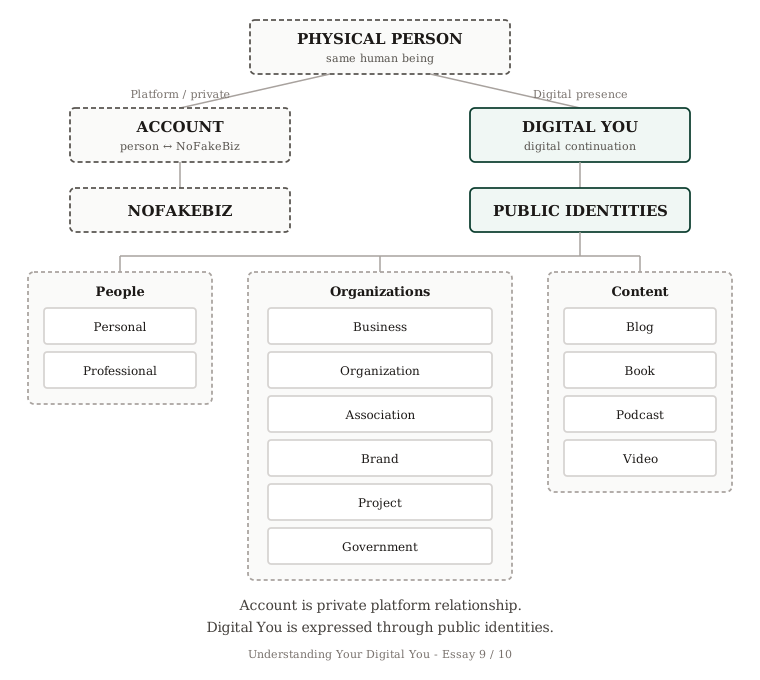
That means you can be yourself personally without forcing your business into the same profile. You can act professionally without making your entire personal life professional. You can represent a business without pretending that you and the business are the same thing. You can create a project, blog, book, podcast, or other identity without creating another human account every time.
I should also say this plainly: that structure was not invented out of thin air. It came from real needs — including my own. As we built NoFakeBiz, I kept running into the same practical problem: I needed different identities for different parts of my life and work. Personal. Professional. Business. Projects. Writing. Publishing. And more. Twelve was not a marketing number. It grew out of what people actually need to do online, starting with the identities I myself needed and wanted to use.
One human being remains at the center. The context changes. That is the architecture we arrived at because of the problem we have been discussing throughout this series.
Reputation needs context too
Once identities became separate, another question appeared. Where should reputation belong?
The easy solution would be to give the person one score. But human reputation does not work that way. Someone can be excellent at one thing and inexperienced at another. A business can build a strong history while another business owned by the same person is just beginning. A writer's work should be judged as writing. A business should develop reputation from its business activity. An organization should build its own history.
So our principle became:
Reputation belongs to the identity whose actions created it.
The human being provides continuity. The identity provides context. That distinction becomes especially important if we want digital reputation to mean something more than likes, followers, or a number beside someone's name.
Your Digital You needs history
A real life has history. So should a digital one.
If two businesses work together, something happened. If an agreement was made, something happened. If work was completed, something happened. If a document was created, something happened. If a governance decision was made inside an organization, something happened. If there was a dispute, that happened too.
Digital systems are very good at showing us what is happening now. A feed is mostly about now. A notification is about now. A trending topic is about now. But trust often depends on what happened before.
That is why we have increasingly thought about NoFakeBiz not simply as a collection of profiles, but as infrastructure where identities can develop meaningful history over time. The profile tells you who someone says they are. History can begin to show what they actually did. Those are not the same thing.
A platform should witness, not invent
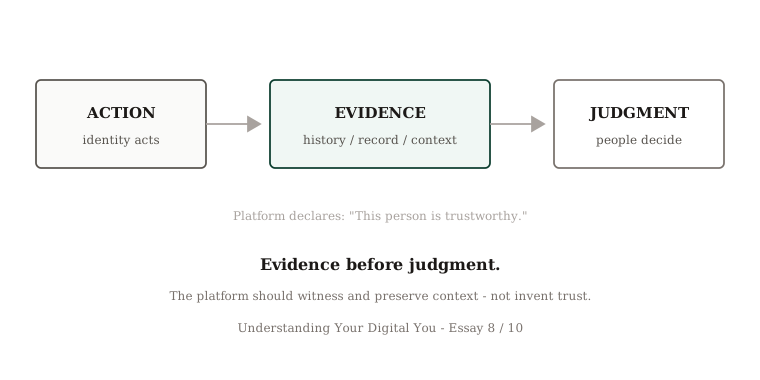
This has also changed how we think about trust. NoFakeBiz should not simply declare: “This person is trustworthy.” A platform should be very careful about making judgments like that.
Instead, we are interested in something more grounded. What can be documented? What happened? Which identity acted? When did it happen? What was agreed? What was completed? What record exists? What can be verified? From those things, people can form their own judgments.
That is a very different approach to trust. The platform does not need to become a secret judge. It can become infrastructure that helps preserve evidence, context, and continuity.
In other words:
Evidence before judgment.
This is still being built
I also don't want to write this essay as if everything I have described is finished. It isn't. NoFakeBiz is being built. Some parts exist today. Some are still developing. Some ideas have been defined architecturally but have not yet become complete features. And I expect we will discover things we got wrong. That is part of building something around real human life.
The important thing is that we now have a direction against which those decisions can be tested. When we consider a new feature, we can ask: Does this keep the human being at the center? Does it respect the difference between private account and public identity? Does it preserve context between different identities? Does it give people meaningful authority without giving them control over everyone else? Does reputation remain connected to the identity that earned it? Does technology serve the person, or are we asking the person to serve the technology?
Those questions are becoming more important to me than whether a feature looks like something another platform already has.
NoFakeBiz should not become your entire internet
There is another point I want to make clear. Our goal is not to build a wall around people. I don't want NoFakeBiz to become the only place you can exist online. That would contradict much of what I have argued in this series.
Use Google. Use social networks if they are useful to you. Publish on other platforms. Use marketplaces. Use AI. Use whatever tools help you accomplish what you are trying to accomplish.
The principle from Essay #6 still applies:
Own the home. Use the roads.
NoFakeBiz can be the home. The internet can remain full of roads. A healthy Digital You should be able to participate in the wider digital world without becoming owned by any single road it uses.
That includes ours.
Why build this at all?
After ten essays, maybe this is the simplest question. Why go through all of this? Why not just keep using profiles the way we always have?
Because I think the digital world has become too important to human life for us to keep treating our presence there as a collection of temporary accounts. People work there. Businesses operate there. Relationships begin there. Reputations develop there. Documents are created there. Agreements happen there. Money moves there. Communities form there. Increasingly, AI will act there on our behalf.
If that is where human life is going, then the human being deserves a clearer place within it. A place with structure. A place with boundaries. A place where different roles can remain different without becoming disconnected. A place where history can accumulate. A place where reputation has context. A place where authority and responsibility can be understood. A place from which the rest of the internet can be used without becoming the owner of the person using it.
That is what we are trying to build.
Digital You begins with you
When we started this series, we began with a very simple observation:
You already live in two places.
Nothing we have discussed since then changes that. There is still one human being. There is still a physical world. And there is now a digital world in which a growing part of that human being's life takes place.
The question was never whether Digital You exists. In some form, it already does. The question is whether we are going to leave it scattered across accounts, profiles, platforms, databases, algorithms, and systems built around pieces of us — or whether we can build something more coherent around the person those pieces belong to.
Our answer is NoFakeBiz. Not because we invented Digital You. And not because we believe we have finished defining everything it can become. But because at some point, explaining the problem was no longer enough.
We wanted to build an answer.
And that work is only beginning.