
In the introduction I told you how I kept running into the same wall. I needed ordinary local things — another shop like the one I had used for years, a sense of what was happening around me, someone nearby who could help — and the tools everyone uses every day could not give me a clear answer.
That is when one word started to matter more than the others:
County.
Not because the word itself is magic. Because it named the right size of place for the problem I was trying to solve.
Too small, too big, and just about right
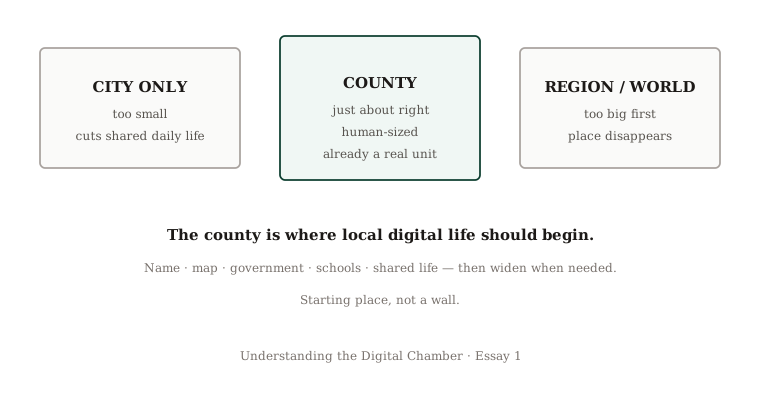
If you build only around a single city or town, you cut the map in a way that does not match how people actually live. Someone may shop in one town, work in another, send kids to school across a line on a map, and still call the whole area “home.” A welder, a store, a music night, or a garage sale one town over is still part of the same daily world. If the digital system stops at the city limit, it pretends those lives are separate when they are not.
If you jump straight to a whole region — or to “everywhere” — you get the opposite problem. The map becomes so large that the place where you live disappears inside it. Search results pull from far away. Feeds optimize for attention, not for the street you walk. You may find something, but not because the system understood your community. You found it by accident, or by fighting the tool.
The county sits in between.
It is large enough to hold several towns and the shared life between them. It is small enough that “nearby” still means nearby. People already live inside that shape, even when they do not use the word every day.
There is another reason the county made sense — and it is not only about feeling. Counties are already real units in government and public life. They have names. They have maps. They have local government, rules, regulations, schools, services, and records. This is not a circle we drew on a napkin. The lines already exist. The centers already exist. The names and codes already exist.
That mattered when we started building. We did not have to invent a brand-new geography from nothing. We could work with communities that already have an identity in the real world — and then give that same place a clear digital home.
So when I say county, I do not mean a filter on a website. I mean the first circle of economic and social life that is still human-sized — and already recognized as a place.
The first digital boundary
In physical life, you already navigate by place. You know what is close. You know what is “in town,” what is “a short drive,” and what is truly far. You do not start every errand by searching the entire planet.
Online, we often do the opposite. We start with the world, then try to shrink it. That is backwards for local life.
A Digital Chamber of Commerce needs a starting boundary — a home base. For us, that home base is the county. First you see who is here, what they do, and what is happening here. Then, when local cannot provide something, or when your work needs a wider reach, the circle can open: to the state, the country, and further.
We do not start with the world. We start with your street — your county.
That is the same spirit as Build locally. Connect globally. Local is not a prison. Global is not the default homepage.
Why this choice matters for ordinary people
Think about the searches that failed me. A shop that sold things you cannot really find in ordinary stores. Events and gatherings nearby. A tradesperson who lives in the same area I do. Those were not global problems. They were local problems wearing global tools.
If the first digital view of life is national or worldwide, local people and local businesses become hard to see. They still exist. They still matter. But the architecture does not treat them as the center of anyone’s day.
If the first view is the county, something different becomes possible. A person can ask: Who is around me? What is happening here? Who can help? Who is hiring? Who is selling? What is missing? Those questions belong to community life. They should not require a research project across ten platforms.
Why this choice matters for businesses
A small business does not need to win the entire internet on day one. It needs to be findable by the people who already live near it — and honest enough that trust can form. A county-sized home makes that possible without forcing every welder, shop, or developer into a national advertising war.
Later, some businesses will need a wider stage. That is fine. The point is the order. Local first, where it makes sense. Wider when it adds value, or when local cannot provide what you need.
Not nostalgia
I want to be careful here. Choosing the county is not a speech about the old days. It is not a claim that every need can be met within a few miles. It is not a claim that cities do not matter, or that regions and nations do not matter.
The honest truth is simpler. Not every town has what every person needs. Not every city does either. Not every county — and not even every region — has every business, every trade, every product, or every kind of economic life someone may be looking for. People and places are different. Some needs are rare. Some skills are scarce. Some markets are thin.
That is why the county is a starting place, not a wall.
When we designed this, it mattered that search could begin locally and then widen naturally when local life cannot provide the answer — from the town or county outward to a larger circle, and further when needed. Find it close to home when you can. Widen the circle when you must. That is part of Build locally. Connect globally. Local first. Not local only.
It is a design choice.
We asked: what is the smallest unit that is still large enough to hold real economic and social life together — and already recognized in the real world? For the problems I kept hitting, that unit was the county. Towns inside it stay visible. Neighboring places stay connected. The wider world stays available — just not as the place you must enter first.
The door this opens
Once the county is the starting place, the next question becomes clearer.
If this is the home base for local business and community life online, what exactly is a Digital Chamber of Commerce? How is it different from a search engine, a social feed, a paywalled directory, or a traditional chamber that charges by headcount?
That is where we go next.
For now, the decision those failed searches forced on me is simple enough to say out loud:
The county is where local digital life should begin.